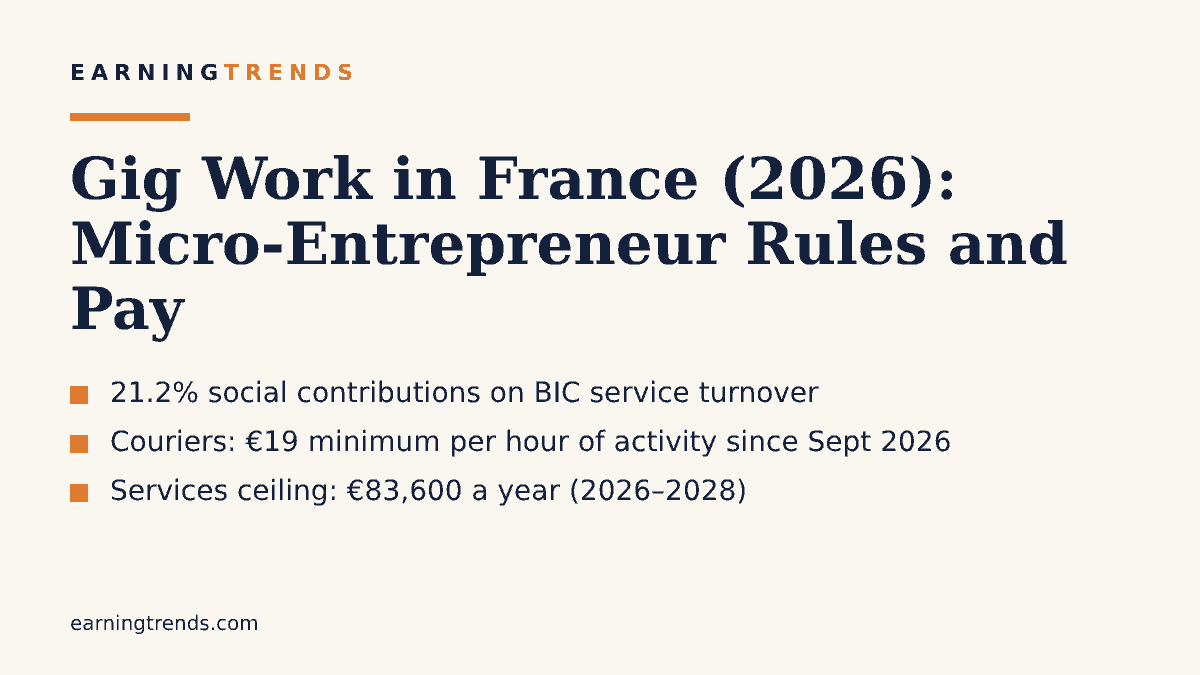
Gig Work in France (2026): Micro-Entrepreneur Rules and Pay
If you want to deliver food, run errands, do odd jobs or take small freelance gigs in France, you will almost always do it as a micro-entrepreneur (often still called auto-entrepreneur). Registration is online and free, social contributions are a flat percentage of what you actually earn, and in 2026 the key numbers are clear: 21.2% contributions on most service turnover, a €83,600 annual ceiling for services, and, for platform couriers, a guaranteed minimum of €19 per hour of activity since September 2026.
This guide explains how gig work in France is set up legally, what you really keep from each euro, and which 2026 changes matter most.
Who this guide is for
It is aimed at people living in France who want side income or flexible work through apps and local services: delivery riders, handypersons, cleaners, pet sitters, tutors, small online freelancers. Rules for ride-hailing (VTC) drivers are stricter and are only touched on briefly. If you are an employee, a student or receiving unemployment benefits, the micro-entreprise can usually sit alongside your situation, but always check the effect on your benefits with the relevant body first.
Step by step: starting gig work legally in France
- Choose your activity category. Most gig work (delivery, odd jobs, cleaning) counts as commercial or craft services (BIC services). Intellectual services such as tutoring or consulting are usually liberal professions (BNC).
- Register your micro-entreprise online through the government’s single business formalities portal (guichet unique at formalites.entreprises.gouv.fr). You receive a SIRET number, which platforms ask for before you can start.
- Decide whether to apply for ACRE (see below) and whether to opt for the versement libératoire income tax option.
- Declare your turnover monthly or quarterly on the URSSAF auto-entrepreneur website and pay contributions as a percentage of what you declare. If you earned nothing, you pay nothing.
- Keep a simple record of receipts and invoices. Once your turnover exceeds €10,000 for two consecutive calendar years, you also need a separate bank account for the business.
2026 contribution rates for micro-entrepreneurs
Social contributions are calculated on turnover (chiffre d’affaires), not profit. You cannot deduct fuel, phone, bike repairs or insulated bags. These are the 2026 rates for the main categories:
| Activity | Social contribution rate 2026 | Typical gig examples |
|---|---|---|
| Sales of goods | 12.3% | Reselling products, market stalls |
| Commercial and craft services (BIC) | 21.2% | Delivery, odd jobs, cleaning, pet sitting |
| Liberal professions (BNC, SSI) | 25.6% | Tutoring, coaching, freelance consulting |
| Liberal professions under CIPAV | 23.2% | Certain regulated professions |
A small vocational training contribution (CFP) is added on top, a fraction of a percent depending on your activity. In practice, a delivery rider declaring €1,500 in a month pays around €318 in social contributions (21.2%), before CFP and before income tax.
Income tax: standard route or versement libératoire
By default, your micro-entreprise turnover is added to your household income tax return after a flat allowance for costs: 71% for sales, 50% for BIC services and 34% for BNC activities. Tax is then calculated at your normal rate.
Alternatively, if your household’s reference tax income is low enough, you can pay income tax as a flat extra percentage of turnover with each declaration (versement libératoire): 1% for sales, 1.7% for BIC services and 2.2% for BNC. For 2026 the limit is a 2024 reference tax income of €29,579 per tax share. The option must normally be chosen by 30 September for the following year; a new business can opt until the end of the third month after its creation. Whether it saves you money depends on your household, so it is worth checking with a qualified tax advisor or your local tax office (not legal or financial advice).
Turnover ceilings and VAT in 2026
The micro-entreprise regime has turnover ceilings that were revised for 2026–2028 by the 2026 finance law:
- €203,100 per year for sales of goods and accommodation
- €83,600 per year for services and liberal professions
VAT works separately. Under the basic VAT exemption (franchise en base), you do not charge VAT as long as turnover stays below €37,500 for services or €85,000 for sales, with higher tolerance thresholds of €41,250 and €93,500. A planned single €25,000 VAT threshold was dropped after strong opposition, but VAT rules for small businesses have changed several times recently, so check the current thresholds on impots.gouv.fr before you plan around them.
ACRE: smaller start-up relief from July 2026
ACRE reduces contributions during your first year of activity, and only certain profiles qualify (for example some jobseekers and young people). A decree published in February 2026 cut the benefit: for micro-entrepreneurs who start on or after 1 July 2026, you pay 75% of the normal rates instead of 50%, so the reduction shrinks from 50% to 25%. The request must be made to URSSAF within 60 days of your start date. If you started before July 2026, the older rules generally still apply to you.
Delivery couriers: the new €19 minimum
France has a system of sector agreements between platforms and independent couriers, overseen by the ARPE (the authority for social relations on employment platforms). An amendment signed on 10 July 2026 and made binding in September raised the guaranteed minimum for delivery couriers from €11.75 to €19 per hour of activity, from 1 September 2026.
The details matter:
- It applies to independent couriers (micro-entrepreneurs or sole traders) delivering by two- or three-wheeled vehicle through platforms covered by the agreement.
- “Hour of activity” means the time the platform estimates between accepting an order and handing it to the customer. Time spent logged in and waiting does not count.
- The check is now weekly (Monday to Sunday). If your pay for the week falls short, the platform must pay the difference within seven days.
- Tips are excluded from the calculation.
The €19 is a floor on gross earnings, not take-home pay. You still pay contributions on your turnover and cover your own equipment, phone and transport. For a wider look at how EU rules on platform work could change the picture, see our guide to the EU Platform Work Directive for gig workers.
What can you realistically earn?
There is no reliable official average for all gig work in France, and earnings vary a lot by city, season and hours. A simple way to estimate is to work backwards:
| Example monthly figure | Amount |
|---|---|
| Turnover declared (BIC services) | €1,500 |
| Social contributions at 21.2% | −€318 |
| Versement libératoire at 1.7% (if eligible) | −€25.50 |
| Your own costs (example: phone, bike, insurance) | varies |
The point is to price your time knowing that roughly a fifth of service turnover goes to contributions before any costs. Local services such as cleaning, garden work or pet sitting can pay better per hour than delivery, but you have to find your own clients or use marketplaces. Our list of freelance platforms for beginners compares common options and fees.
Ride-hailing (VTC) is a different case
Driving passengers for apps requires a professional VTC card, a suitable vehicle and specific registration, on top of the business status. Start-up costs and rules are much heavier than for delivery or odd jobs, so treat it as a separate project and check the official requirements before investing in a car.
Common mistakes
- Treating the platform payout as profit. Contributions are calculated on turnover, so set aside around 22–25% of every payment for contributions and tax.
- Forgetting to declare zero. Even with no turnover, you must still submit your declaration on time to avoid penalties.
- Missing the ACRE deadline. The request must reach URSSAF within 60 days of your start date.
- Picking the wrong category. Tutoring declared as a commercial service, or the reverse, leads to wrong rates and later corrections.
- Ignoring the turnover and VAT thresholds as you grow, especially if you combine several gigs.
- Assuming the €19 minimum covers waiting time. It only counts active delivery time as estimated by the platform.
FAQ
Can I do gig work in France alongside a salaried job?
Generally yes. Many people run a micro-entreprise as a side activity. Check your employment contract for exclusivity or non-compete clauses, and declare your turnover separately.
Do I pay contributions if I earn nothing in a month?
No. Contributions are a percentage of declared turnover, so zero turnover means zero contributions, but you still have to file the declaration.
Is the €19 courier minimum per hour logged in?
No. It is per hour of activity, measured from accepting a delivery to handing it over. Waiting time while connected is not included.
Do I need to charge VAT as a delivery rider?
Not while your turnover stays below the VAT exemption threshold for services (€37,500 in 2026, with a tolerance up to €41,250). Above that, VAT rules apply.
Conclusion
Gig work in France is easy to start legally: register a micro-entreprise, declare your turnover and pay a flat percentage. The 2026 picture is mixed. Couriers now have a much stronger €19 per active hour floor, while new micro-entrepreneurs get less ACRE relief from July 2026. Before you sign up for an app, do the maths on contributions, costs and your realistic active hours. If you are comparing countries, our guide to food delivery work in Poland shows how differently the same job can be set up elsewhere in Europe.
Sources
- Service-Public.gouv.fr – Delivery couriers: minimum income guarantee raised to €19 (Sept 2026)
- CCI Paris Île-de-France – Micro-entrepreneur turnover thresholds for 2026–2028
- Légifiscal – Decree reducing ACRE for business creators (Feb 2026)
- Le Coin des Entrepreneurs – Micro-entrepreneur contribution rates 2026
- Assurup – How the courier minimum income works (Sept 2026)
- Wisestart – VAT exemption thresholds for micro-entrepreneurs in 2026