EU Platform Work Directive 2026: What Gig Workers Should Know
If you deliver food, drive for a ride-hailing app or take tasks through a platform, the EU Platform Work Directive is the most important change to your working rights in years. It does two things. It makes it easier to be recognised as an employee when an app really controls your work. It also gives every platform worker, including the self-employed, new rights over the algorithms that assign jobs, rate you and can block your account. EU countries must put it into national law by 2 December 2026. Poland is still working on its bill. Here is what the directive says, where Poland stands and what you can do now.

What is the Platform Work Directive?
Directive (EU) 2024/2831 on improving working conditions in platform work was adopted in October 2024. It covers people who work through digital labour platforms in the EU, wherever the platform is based. Typical examples are food and parcel couriers, ride-hailing drivers, cleaners and handymen booked through apps, and online task workers.
A directive does not apply on its own. Each member state must write its rules into national law by 2 December 2026. The details, such as fines, procedures and which authority enforces the rules, will therefore differ from country to country.
The presumption of employment
Today many platform workers are treated as self-employed contractors, even when the app sets prices, assigns orders and monitors performance. The directive tackles this with a legal presumption. If the facts show that the platform directs and controls your work, you are presumed to be an employee. The platform can rebut that, but it has to prove that no employment relationship exists. The burden of proof moves from you to the platform.
This does not make every gig worker an employee automatically. Genuine freelancers who choose their clients, set their own prices and organise their own work can stay self-employed. What counts is how the work is actually done, not what the contract is called.
New rights over algorithms
The second big part of the directive regulates algorithmic management, meaning automated systems that monitor you or make decisions about you. Most of these rights apply to everyone who performs platform work, including the self-employed.
- Transparency: platforms must tell you which automated monitoring and decision-making systems they use and what they decide.
- Data limits: platforms may not use automated systems to process data about your emotional or psychological state, your private conversations, or data collected when you are not working or offering to work.
- Human oversight: trained people must oversee the systems and be able to override them.
- Explanation and review: you can ask for an explanation of decisions made or supported by automated systems. Serious decisions, such as closing your account, must be explained in writing no later than the day they are made. You can ask for a human review, and the platform must reply within two weeks.
- Data portability: you can get your personal data, including ratings and reviews, free of charge, which can help when you move to another platform.
- No retaliation: platforms may not punish you for using these rights.
Some rights, such as collective information and consultation and parts of the health and safety rules, apply only to workers with employment status.
Where Poland stands
Poland’s draft law on work through digital labour platforms (project UC160) was published for public consultation on 6 August 2026, and the consultation closed on 25 August. As of the latest public information, adoption by the Council of Ministers was planned for the fourth quarter of 2026, and the text could still change in government and in parliament. According to the draft and its summaries, the main points are:
- Presumption of employment: a worker only needs to make it plausible that the platform directs and controls their work. The platform must then prove they are not an employee under the Labour Code, both in court and in proceedings before the National Labour Inspectorate (PIP).
- A stronger labour inspectorate: if the presumption is not rebutted, an inspector can issue a decision establishing an employment relationship.
- Human decisions on accounts: a person, not only an algorithm, must make the final decision to block an account or end a contract.
- Intermediaries: platforms would be jointly liable with intermediaries, such as fleet partners who settle drivers’ and couriers’ pay.
- Fines: the draft sets fines from 2,000 zł to 60,000 zł for breaches.
The draft does not ban civil-law or B2B contracts. They stay legal where the worker is actually independent. Employers’ organisations have criticised parts of the draft, for example the definition of a platform and the short time platforms would have to rebut the presumption, so watch for changes before the final vote.
Employee or self-employed: what changes
| Recognised as an employee | Genuinely self-employed | |
|---|---|---|
| Who must prove your status | The platform, if the presumption applies | No change: your contract and how you actually work decide |
| Algorithm transparency and data limits | Yes | Yes |
| Explanation and human review of decisions | Yes | Yes |
| Employment rights (paid leave, minimum wage, social insurance) | Yes, under national labour law | No, you keep a contractor’s freedom and responsibilities |
| Collective consultation on algorithms | Yes, through worker representatives | Limited |
Being an employee is not automatically better for everyone. Some couriers and drivers value the freedom to log in when they want and to work for several apps at once. Employment brings social security and paid leave, but it can also bring fixed schedules and lower flexibility. Think about which model fits your life before you push for a change. Our guides to turning gig work into a full-time income and what ride-hailing drivers can earn can help you weigh the options.
Practical steps for gig workers now
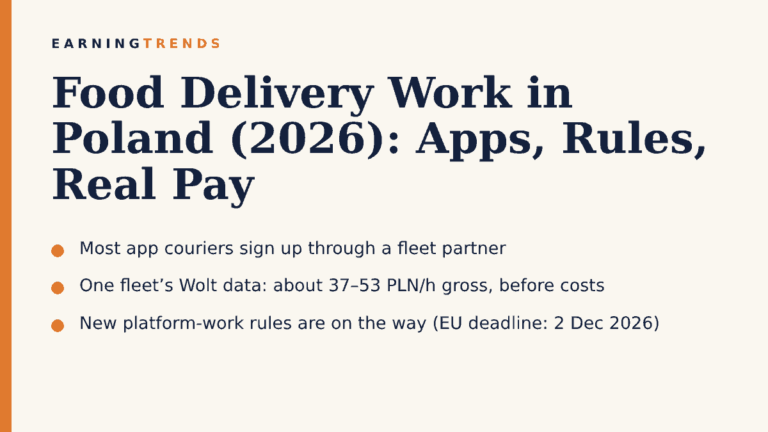
- Know who you contract with. In Poland many drivers and couriers are paid through a fleet partner rather than the app itself. Check who signs your contract and who pays you.
- Keep evidence of control. Save screenshots of rules, penalties for declining orders, required shift times, rating thresholds and messages from the platform. This is the kind of evidence that can trigger the presumption.
- Download your data. Use the platform’s data download tool or a GDPR access request to get your earnings history, ratings and activity records.
- Challenge automated decisions in writing. If your account is restricted or closed, ask for a written explanation and a human review. Keep copies of everything.
- Use the labour inspectorate. In Poland, PIP can examine whether a civil-law contract is really employment. Trade unions and worker groups can also help.
- Follow the final law. Check the government legislative pages for project UC160 and news from your platform about changes to contracts.
This article is general information, not legal or tax advice. Your status depends on your own situation and the final national law, so speak to an employment lawyer, a trade union or a qualified advisor before acting.
Common mistakes to avoid
- Assuming you become an employee on 2 December 2026. The deadline is for governments. Your rights depend on the national law and on the facts of your work.
- Not keeping records. Without screenshots and data, it is hard to show that the platform controls your work.
- Ignoring the intermediary. If a fleet partner pays you, your claims may involve both that company and the platform.
- Accepting a blocked account without asking why. The directive gives you a right to an explanation and a human review. Use it.
- Forgetting tax and social insurance. A change in status changes how your income is taxed and insured. Check before you sign anything new.
FAQ
When does the Platform Work Directive apply?
EU countries must transpose it by 2 December 2026. In practice, your rights start when your country’s implementing law comes into force.
Will all couriers and drivers become employees?
No. Only people whose work is actually directed and controlled by the platform are presumed to be employees, and the platform can rebut the presumption. Genuinely independent contractors stay self-employed.
Do the algorithm rules help self-employed workers?
Yes. Transparency, data limits, human oversight and the right to an explanation and review apply to all people doing platform work, whatever their status.
Has Poland passed its law yet?
Not as of the latest information. The draft (UC160) went through public consultation in August 2026, and government adoption was planned for the fourth quarter of 2026. Check the current status before relying on specific provisions.
Conclusion
The Platform Work Directive shifts the balance of proof in favour of workers and brings algorithms under human control. For gig workers in Poland and across the EU, the smartest move now is to understand your current setup, keep good records and download your data, so you are ready when the national rules take effect. If you are still choosing a side income, see our list of gig jobs you can start without experience.
Sources
- CMS – From gig to guarantee: how the EU is transforming platform work (2026)
- Ius Laboris – EU Platform Work Directive: which countries have implemented (2026)
- ETUC – Manual on transposing the Platform Work Directive (2026)
- Ministry of Family, Labour and Social Policy – Platform work bill sent to consultation (Aug 2026)
- Chancellery of the Prime Minister – Draft law UC160
- Firmove – Platform work bill after consultations (Sep 2026)
Images: EarningTrends graphic.