Gig Work in Spain (2026): Autónomo Rules, Rider Law and Taxes
Gig work in Spain looks very different in 2026 than it did a few years ago. If you want to deliver food, the big apps now hire riders as employees or through partner fleets, not as freelancers. If you want to sell your own services, such as design, translation, tutoring, repairs or cleaning, you will usually need to register as an autónomo (self-employed worker) with Social Security and the tax office. This guide covers both routes, what they cost, and the tax rules to know before you start.
The short answer
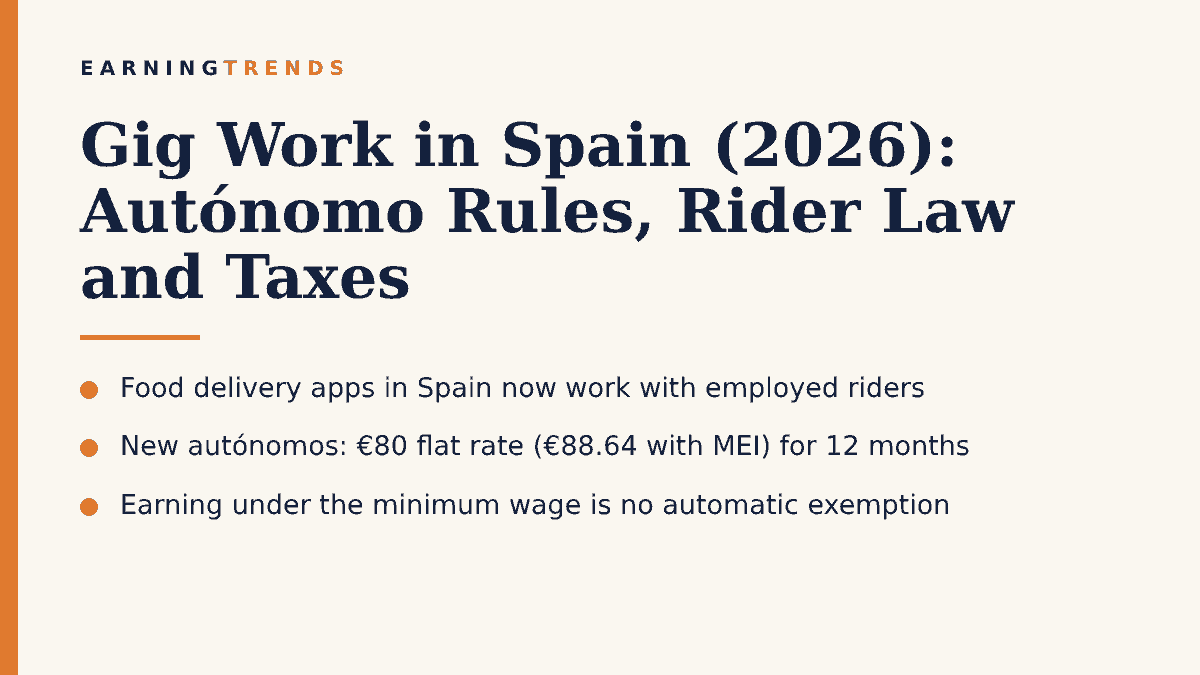
- Food delivery: since Spain’s Rider Law (Ley Rider) of 2021, delivery riders on digital platforms are presumed to be employees. Glovo completed its switch to an employment model in 2025, and Uber Eats says that from 30 November 2026 it will no longer be possible to work for it as a self-employed rider.
- Selling your own services: regular self-employed work generally means registering as an autónomo. New autónomos can usually pay a reduced flat-rate contribution of €80 a month for the first 12 months (€88.64 in 2026 once the MEI surcharge is added).
- Low income is not an automatic exemption: Spain’s Supreme Court has confirmed that earning less than the minimum wage does not by itself free you from registering, except in specific cases such as retirement pensioners.
Delivery and ride apps: now a job, not a gig
Spain was one of the first EU countries to legislate for platform workers. The Rider Law, in force since August 2021, created a presumption of employment for people delivering goods through digital platforms and added rules on algorithmic transparency. It took years for the market to adjust, but the main apps have now moved:
- Glovo moved its Spanish riders to employment contracts in 2025. Eurofound reports that it completed the hiring of around 14,000 riders as salaried employees by June 2025, after years of fines and inspections.
- Uber Eats announced in January 2026 that it would stop working with self-employed couriers. In October 2026 it reached an agreement with the UGT and CCOO unions under which its remaining 4,286 self-employed riders become employees, and from 30 November 2026 self-employed delivery work on the app ends in Spain.
- Just Eat works with riders employed through specialised logistics companies.
For you, this means delivery work in Spain is applied for like a normal job: a contract (often part-time), a payslip, and social security paid by the employer. You no longer need to register as an autónomo to deliver for the big apps, and you can’t simply download the app and start. Pay and hours depend on the contract and the applicable collective agreement, so read the offer carefully and ask how hours, waiting time and vehicle costs are handled.
Spain’s approach is close to where the whole EU is heading. Our guide to the EU Platform Work Directive explains what the directive will require of other member states.
Freelance gigs: becoming an autónomo
Most other side income, such as freelance writing, design, development, tutoring, photography, handyman jobs or cleaning for private clients, counts as self-employed economic activity. If you do it regularly (habitualmente), you are expected to register in the special scheme for self-employed workers (RETA) and with the tax agency (Agencia Tributaria).
Step-by-step registration
- Get your identification sorted. Spanish nationals use their DNI. Foreign residents need an NIE, and non-EU citizens also need a residence and work authorisation that allows self-employment.
- Register with the tax agency (census declaration, usually form 036 or 037). You choose the activity code (IAE epígrafe) that matches what you do. This decides, for example, whether your invoices carry income tax withholding.
- Register with Social Security (RETA) online through the Import@ss portal. You estimate your net monthly earnings, which sets your contribution bracket, and you can apply for the flat rate at this point.
- Start invoicing with the correct VAT (IVA) and, if you are a professional working for businesses, the correct IRPF withholding.
- File quarterly and annual returns, typically VAT and advance income-tax payments each quarter, plus the annual income tax return.
What it costs: social security in 2026
Since 2023 autónomos pay contributions based on their real net income across 15 brackets. The government kept the 2026 contribution tables at 2025 levels after negotiations on new tables failed. At the minimum contribution base, monthly payments range from roughly €200 in the lowest bracket (net income up to €670 a month) to about €590 in the top bracket (above €6,000 a month). The MEI surcharge rose to 0.9% in 2026, which adds a few euros on top.
You declare an income forecast, can change your base up to six times a year, and Social Security later regularises the year against your tax return. If you underestimated, you pay the difference; if you overestimated, you get a refund.
The €80 flat rate (tarifa plana)
New autónomos can apply for a flat rate of €80 a month for the first 12 months, regardless of income. In 2026 the actual payment is €88.64 because of the MEI. The main conditions are that you have not been registered as self-employed in the previous two years (three if you used the flat rate before) and that you have no debts with Social Security or the tax agency. If your net income in that first year stays below the minimum wage, you can usually extend the flat rate for another 12 months. Some regions add their own aid that refunds part or all of the flat rate, so check with your autonomous community.
Income tax and invoices
Autónomos pay personal income tax (IRPF) on their net profit at progressive rates, which vary slightly by region. If you are registered under a professional activity and invoice Spanish businesses or other professionals, your client normally withholds 15% of the invoice base and pays it to the tax office on your behalf. New professionals can apply a reduced 7% rate in the year they start and the following two years, but only if they tell the client in writing. Business-type activities and invoices to private individuals generally carry no withholding. Most services also carry 21% VAT, although some (certain education and health services, for instance) are exempt.
Tax rules depend on your activity, your region and your personal situation, so check your set-up with a gestoría (tax adviser) or the Agencia Tributaria before you start. This guide is not tax or legal advice.
Comparing your options
| Route | Status | Who pays social security | Good for |
|---|---|---|---|
| Food delivery (Glovo, Uber Eats fleets, Just Eat partners) | Employee (direct or via a fleet company) | Employer, plus your payslip deductions | Steady part-time hours with employment protection |
| Freelance services (design, tutoring, IT, translation) | Autónomo | You: €80 flat rate at first, then €200–€590+ a month by income | Higher-value skills and several clients |
| Selling second-hand items | Usually private individual | None if it is occasional sale of your own things | Decluttering, not a business |
| Occasional one-off jobs | Unclear, depends on regularity | Assess case by case | Get advice before invoicing |
Selling online and DAC7 reporting
If your “gig” is selling on marketplaces or renting out property and services through platforms, the EU’s DAC7 rules apply. Platforms report data on their sellers to the Spanish tax agency (on form 238), including the consideration received each quarter and the number of transactions. The tax agency points out that DAC7 does not create new tax obligations for sellers. It does mean the tax office can see the income, so anything that is taxable should be declared. Selling your own used items occasionally is a different situation from buying goods to resell. Our guide to Wallapop vs Vinted in Spain covers fees and the tax side for casual sellers.
Common mistakes
- Assuming “under the minimum wage” means no registration. In a July 2025 ruling (STS 941/2025), the Supreme Court said that income below the minimum wage is only one indicator. It does not automatically exclude regular activity, except for retirement pensioners, who have a specific rule.
- Renting someone else’s delivery account. Using another person’s rider account was always risky. With the big apps now on employment models, it is a fast way to lose income and end up in an irregular situation.
- Forgetting the 7% notice. The reduced withholding for new professionals is not automatic. Without written notice, clients withhold 15%.
- Underestimating income on Import@ss. The annual regularisation can turn a low forecast into a lump-sum bill. Update your forecast when your earnings change.
- Skipping quarterly filings. Late VAT and income-tax returns lead to surcharges, even when the amounts are small.
FAQ
Can I still deliver food as a freelancer in Spain?
For the major apps, no. Glovo switched to employment in 2025, and Uber Eats ends self-employed delivery on 30 November 2026. Delivery work is now offered through employment contracts, either directly or via fleet companies.
How much does it cost to be an autónomo in the first year?
If you qualify for the flat rate, €88.64 a month in 2026 (€80 plus the MEI surcharge) for 12 months. After that you move to the income-based brackets, starting at about €200 a month at the minimum base.
Can I be employed and an autónomo at the same time?
Yes. This is called pluriactividad. You contribute in both schemes, and there are specific rules and possible refunds when combined contributions exceed certain limits. Check your case with Social Security or a gestoría.
Do foreigners need anything extra?
EU, EEA and Swiss citizens need an NIE and registration as residents if they live in Spain. Non-EU citizens need a residence permit that allows self-employment or employment, depending on the route.
Conclusion
Spain has effectively split gig work in two. App-based delivery is now employment, with contracts and employer contributions. Everything else, from freelance design to private tutoring, runs through the autónomo system. The €80 flat rate makes the first year affordable, but registration, invoicing and quarterly filings are real obligations from day one. If you are comparing countries, see how the rules work for gig work in Portugal next door.
Sources
- elDiario.es / EFE: Uber Eats agreement with UGT and CCOO to employ its remaining self-employed riders (October 2026)
- Eurofound Platform Economy Database: Glovo and Spain’s Rider Law
- El Derecho: Government extends 2025 autónomo contribution tables into 2026
- Infoautónomos: Tarifa plana de 80 euros para autónomos en 2026
- Infoautónomos: Being self-employed on a low income (Supreme Court ruling on the minimum wage)
- Agencia Tributaria: DAC7 FAQ on seller information (form 238)