How to Start Freelancing Legally in Poland (2026)
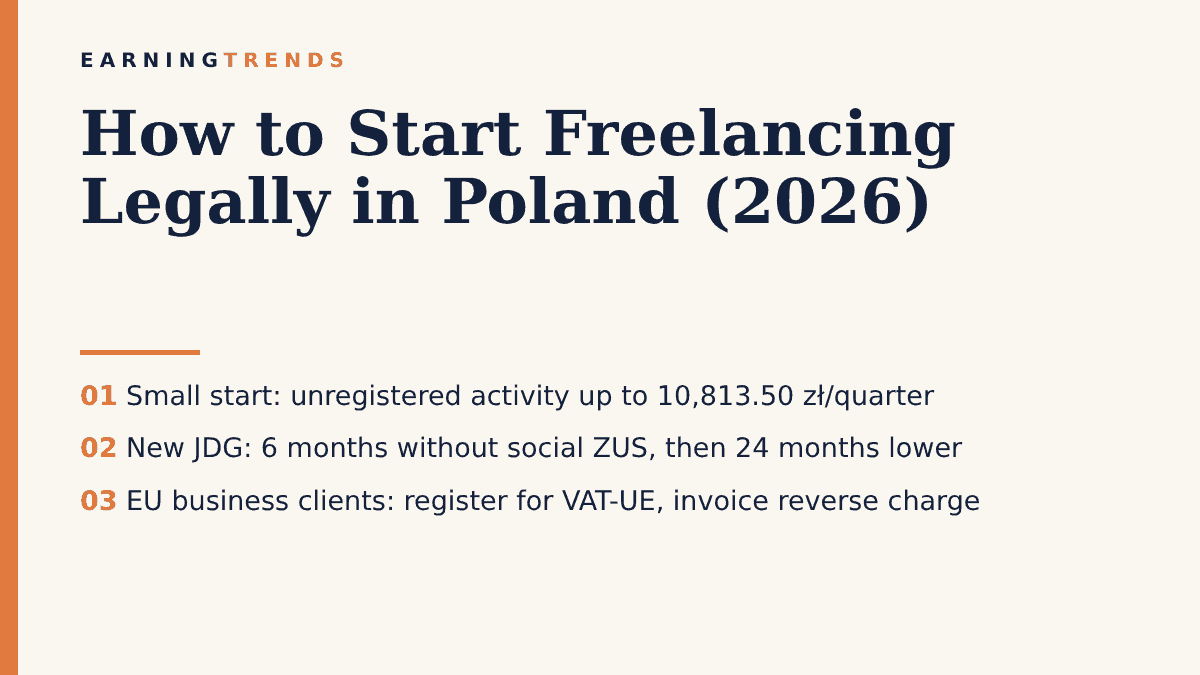
If you live in Poland and earn money from clients on Upwork, Fiverr or directly from companies abroad, you need a legal way to bill them and pay tax. In 2026 you have two main options. If your income is small, you can use unregistered activity (działalność nierejestrowana) up to 10,813.50 zł per quarter. If it is larger, you open a sole proprietorship (jednoosobowa działalność gospodarcza, JDG), which gets six months without social ZUS contributions and then 24 months of reduced ones. This guide walks through both options, the ZUS reliefs, the tax forms and how to invoice foreign clients.
Option 1: Unregistered activity for a small start
Unregistered activity lets you test freelancing without opening a company. In 2026 the limit is 225% of the minimum wage per quarter: 10,813.50 zł, based on a minimum wage of 4,806 zł. You do not register in CEIDG and do not pay ZUS contributions on this income, but you must keep a simple sales record and declare the income in your annual PIT return at the tax scale rates.
It suits people who are testing their first gigs, for example a few translation, design or writing jobs a month. Once you go over the quarterly limit, you have seven days to register a business. Unregistered activity does not remove your VAT obligations either: if you serve business clients in other EU countries, the VAT-UE rules below still apply.
Option 2: Sole proprietorship (JDG) and ZUS reliefs
A JDG is the standard setup for full-time or growing freelancers. You register it free of charge online in CEIDG, choose your PKD activity codes and your tax form, and you can start the same day. The big cost for new businesses is ZUS, but in 2026 there is a clear path of reliefs.
Step 1: Ulga na start (first 6 months)
For the first six full calendar months, you pay no social insurance contributions, only the health contribution. You cannot use this relief if you ran a business in the last 60 months, or if you work for a former employer doing the same kind of work you did for them as an employee in the current or previous year.
Step 2: Preferential ZUS (next 24 months)
Next, you pay social contributions on a base of 30% of the minimum wage, which is 1,441.80 zł in 2026. That works out to about 420.86 zł a month without sickness insurance, or 456.18 zł with the voluntary sickness insurance. The health contribution is paid on top.
Step 3: Mały ZUS Plus or full ZUS
After the preferential period, you can use Mały ZUS Plus if your revenue in the previous year was no more than 120,000 zł and you ran the business for at least 60 days in that year. Your contributions are then based on your income instead of a fixed amount, for up to 36 months within any 60-month period. Otherwise, you pay full ZUS: in 2026 the base is 5,652 zł and social contributions total 1,926.76 zł a month, including the Labour Fund.
Wakacje składkowe: one month off
Small businesses can apply for “contribution holidays” once a year. The state then covers one month of your social contributions. You need to have no more than 10 insured people and revenue below €2 million in the previous year. You must file the RWS application through PUE ZUS (eZUS) in the month before the holiday month, and it cannot be backdated. The health contribution is still due for that month.
Health contribution and tax forms in 2026
When you register a JDG, you choose one of three main tax forms. Your choice also sets how your health contribution is calculated.
- Tax scale (skala podatkowa): 12% on income up to 120,000 zł and 32% above that, with a 30,000 zł tax-free amount. You are taxed on income (revenue minus costs). The health contribution is 9% of income, with a minimum of 432.54 zł a month.
- Flat tax (podatek liniowy): 19% on income from the first złoty, with no tax-free amount. The health contribution is 4.9% of income, with the same minimum. It usually only pays off at higher incomes.
- Lump-sum tax (ryczałt): a fixed percentage of revenue, with no deduction of costs. Typical rates are 12% for programming and most software services, 8.5% for many other services (including some IT support), 14% for engineering and architectural services, and 15% for advertising, marketing and some consulting. The health contribution is a fixed monthly amount based on yearly revenue: 498.35 zł up to 60,000 zł, 830.58 zł up to 300,000 zł, and 1,495.04 zł above that.
For freelancers with low costs, such as writers, developers or virtual assistants working from home, ryczałt is often worth checking because costs do not matter. The correct rate depends on the exact service and its PKWiU classification, and the tax office has issued strict interpretations for IT, so confirm your rate before you register.
Comparison: which setup fits you?
| Unregistered activity | New JDG (first 30 months) | Established JDG | |
|---|---|---|---|
| Income limit | 10,813.50 zł per quarter (2026) | None | None |
| Social ZUS | None | 0 zł for 6 months, then about 421–456 zł a month for 24 months | Mały ZUS Plus if eligible, otherwise 1,926.76 zł a month |
| Health contribution | None | Yes, depends on tax form | Yes, depends on tax form |
| Tax | Tax scale in your annual PIT | Scale, flat 19% or ryczałt | Scale, flat 19% or ryczałt |
| Best for | Testing a few gigs | Starting full-time freelancing | Steady, growing income |
Invoicing foreign clients and VAT basics
Most freelancers start without registering as active VAT payers. In 2026 the VAT exemption limit for Polish sales is 240,000 zł a year, up from 200,000 zł. Services you sell to foreign business clients usually do not count towards this limit, because they are taxed in the client’s country.
Business clients in the EU
- Register for VAT-UE before your first service, using form VAT-R. You get a “PL” VAT-UE number even if you are otherwise VAT-exempt.
- Issue the invoice without Polish VAT. Include your VAT-UE number, the client’s EU VAT number and the note “reverse charge” (odwrotne obciążenie).
- File the VAT-UE summary declaration electronically by the 25th of the month after the service. No zero declaration is needed for months without EU sales.
Clients outside the EU and freelance platforms
Business services for clients outside the EU, for example in the US or UK, are generally also taxed outside Poland. You invoice without Polish VAT and do not file a VAT-UE summary for them. Platforms add a layer: the platform’s own service fees are usually invoiced to you by a foreign company, which can count as an import of services in Poland. Ask your accountant how to treat your platform’s fees and payouts. If you are still choosing a platform, see our comparison of Fiverr vs Upwork and our list of freelance platforms for beginners.
This article is general information, not tax or legal advice. Rules change and depend on your situation, so check with a qualified accountant or tax advisor before you choose a tax form or register for VAT.
Step-by-step: going legal in 2026
- Estimate your income. If it will stay under 10,813.50 zł per quarter, unregistered activity may be enough to start.
- Check the ZUS reliefs. Confirm you have not run a business in the last 60 months and are not working for a former employer.
- Choose PKD codes and a tax form. Match your main service to a code and compare scale, flat tax and ryczałt for your expected income and costs.
- Register in CEIDG. Registration is free and online. Choose your ZUS relief and tax form during registration.
- Register for VAT-UE if needed. Do this before your first invoice to an EU business client.
- Open a separate bank account and set up invoicing. Keeping business money separate makes records and tax returns much simpler.
Common mistakes to avoid
- Billing foreign clients with no legal basis. Platform payouts are visible to banks and tax authorities. Choose unregistered activity or a JDG from the start.
- Forgetting VAT-UE. Invoicing an EU company without a VAT-UE registration is one of the most common errors among new freelancers.
- Picking the wrong ryczałt rate. IT services in particular are split between 12% and 8.5%, and the tax office checks this.
- Missing the RWS deadline. The contribution holiday must be requested in the month before. Late applications are rejected.
- Ignoring the health contribution. No ZUS relief covers it, so budget for it from your first month.
FAQ
Can I work for foreign clients with unregistered activity?
Yes, as long as you stay within the quarterly limit. You still declare the income in your PIT return, and VAT-UE rules apply if your clients are businesses in other EU countries.
How much ZUS will I pay in my first year?
If you qualify for both reliefs, you pay no social contributions for six months, then about 421–456 zł a month. The health contribution is added throughout and depends on your tax form.
Do I charge Polish VAT to an American client?
Generally not for business services. The service is taxed where the client’s business is, so you invoice without Polish VAT. Check special cases with an accountant.
Is ryczałt always the cheapest option?
No. It is often good when your costs are low, but your rate, revenue and health contribution decide the result. Compare all three forms for your numbers before you register.
Conclusion
Going legal as a freelancer in Poland is easier than many people expect. Start with unregistered activity if your income is small. Move to a JDG when you grow, and make the most of the six-month relief and preferential ZUS. Register for VAT-UE before you invoice EU companies. With the setup done right, you can focus on finding clients and turning gigs into a steady income. Our guide to turning gig work into a full-time income covers the next step.
Sources
- Zielona Linia (gov.pl) – ZUS contributions for entrepreneurs in 2026
- Infor.pl – Unregistered activity limits in 2026
- Podatki.biz – Mały ZUS Plus changes from 2026
- inFakt – Health contribution 2026 by tax form
- Infor Księgowość – VAT exemption limit of 240,000 zł from 2026
- Poradnik Przedsiębiorcy – Selling services to the EU without active VAT
Images: EarningTrends graphic.