Online Tutoring in Poland (2026): Platforms, Fees and Taxes
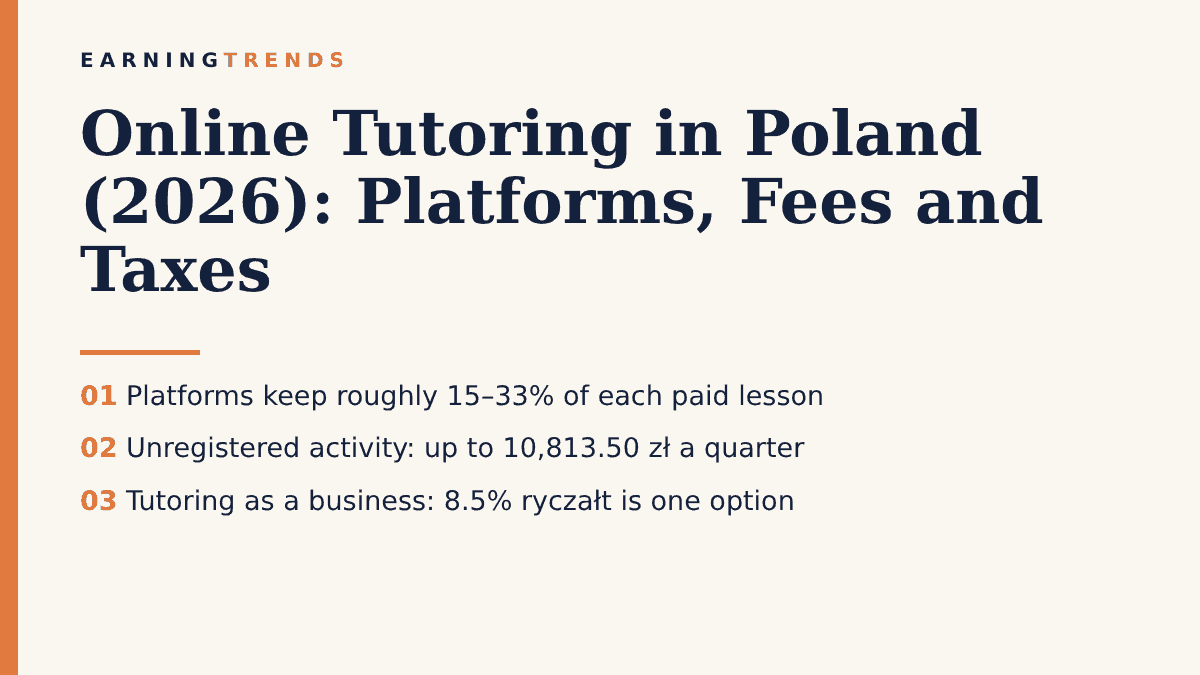
Online tutoring is one of the most practical side incomes you can run from Poland or anywhere in the EU. You need a skill people pay to learn, such as a language, maths or exam preparation, plus a laptop and a stable connection. You can find students through international platforms like Preply and italki, which take a commission, or through Polish listing sites and your own network. In Poland, small-scale tutoring can start as unregistered activity (działalność nierejestrowana) up to 10,813.50 zł in revenue per quarter in 2026. Above that you register a sole proprietorship (JDG), where an 8.5% flat-rate tax is one option. Here is how it works in practice.
What you can teach online
Languages are the biggest category on international platforms. If you speak Polish natively and English or German well, you can teach Polish to foreigners or a foreign language to Polish learners. School subjects, especially maths, physics, chemistry and preparation for the egzamin ósmoklasisty and matura, are in steady demand among Polish families. Skills such as programming, Excel or music theory also work online if you can explain them clearly.
Formal teaching qualifications help you stand out, but most platforms do not require them for every subject. What matters most to students is clear explanations, reliability and good reviews.
Where to find students
Preply
Registration and your profile are free. Preply earns through commission. It keeps 100% of the trial lesson with each new student. After that, it takes 18% to 33% of each lesson, depending on how many hours you have taught on the platform in total. New tutors start at 33%, which falls to 28% after 20 hours and keeps dropping as you teach more. Preply’s own example: at 40 zł per hour, a new tutor receives 26.80 zł per regular lesson, and a tutor with more than 400 hours receives 32.80 zł.
italki
italki focuses on languages. It takes no commission on trial and instant lessons. The commission is 21% on a single lesson, 19% on a 5-lesson package, 17% on a 10-lesson package and 15% on 15- or 20-lesson packages. Group classes carry a 30% commission. Withdrawing your earnings is free, except for express withdrawal, but your payment provider may charge its own fees.
Polish listing sites and direct clients
Polish tutoring directories, such as e-korepetycje.net, let you post a profile that local students and parents can find. Their pricing models differ, so check each site’s current terms before you sign up. Many tutors gradually build a base of direct clients through recommendations, local Facebook groups and school contacts. With direct clients there is no platform commission, but you handle scheduling, payments and cancellations yourself.
Platform comparison
| Preply | italki | Direct clients / listing sites | |
|---|---|---|---|
| Main subjects | Languages and many school subjects | Languages | Anything you can market locally |
| Trial lesson | Platform keeps 100% | 0% commission | Your choice |
| Regular lessons | 33% falling to 18% as your teaching hours grow | 21% single; 15–19% packages; 30% group | No platform commission (listing fees may apply) |
| Finding students | Platform brings international demand | Platform brings international demand | You do the marketing |
| Admin | Payments and booking handled | Payments and booking handled | You handle everything |
If you are comparing tutoring with other online work, our overview of freelance platforms for beginners covers marketplaces for writing, design and admin tasks.
How to set your rates
There is no official rate table, and prices vary widely by subject, language, level and reviews. Instead of guessing, use this method:
- Research your niche. Filter the platform by your subject and language and note the prices of tutors with similar experience and a similar number of reviews.
- Work back from what you keep. On Preply, a new tutor keeps 67% of the lesson price. On italki, the share depends on whether students buy single lessons or packages. Decide what you need per hour after commission, then set the listed price.
- Start slightly below established tutors. Early reviews matter more than the extra few złoty. Raise your price once you have steady bookings and good ratings.
- Count unpaid time. Preparation, messages and trial lessons that do not convert all take time. Your real hourly rate is lower than your lesson price.
- Offer packages to direct clients. Selling 5 or 10 lessons upfront gives you more predictable income and fewer cancellations.
Getting started: step by step
- Pick a narrow offer. “Matura maths, extended level” or “Business English for IT professionals” is easier to sell than “English lessons”.
- Set up your equipment. A headset with a microphone, a quiet room, good lighting and a reliable connection. A drawing tablet helps with maths and science.
- Create a strong profile. Record a short, friendly intro video, and explain who you help and how your lessons work.
- Open your calendar. Students often book evenings and weekends. Availability at those times brings early bookings.
- Turn trials into regular students. End each trial with a clear plan for the next few lessons.
- Keep a revenue log from day one. You need it for tax, whichever setup you choose.
Legal setup and taxes in Poland
Unregistered activity
From 2026, the limit for unregistered activity is set per quarter at 225% of the minimum wage: 10,813.50 zł, based on a minimum wage of 4,806 zł. The limit applies to revenue, not profit. In this setup you pay no ZUS contributions. You keep a simple revenue log (date, amount and what the payment was for) and report the income in your annual PIT-36 return. Invoices or receipts are not needed for private students unless they ask for one, in which case you must issue it. Platform payouts from Preply or italki count as your revenue too.
If you exceed the quarterly limit, you have to register a business in CEIDG.
Sole proprietorship (JDG)
With a registered sole proprietorship you choose a tax form. The options are the tax scale (12% and 32%), the 19% flat rate, or the lump-sum tax on recorded revenue (ryczałt). Tutoring falls under education services, for which the ryczałt rate is 8.5%. Under ryczałt you pay tax on revenue and cannot deduct costs. You also pay ZUS contributions as a business owner, and the amount depends on your situation and any relief you qualify for. A JDG gives you more admin, but no quarterly revenue cap.
VAT and cash registers
Private lessons you give personally can generally be VAT-exempt. Small sellers are also exempt from using a cash register (kasa fiskalna) up to 20,000 zł in sales to private individuals, and education services have their own exemption. Details depend on how and from whom you receive payment, so confirm them for your case.
This is general information, not tax or legal advice. Tax rules depend on your circumstances and differ between EU countries, so check with a qualified tax advisor or your local tax office before you start.
Outside Poland, most EU countries have their own simplified schemes for small self-employed activity, but the thresholds and rules are different. If you live elsewhere in the EU, check your national tax authority’s guidance.
Common mistakes
- Ignoring the commission. Pricing as if you keep the full amount means you earn far less per hour than you planned.
- Thinking platform income is not taxable. Money paid out by a foreign platform is still income you must declare in Poland.
- Missing the quarterly limit. The unregistered-activity cap is per quarter in 2026. A busy exam season can push you over it.
- Offering too broad a service. A generic profile competes with thousands of others.
- No cancellation policy. With direct clients, agree upfront how late cancellations are handled.
- Burning out. Back-to-back evening lessons after a full-time job add up quickly. Set a weekly hour cap.
FAQ
Do I need a company to tutor online in Poland?
Not at first. If your revenue stays within 10,813.50 zł per quarter in 2026, you can tutor as unregistered activity and declare the income in your annual PIT-36.
Which platform takes the lowest commission?
It depends on how you teach. italki charges 15–21% on individual lessons and nothing on trials. Preply starts at 33% plus the full trial lesson, but falls to 18% for tutors with many hours taught.
What tax rate applies to tutoring as a business?
A JDG can choose the tax scale, the 19% flat rate or ryczałt. For tutoring, the ryczałt rate is 8.5% of revenue, with no deduction for costs.
Can I tutor from Poland for students abroad?
Yes. International platforms connect you with students worldwide. As a Polish tax resident, you declare that income in Poland.
Conclusion
Online tutoring turns knowledge you already have into flexible income, with almost no startup costs. Platforms like Preply and italki bring students but take a share, while direct clients pay more per lesson and need more effort. Start small with unregistered activity, track every payment, and move to a JDG once your income grows. If you want more side-income ideas that use what you already have, see our guides on selling digital products such as online courses and selling on Vinted in Poland.
Sources
- Preply Help Centre – Commission model
- italki Support – Teacher commission
- Solidna Księgowa – Tutoring as unregistered activity (2026)
- Solidna Księgowa – Tutoring and ryczałt
- Infor.pl – Unregistered activity limits in 2026
- ifirma.pl – Tutoring and taxes (VAT and cash register rules)
Images: EarningTrends graphic.