Gig Work in Italy (2026): Partita IVA, Occasional Work, Taxes
If you want to earn on the side in Italy through gig work, freelancing or delivery apps, you have two main legal routes: occasional self-employed work (prestazione occasionale) for genuinely one-off jobs, or a VAT number (partita IVA) under the flat-rate regime forfettario once the work becomes regular. The first is simple but limited; the second costs more admin but gives you a 5% or 15% substitute tax on a fixed share of your revenue. This guide explains both, what delivery platforms actually offer riders in 2026, and the mistakes that cause trouble with the tax office.
Route 1: Occasional self-employed work (prestazione occasionale)
Occasional self-employed work (lavoro autonomo occasionale, based on article 2222 of the Civil Code) lets you do a job for a client without opening a VAT number. It fits one-off tasks: translating a document, designing a logo, helping at a single event.
How it works in practice
- No VAT number. You issue a simple receipt (ricevuta) instead of an invoice.
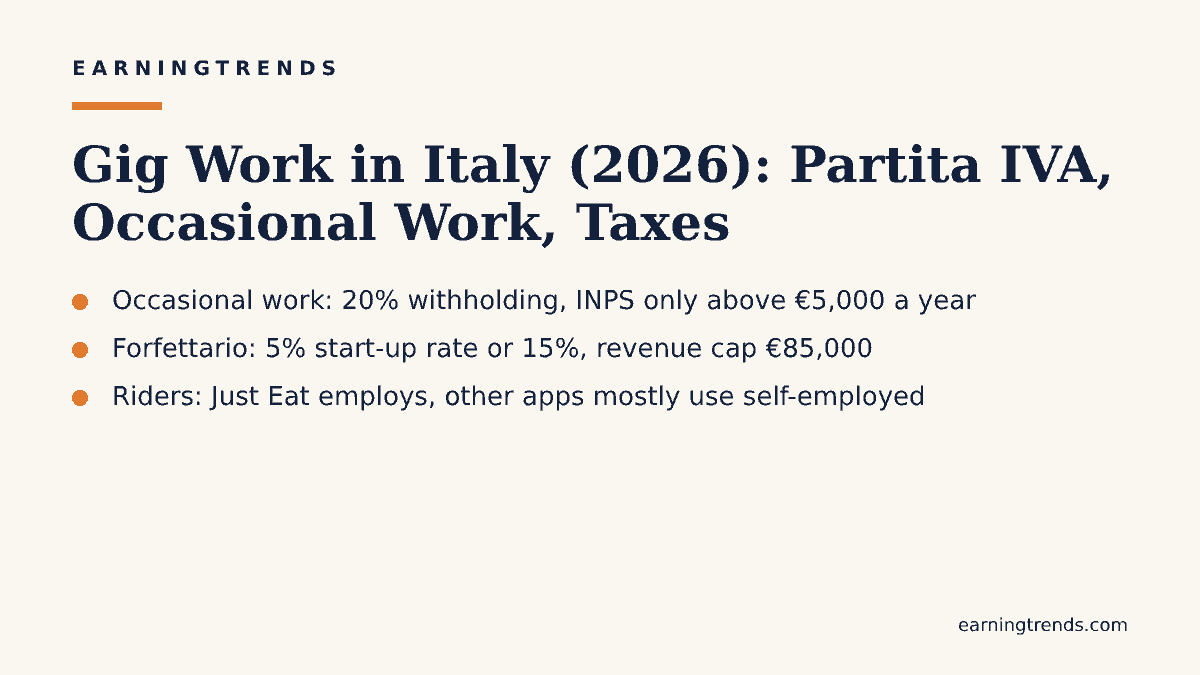
- 20% withholding. When your client is a business or professional acting as withholding agent, it holds back a 20% advance on income tax (ritenuta d’acconto) and pays it to the state. On a €1,000 gross fee you receive €800. The final tax is settled in your annual tax return together with your other income.
- The €5,000 social security threshold. Once your total occasional income exceeds €5,000 gross in a calendar year, you must register with the INPS separate pension fund (Gestione Separata). Contributions are due only on the part above €5,000, split one third to you and two thirds to the client.
- It must stay occasional. There is no fixed euro limit for “occasional”, but the work must be sporadic, without continuity or business organisation. Advertising your services, working for the same client every week or using it as your main job points towards a VAT number.
The €5,000 figure is not a cap on what you may earn. It is only the point where INPS contributions start. The real limit is the nature of the work.
Route 2: Partita IVA with the regime forfettario
If you deliver, freelance or sell services regularly, the usual answer is a VAT number under the flat-rate regime (regime forfettario). The 2026 Budget Law kept the rules unchanged from 2025.
Key rules for 2026
- Revenue cap: up to €85,000 of revenue or fees collected per year. If you go above €85,000 but stay under €100,000, you leave the regime from the following year; above €100,000 you leave it immediately.
- Substitute tax: 15% as standard, or 5% for the first five years of a genuinely new activity if you meet the start-up conditions.
- Taxable base: your collected revenue multiplied by a fixed profitability coefficient (coefficiente di redditività) linked to your ATECO activity code, minus the social security contributions you paid. Common coefficients are 40% for retail trade and food services, 67% for many other activities and 78% for professional, scientific and technical services.
- Employment income limit: you can combine the regime with a job, but for 2026 your employment or pension income in the previous year must not exceed €35,000 (an extension of the usual €30,000 limit).
- No VAT on your invoices and simplified bookkeeping.
Social security contributions
This is the cost many newcomers underestimate. Freelance professionals without their own professional fund pay into the INPS Gestione Separata. According to INPS circular no. 8 of 3 February 2026, the total rate for these professionals is 26.07% of taxable income (24% if you are already a pensioner or insured elsewhere). There is no fixed minimum payment: you pay in proportion to income.
Craft workers and traders (for example some couriers or people selling goods) pay into the artisans or traders scheme instead. These schemes have a fixed minimum yearly contribution, and flat-rate taxpayers can ask INPS for a 35% reduction, which also reduces future pension credits. Which fund applies depends on your activity code, so check it with an accountant (commercialista) before you register.
A simple worked example
A new freelancer with a 67% coefficient collects €20,000 in a year:
- Taxable base before contributions: €20,000 × 67% = €13,400
- Gestione Separata contributions at 26.07% of that base: about €3,490
- Substitute tax: 5% (start-up) on the base after deducting contributions paid in the year
Contributions are deducted in the year you actually pay them, so first-year numbers differ from later years. Treat this as an illustration only and run your own figures with a qualified advisor.
Comparison: which route fits you?
| Prestazione occasionale | Partita IVA forfettario | |
|---|---|---|
| Best for | One-off, sporadic jobs | Regular gig or freelance work |
| VAT number | No | Yes |
| Tax | Normal income tax, 20% advance withheld by business clients | 5% (first 5 years, if eligible) or 15% substitute tax |
| Social security | Only above €5,000 a year, on the excess | From the first euro (Gestione Separata or artisans/traders) |
| Revenue limit | No fixed limit, but must stay occasional | €85,000 per year |
| Admin | Receipts, tax return | Registration, invoices, yearly return, often an accountant |
Delivery riders in Italy: what the apps offer in 2026
Food delivery is one of the most visible gig jobs in Italy, and the contract model matters more here than almost anywhere else in Europe.
- Just Eat is the only major platform that hires its riders as employees. Since 2021 it has applied the national logistics collective agreement (CCNL logistica) to around 2,500 riders, with a fixed hourly wage, paid holidays and severance pay.
- Glovo (Foodinho) and Deliveroo mostly work with self-employed riders paid per delivery. In February and March 2026 Milan prosecutors placed both companies under judicial control in an investigation into alleged labour exploitation. In May 2026 Glovo proposed raising its guaranteed minimum to €14 gross per hour and €3 per delivery, together with talks on a collective agreement. Check the current terms in the app before you sign up, because these conditions were still changing during 2026.
- The EU Platform Work Directive must be transposed into Italian law by 2 December 2026. It introduces a presumption of employment for platform workers in certain situations and rules on algorithmic management. Our guide to the EU Platform Work Directive explains what it means for riders across Europe.
If you ride as a self-employed courier, you will normally need a VAT number once the work is regular, and you must budget for tax, INPS contributions, insurance and your own vehicle costs out of the per-delivery pay. For a comparison with a neighbouring market, see food delivery work in Austria.
Step-by-step: getting started legally
- Get a tax code (codice fiscale) if you do not already have one. Foreign residents need it for almost everything, including registering with apps.
- Decide the route. One or two small jobs a year can stay occasional. Regular work for platforms or repeat clients needs a VAT number.
- Choose your ATECO code carefully. It sets your profitability coefficient and which INPS fund you join.
- Open the partita IVA with the Revenue Agency (Agenzia delle Entrate), opting for the flat-rate regime, usually through an accountant or an online service.
- Register with INPS in the correct fund at the same time.
- Set money aside from every payment for substitute tax and contributions, which are paid in instalments the following year.
- Keep records of every receipt or invoice and every contribution paid.
Common mistakes
- Treating €5,000 as a tax-free allowance. It is a social security threshold, not an exemption. Income tax is due on all occasional income.
- Staying “occasional” too long. Regular weekly work on receipts can be reclassified, with back taxes and penalties.
- Assuming the 5% rate applies automatically. You must meet the start-up conditions, for example not continuing an activity you previously did as an employee.
- Forgetting contributions. At 26.07% of the taxable base, INPS can cost more than the tax itself.
- Exceeding €100,000 without planning. You leave the flat-rate regime in the same year and must apply VAT from that point.
FAQ
Can I do gig work in Italy while employed?
Yes. With the flat-rate regime, your employment income in the previous year must not exceed €35,000 for 2026. Occasional work has no such limit but must stay genuinely occasional.
Do I pay INPS on occasional work under €5,000?
No. Gestione Separata registration and contributions start only above €5,000 of total occasional income in a year, and only on the excess.
Is the 5% flat tax available to everyone?
No. It applies for up to five years to new activities that meet specific conditions. Otherwise the rate is 15%.
Are delivery riders employees in Italy?
It depends on the platform. Just Eat hires riders as employees; Glovo and Deliveroo mostly use self-employed riders, although this is under legal and regulatory pressure in 2026.
Conclusion
Italy gives side earners a clear choice. Occasional work suits small one-off jobs, while regular gig or freelance income belongs in a VAT number under the flat-rate regime, where low substitute tax is balanced by significant INPS contributions. Delivery riders should compare contract models closely, as conditions have been changing during 2026. Tax and contribution rules depend on your personal situation, so check your plans with a qualified Italian accountant (commercialista) before you register; this article is general information, not tax or legal advice. If you are comparing countries, our guide to gig work in France covers the micro-entrepreneur system.
Sources
- Gestione Separata 2026 rates under INPS circular 8/2026 (Money.it)
- Regime forfettario 2026: limits and rates (QuickFisco)
- Exceeding €5,000 in occasional work (Fiscozen)
- Glovo’s plan for riders after the Milan investigation (Il Post, May 2026)
- Riders: self-employed or employees? Contracts in Italy (Avvenire, February 2026)