Equity Savings Account in Finland (2026): Tax, Limit, Rules
Finland’s equity savings account (osakesäästötili, often shortened to OST) lets you buy and sell listed shares and reinvest dividends without paying tax until you withdraw money. You can deposit up to €100,000 in cash, you may hold only one account at a time, and when you take money out, the profit share of the withdrawal is taxed as capital income at 30% (34% on capital income above €30,000). This guide explains how the account works in 2026, how the tax is calculated, and when an ordinary book-entry account may suit you better.
What the equity savings account is
The account was introduced in 2020 by the Equity Savings Account Act. It is a tax “wrapper”: inside it you can trade shares freely, and neither sales nor dividends trigger tax at the time they happen. Tax is only calculated when money leaves the account.
Each account has two parts: a cash account and a share account. You can only deposit money (not shares you already own), and you can only withdraw money, so shares must be sold before you take funds out.
Banks and investment firms authorised in the European Economic Area can offer the account. Minors can have one too, and some providers market it for children.
Key rules in 2026
- Deposit limit: €100,000 in total, in one lump sum or several deposits. The limit was raised from €50,000 at the start of 2024. The account value can grow beyond €100,000 through returns; only deposits are capped.
- One account per person: if you hold more than one at the same time, the Tax Administration (Vero) can impose a tax increase of €10 per day for each account. Vero can reduce or waive it for obvious mistakes, for example when only one account actually held money.
- What you can buy: shares listed on regulated markets and multilateral trading facilities, including foreign exchanges and Finland’s First North growth market. Investment funds, ETFs and other exchange-traded products cannot be held in the account.
- Withdrawals: allowed at any time, with no minimum holding period.
- Switching provider: you can move the account to another bank without selling shares and without tax. You end the old contract and sign a new one, and the assets move across.
How the tax works
Inside the account
Trades and dividends are not taxed when they happen. Dividends are paid into the account and can be reinvested in full. One trade-off: on an ordinary book-entry account, 15% of dividends from Finnish listed companies is tax-exempt, but on the equity savings account that partial exemption does not apply. All profit, including dividends, is taxed as capital income when withdrawn. You also cannot use the deemed acquisition cost (hankintameno-olettama) that is available when selling shares from an ordinary account.
When you withdraw
Each withdrawal is split into a tax-free return of your own capital and a taxable profit share. The profit share is calculated from the whole account, not from the shares you sold:
Taxable part = (total profit ÷ fair value of the account) × amount withdrawn
Vero gives this example: you deposit €10,000 and buy shares that rise in value by €5,000. The account is worth €15,000, with €5,000 profit. You withdraw €1,500. The taxable part is €5,000 ÷ €15,000 × €1,500 = €500. The other €1,000 is tax-free capital, and your remaining deposited capital falls to €9,000.
If the account as a whole is at a loss when you withdraw, the withdrawal is not taxed. A loss can only be deducted from your capital income in the year you close the account completely.
Who reports the tax
Your bank or broker calculates the profit share and withholds 30% tax on it. The figures are transferred to your pre-completed tax return, so you only need to check them. Service fees are normally charged from the account’s cash and cannot be deducted separately from your other capital income.
The capital income tax rate is 30% on capital income up to €30,000 per year and 34% on the part above.
Equity savings account vs book-entry account
| Equity savings account (OST) | Book-entry account (arvo-osuustili) | |
|---|---|---|
| Deposit limit | €100,000 in cash | No limit |
| Number of accounts | One per person | As many as you like |
| What you can hold | Listed shares only | Shares, funds, ETFs and other listed products |
| Tax on sales and dividends | Deferred until withdrawal | Taxed in the year they happen |
| 15% tax-exempt part of Finnish dividends | Not available | Available |
| Deemed acquisition cost | Not available | Available |
| Losses | Deductible only when the account is closed | Deductible in the tax year of the sale |
| Transfer of existing shares | Not possible | Possible |
In practice many investors use both: the equity savings account for actively traded or long-held shares where they want to reinvest freely, and a book-entry account or fund savings for ETFs and funds, which the OST cannot hold.
Who the account suits
- Long-term share investors who want to rebalance and reinvest dividends without yearly tax.
- Investors in foreign dividend shares, since dividends land in the account without Finnish tax at that point (foreign withholding taxes can still apply under the source country’s rules).
- People who trade fairly often, because each sale inside the account is tax-neutral.
It suits you less if you prefer funds or ETFs, if you mainly hold Finnish dividend shares and value the 15% exemption, or if you plan to give shares as gifts, because shares cannot be moved out without selling them. Note also that the account ends if the holder dies.
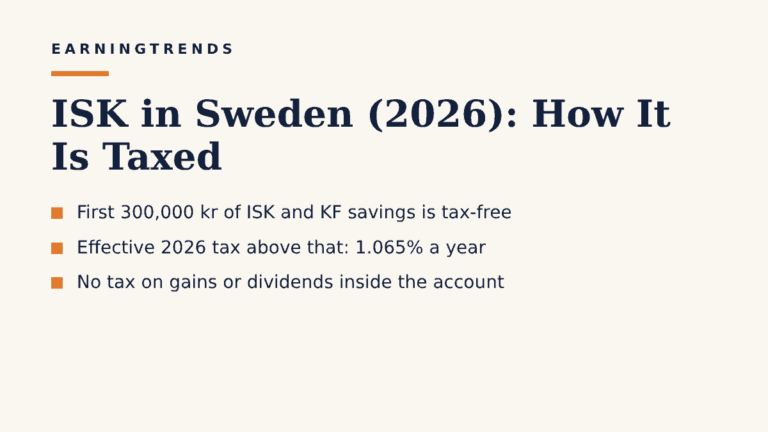
For comparison with Finland’s neighbours, see how the Swedish ISK, the Norwegian aksjesparekonto and the Danish aktiesparekonto handle the same idea with different tax models.
How to open an account: step by step
- Check you don’t already have one. If you opened an OST years ago and forgot about it, a second account can trigger the daily tax increase.
- Compare providers. Look at custody fees, trading fees, which foreign markets are available and how currency exchange is priced. Some providers waive fees for young customers.
- Open the account online with strong identification and sign the equity savings account contract.
- Deposit cash, either at once or in instalments, keeping track of your total deposits against the €100,000 limit.
- Buy shares and leave dividends in the account to be reinvested.
- Plan withdrawals. Remember that each withdrawal contains a profit share taxed at 30%, and that losses only count when you close the account.
- Check your pre-completed tax return each spring.
Common mistakes
- Opening a second account at another bank instead of transferring the existing one.
- Expecting to buy ETFs or funds. The account is limited to listed shares.
- Trying to move existing shares in. Only cash can be deposited, so moving a portfolio means selling first, which may itself be taxable on your ordinary account.
- Thinking you choose which shares the withdrawal comes from. The taxable share is always based on the profit of the whole account.
- Assuming losses help every year. They are only deductible when the account is closed.
- Ignoring diversification. Because funds are excluded, a small account can easily end up concentrated in a few companies.
FAQ
How much can I put into an equity savings account in Finland?
Up to €100,000 in cash in total. Growth in value above that is allowed.
Can I hold ETFs in an osakesäästötili?
No. Only shares listed on regulated markets or multilateral trading facilities can be bought. Funds and ETFs are excluded under the current rules.
What tax do I pay when I withdraw?
Capital income tax on the profit share of the withdrawal: 30%, and 34% on capital income above €30,000 a year. The provider withholds 30% automatically.
Can I change banks without paying tax?
Yes. The account can be transferred directly to a new provider without selling shares.
Conclusion
The equity savings account is one of the simplest ways for Finnish residents and other eligible investors to build a share portfolio and reinvest without yearly tax friction. Its limits are real: one account, €100,000 of deposits, shares only, and a profit share taxed at 30–34% when you withdraw. Industry groups have proposed widening the account to funds and ETFs, so watch for changes, but the rules above are those published by the Finnish Tax Administration for 2026. Investing involves risk and your tax position depends on your situation, so check with a qualified financial or tax advisor in Finland before making decisions; this article is general information, not financial advice.
Sources
- Equity savings account (Finnish Tax Administration, vero.fi)
- Osakesäästötilin verotus, detailed guidance (vero.fi)
- Deposit limit rises to €100,000 (Finnish Government, valtioneuvosto.fi)
- What can equity savings account funds be invested in? (Nordnet FAQ)
- Ten things investors should know about the equity savings account (Taloustaito)