Aksjesparekonto (ASK) in Norway (2026): Rules, Tax, How It Works
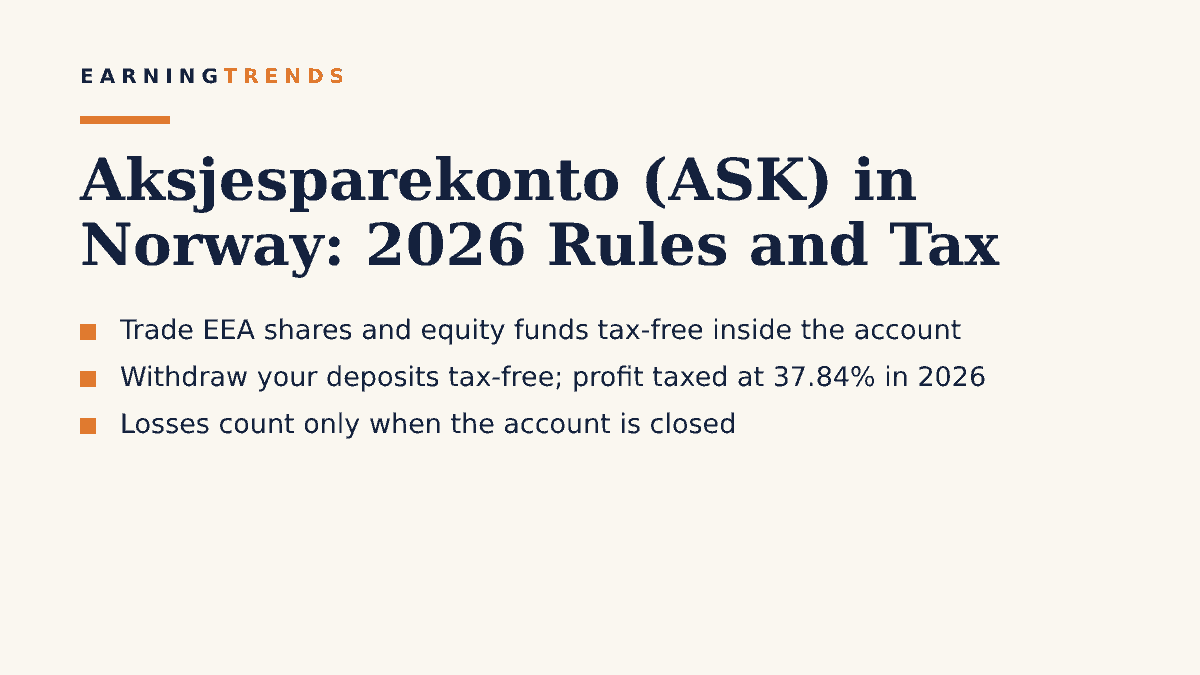
An aksjesparekonto (ASK), or share savings account, is Norway’s tax wrapper for people who invest in shares and equity funds. Inside the account you can buy, sell and switch between investments without paying tax on each gain. You only pay tax when you take out more than you put in. In 2026 that taxable profit is taxed at an effective 37.84%, after a “shield” deduction. Below we cover who can open an ASK, what you can hold in it, how withdrawals are taxed, and the change the government has proposed for 2027.
What an aksjesparekonto is (and isn’t)
The ASK was introduced in 2017 to make long-term share saving simpler. According to Skatteetaten (the Norwegian Tax Administration), gains inside the account are not taxed and losses are not deductible as long as the money stays in the account. Since 2019, dividends paid on shares and funds held in an ASK are also not taxed when they are paid out. They stay in the account and are only taxed when you withdraw.
It is a deferral scheme, not a tax-free one. The tax is postponed, not removed. The main benefit is that money which would otherwise go to tax on each sale keeps working for you, so it compounds over many years.
The scheme is widely used. A Ministry of Finance consultation paper from 2026 cites Skatteetaten figures showing 2,177,467 registered share savings accounts in Norway at the end of 2024.
Who can open one
ASKs are for personal taxpayers. Banks, securities firms and fund management companies can offer them, and you can hold as many accounts as you like, with one provider or several. Skatteetaten’s handbook notes that people living outside the EEA could open an ASK only before 1 January 2019. Today the scheme is aimed at people who are tax resident in Norway. If you are moving to or from Norway, check your own situation first, because an ASK falls under Norway’s exit tax rules if you moved or transferred assets abroad on or after 20 March 2024.
Opening an account is normally free. Nordnet, for example, says it charges no account fee for an ASK. You still pay the usual brokerage on share trades and the ongoing fees of any fund you buy. Those costs are the same inside and outside the account.
What you can hold in an ASK
Skatteetaten’s rules are strict about what qualifies:
- Shares listed on a stock exchange or other regulated market, in companies domiciled in the EEA.
- Units in equity funds domiciled in the EEA. An equity fund here means a fund with more than 80% shares at the start of the income year.
- Cash. You can hold cash in the account, but by law it earns no interest.
You cannot hold pure bond or money market funds, or combination funds with less than 80% equities. Some companies listed on Oslo Børs are not domiciled in the EEA, so they are not eligible either. Nordnet’s FAQ gives Bermuda-registered companies as an example. Under the current rules, shares traded on growth markets such as Euronext Growth are also outside the scheme.
If a share or fund qualified when you bought it, you may keep it in the account even if it later stops qualifying. One example is a company that moves its seat to the US.
How tax works: deposits, withdrawals and the shield
The key number is your deposit, also called your cost price. You can withdraw up to the amount you have paid in at any time, tax-free. Only withdrawals above that amount count as taxable profit.
The taxable part is reduced by the shield deduction (skjermingsfradrag). It is calculated as the lowest deposit balance during the year, plus any unused shield from earlier years, multiplied by the shield rate. Skatteetaten set the shield rate for personal shareholders at 3.6% for the 2025 income year. The rate for 2026 is fixed after the year ends.
After the shield, the profit is multiplied by an upward adjustment factor of 1.72 and taxed at the 22% rate on ordinary income. That gives the effective 37.84% that Skatteetaten states for taxable withdrawals in 2025 and 2026.
A simple example
Say you paid in NOK 200,000 and the account has grown to NOK 300,000. You withdraw NOK 250,000. The first NOK 200,000 is a return of your own deposits and is tax-free. The remaining NOK 50,000 is taxable profit, minus any shield deduction you have, at an effective rate of 37.84%. Your deposit balance is now zero, so later withdrawals are taxable profit.
Losses
Losses inside an ASK are only deductible when you close the account completely. Selling a losing fund and buying another one inside the account gives no deduction.
Wealth tax
An ASK does not shelter you from wealth tax. Shares and equity funds in the account get the same valuation discount as outside it. Smarte Penger, a Norwegian personal finance site, reports this discount as 20% for 2025 and 2026, so 80% of market value is counted. Skatteetaten says cash in the account counts in full, krone for krone.
ASK vs a normal investment account
| Feature | Aksjesparekonto | Ordinary account (VPS / fund account) |
|---|---|---|
| Tax when you sell at a gain | No, deferred until withdrawal | Yes, in the year of sale |
| Tax on dividends | Deferred until withdrawal | Taxed when paid |
| Withdraw own deposits | Tax-free at any time | Not relevant |
| Loss deduction | Only when the account is closed | When the loss is realised |
| Eligible assets | EEA-listed shares, EEA equity funds (over 80% equities), cash | Almost any security |
| Interest on cash | None by law | Depends on the account |
| Tax reporting | Done by the provider, pre-filled | Mostly pre-filled for Norwegian securities |
How to open and use an ASK: step by step
- Choose a provider. Compare which funds and shares each one offers inside the ASK, and check brokerage and fund fees rather than the account itself.
- Open the account online. Providers such as DNB and Nordnet let you do this in their online bank or app.
- Move existing holdings carefully. Shares already held outside an ASK cannot be transferred in tax-free. Skatteetaten treats it as a sale on your VPS account and a new purchase inside the ASK, so any gain is taxed. Shares with a gain may be costly to move. Shares with a loss give you a deductible loss when sold.
- Move between ASK providers without tax. Moving from one ASK to another is tax-free as long as both providers handle the transfer, so your deposit and unused shield move with it.
- Check the pre-filled tax return each spring. The provider reports to Skatteetaten, but you are responsible for checking that the figures are correct.
What may change in 2027
In its 2027 budget, presented on 7 October 2026, the government proposed expanding the ASK to include shares and equity certificates traded on multilateral trading facilities (MTFs) such as Euronext Growth. The EEA domicile requirement would stay. According to summaries from KPMG and the law firm Thommessen, the change is proposed from the 2027 income year with no transition rule. Moving existing Euronext Growth shares into an ASK would therefore still be treated as a sale. The ministry has also said it is looking at extending the scheme to bond, interest and combination funds later. These are proposals until the Storting adopts them, so check the final rules before you act.
Common mistakes
- Moving shares with large gains into an ASK and expecting no tax. The move is treated as a sale.
- Using the ASK as a cash savings account. Cash earns no interest by law.
- Buying a non-EEA company listed in Oslo and assuming it qualifies. Check eligibility first.
- Forgetting that withdrawals above your deposits are taxable, including money taken out to fund a big purchase.
- Expecting to deduct a loss inside the account. That only happens when the account is closed.
- Ignoring wealth tax. The ASK defers income tax, but the holdings still count towards your net wealth.
FAQ
Is there an annual deposit limit on a Norwegian ASK?
Skatteetaten’s description of the scheme does not include an annual deposit cap. That is a key difference from Denmark’s aktiesparekonto, which has a fixed yearly limit.
Can I hold US shares or global ETFs?
Not US-domiciled shares. Global index funds can qualify if the fund itself is domiciled in the EEA and holds more than 80% shares. Many providers list the eligible funds in their ASK fund menu.
Do I need to report anything myself?
Usually not. The provider reports deposits, shield, taxable withdrawals and wealth to Skatteetaten, and the figures are pre-filled in your tax return. You must still check them.
Should I combine an ASK with IPS?
They serve different goals. An ASK gives flexible access to your deposits. Individual pension savings (IPS) lock money up until retirement age. Many people use both, depending on their time horizon.
Bottom line
For long-term investors in shares and equity funds who are tax resident in Norway, the aksjesparekonto is usually the default account. It costs nothing to open, you can rebalance without triggering tax, and you can take your own deposits back at any time. The trade-offs are a limited choice of assets, no interest on cash and no loss deductions until you close the account. If you compare Nordic countries, see how this differs from Denmark’s Aktiesparekonto and Sweden’s ISK. For background on income-focused investing, read our guide to dividend stocks.
This article is general information, not financial or tax advice. Tax rules depend on your own circumstances, so check with a qualified financial or tax advisor in Norway before you make decisions.