ETF Savings Plans in Germany (2026): Tax, Allowance, Costs
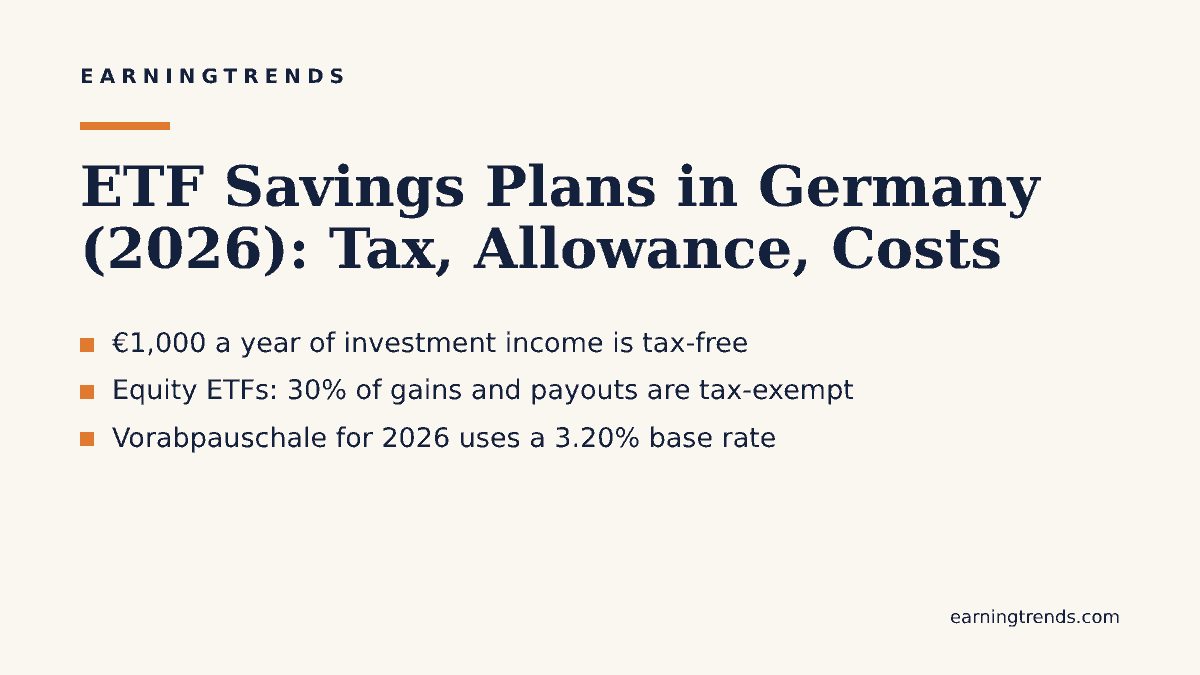
An ETF savings plan (ETF-Sparplan) is one of the simplest ways to build long-term passive income in Germany: you pick a broad index fund, set a monthly amount and let the broker buy automatically. The short answer on tax: the first €1,000 of investment income per person each year is tax-free, equity ETFs get a 30% partial tax exemption, and anything above that is taxed at 25% flat tax plus solidarity surcharge (and church tax if it applies). Accumulating funds also trigger a small yearly “advance lump sum” (Vorabpauschale), which for 2026 is based on a 3.20% base rate and will be charged in January 2027.
This guide explains how the pieces fit together, what a savings plan really costs, and how the new state-subsidised Altersvorsorgedepot starting in January 2027 changes the picture.
How an ETF savings plan works in Germany
You open a securities account (Depot) with a bank, online broker or neobroker, choose one or more ETFs and set up a recurring purchase, often from as little as €1 to €25 a month depending on the provider. Fractional shares are bought on a fixed date, so you invest the same amount regardless of price. There is no contract term: you can pause, change or stop the plan, or move your account to another provider.
Two fund types matter for tax and cash flow:
- Distributing (ausschüttend): dividends are paid out to your account, usually quarterly or yearly.
- Accumulating (thesaurierend): dividends are reinvested inside the fund. You receive no payout, but the Vorabpauschale applies (see below).
If you want to compare with tax-advantaged wrappers elsewhere in Europe, see our guides to the ISK in Sweden and the PEA in France. Germany has no general tax-free wrapper of that kind, so the allowance and the partial exemption do most of the work.
How ETF income is taxed in Germany (2026)
Flat tax (Abgeltungsteuer)
Dividends, distributions and sale gains are taxed at 25% plus a 5.5% solidarity surcharge on that tax, which is 26.375% in total. Church members also pay church tax on top. A German bank or broker withholds this automatically.
Saver’s allowance (Sparer-Pauschbetrag)
The first €1,000 of investment income per year is tax-free for a single person, or €2,000 for jointly assessed spouses or registered partners. To use it during the year, you give your bank a Freistellungsauftrag (exemption order). You can split it across several banks, but the total must not exceed your allowance. The allowance replaces any deduction of actual costs such as account fees.
People with very low total income may instead apply to their tax office for a Nichtveranlagungsbescheinigung (NV certificate), usually valid for up to three years, so that no tax is withheld at all.
Partial exemption (Teilfreistellung)
Because funds already pay some tax at fund level, German investors only pay tax on part of their fund income. For equity funds (more than 50% shares) 30% of distributions, gains and the Vorabpauschale are tax-free. For mixed funds with at least 25% shares, 15% is exempt. Bond and money-market funds get no partial exemption. The bank applies this automatically.
The Vorabpauschale for accumulating ETFs
Since accumulating ETFs pay nothing out, Germany taxes a notional minimum return each year. It is calculated as fund value on 1 January × base rate × 0.7, capped at the fund’s actual rise in value that year and reduced by any distributions. If the fund falls in value, there is no Vorabpauschale. The Federal Ministry of Finance set the base rate for 2026 at 3.20% (2025: 2.53%). The 2026 amount counts as received on the first working day of 2027, which is when your broker will debit any tax due.
Example: you hold €10,000 in an accumulating world equity ETF on 1 January 2026 and it gains €800 during the year. Base return: €10,000 × 3.20% × 0.7 = €224 (lower than the €800 gain, so it applies). After the 30% partial exemption, €156.80 is taxable. If your €1,000 allowance is not used up, you pay nothing. If it is, the tax is about €41.36 (26.375%, without church tax). The amount already taxed is deducted from the taxable gain when you eventually sell, so you are not taxed twice. Keep some cash in your settlement account in January so the debit does not fail.
What an ETF savings plan costs
Costs have fallen sharply. Stiftung Warentest notes that in the best case, ETF savings plans now run with no account fees and no execution fees at all. A February 2026 analysis by biallo.de counted 3,043 free ETF savings plans at Scalable Capital and 2,972 at Trade Republic, with seven brokers offering more than 2,000 each. However, many “free” plans at banks are promotional and become chargeable after a set period.
| Cost type | What it is | What to check |
|---|---|---|
| Execution fee | Charged per savings plan purchase | Is it €0 permanently or only during a promotion? |
| Account fee | Yearly custody fee for the Depot | Free at many online brokers; some branch banks still charge |
| Fund costs (TER) | Ongoing fee deducted inside the ETF | Applies even with a “free” plan; broad index ETFs are usually cheap |
| Trading spread | Gap between buy and sell price | Larger for small or exotic ETFs and outside main trading hours |
| Minimum amount | Smallest monthly rate | From €1 at some neobrokers, €25 or more at others |
Employees can also use an ETF savings plan for vermögenswirksame Leistungen (VL), where the employer pays a contribution into the plan. Whether and how much depends on your employment or collective agreement.
New from 2027: the Altersvorsorgedepot
The pension reform law passed in 2026 replaces Riester for new contracts. According to the Federal Ministry of Finance, providers may offer the new products from 1 January 2027. Key rules:
- Basic allowance: 50 cents per euro on the first €360 you pay in per year, plus 25 cents per euro from €361 to €1,800, so up to €540 a year. You must pay at least €120 a year.
- Child allowance: €1 per euro paid in, up to €300 per child per year (reached at €300 own contribution).
- Starter bonus: a one-off €200 if you sign before your 25th birthday.
- No tax while saving: gains inside the account are not taxed during the savings phase; payouts in retirement are taxed at your personal income tax rate.
- Cost cap: the simple “standard depot” every provider must offer is capped at 1.0% effective costs per year.
- Payouts: generally from age 65 (at the latest 70), as a lifelong annuity or a payout plan running to at least age 85.
Eligibility is broader than Riester: besides employees and civil servants, many self-employed people who file a tax return now qualify. The trade-off is access: the money is locked until retirement except for specific uses such as buying a home you live in. For many savers a sensible setup is both: a flexible ETF savings plan for medium-term goals, and an Altersvorsorgedepot to collect the state allowances for retirement.
How to start: step by step
- Build a cash buffer first so you never have to sell ETFs in a downturn.
- Choose a broker regulated in the EU, ideally one that withholds German tax for you, and check whether its savings plans are free permanently.
- Pick a broad, low-cost ETF, for example a global equity index, and decide between distributing and accumulating.
- Set up the Freistellungsauftrag right after opening the account, up to €1,000 (or €2,000 for jointly assessed couples) across all your banks.
- Automate the monthly amount on a date shortly after payday.
- Review once a year: costs, allowance usage, and from 2027 whether an Altersvorsorgedepot fits your situation.
Common mistakes
- Forgetting the exemption order: without a Freistellungsauftrag, tax is withheld from the first euro. You can reclaim it via your tax return, but only later.
- Exceeding the allowance across banks: the Federal Central Tax Office matches exemption orders by tax ID, so the total must stay within your limit.
- Assuming a foreign broker handles German tax: if your broker does not withhold German tax, you generally have to declare the income, including the Vorabpauschale, yourself in your tax return (Anlage KAP).
- Chasing “free” promotions: switching ETFs every time a promotion ends creates sales and potential tax on gains. A slightly higher fee on a stable plan can be cheaper.
- Selling in a panic: savings plans work over many years. Short-term losses are normal for equity ETFs.
FAQ
Do I have to declare my ETF income if my German broker already withheld the tax?
Usually not, because the flat tax settles it. Filing can still be worthwhile, for example if your personal tax rate is below 25% or you did not use your full allowance.
Is accumulating or distributing better for tax?
Both use the same allowance and partial exemption. Accumulating funds can defer more tax to the sale date, while distributing funds give you regular cash. For small portfolios within the €1,000 allowance the tax difference is often minor.
Can I move my existing ETFs into the new Altersvorsorgedepot?
The Altersvorsorgedepot is a separate, certified contract with its own contribution rules, so check with your provider and the Finance Ministry’s FAQ before assuming existing holdings can be transferred.
What happens to the Vorabpauschale if the market falls?
If the fund loses value over the calendar year, no Vorabpauschale is due for that year.
Conclusion
For most people in Germany, a low-cost equity ETF savings plan is a practical base for long-term passive income: use your €1,000 allowance with a Freistellungsauftrag, let the 30% partial exemption reduce the rest, budget for the January Vorabpauschale debit, and keep costs low. From 2027 the Altersvorsorgedepot adds state allowances for retirement savings on top. Tax treatment depends on your personal situation, so check details with a qualified tax advisor (Steuerberater) in Germany; this article is general information, not financial or tax advice. For another country’s approach, see how the Aktiesparekonto works in Denmark.
Sources
- Bundesministerium der Finanzen: FAQ on the reform of state-subsidised private pensions (Altersvorsorgedepot)
- BMF letter of 13 January 2026: Base rate for the Vorabpauschale as of 2 January 2026 (PDF via BVI)
- Finanzverwaltung NRW: Sparer-Pauschbetrag, Freistellungsauftrag and NV-Bescheinigung
- Stiftung Warentest: ETF savings plan comparison
- biallo.de: Where to find the most free ETF savings plans (February 2026)