DIP in Czechia (2026): Tax Deduction, Rules, How It Works
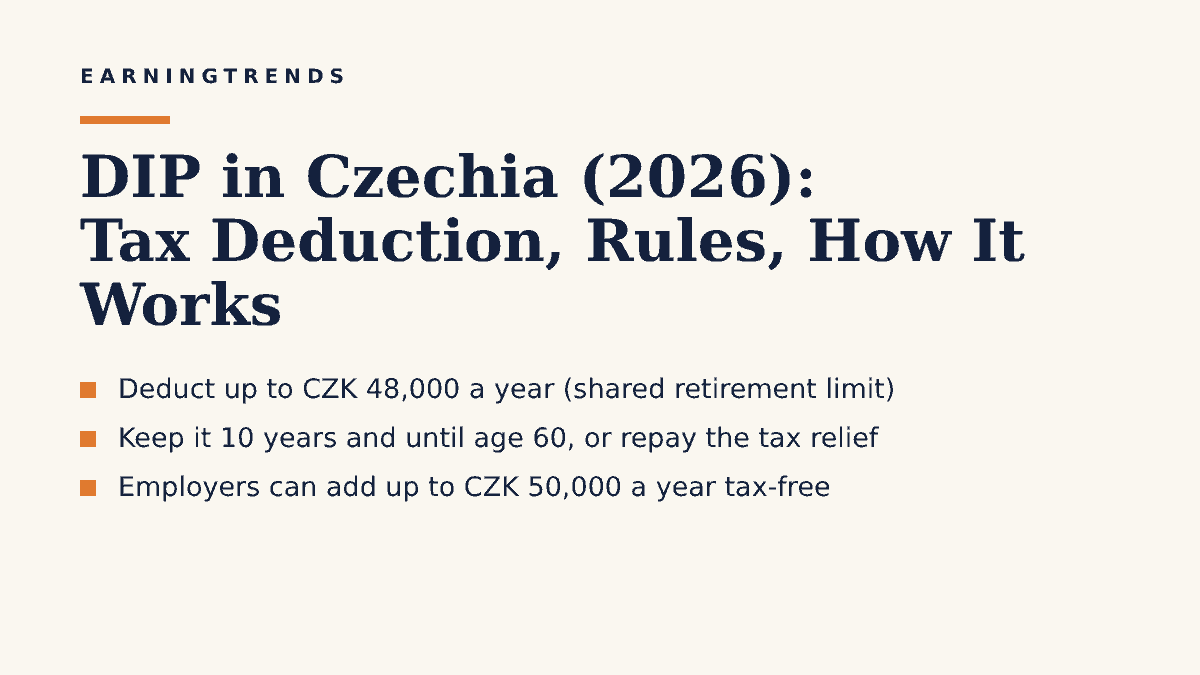
If you pay income tax in Czechia and want to invest for the long term, the DIP (dlouhodobý investiční produkt, or long-term investment product) is one of the most useful tools available in 2026. It lets you deduct up to CZK 48,000 a year from your tax base, and you choose what goes inside: ETFs, shares, bonds, funds or even cash. In return, you agree not to withdraw anything until the DIP is at least 10 years old and you are at least 60. This guide explains how it works, what you can really save, and the mistakes to avoid.
What is a DIP?
The DIP has been available since 1 January 2024. According to the Czech Ministry of Finance, it is not a single fund or product. It is an umbrella label for investment or savings services that support saving for old age and can qualify for tax support. A DIP is created by a contract between you and a provider. An existing brokerage or savings account does not turn into a DIP automatically.
Only these providers can offer a DIP:
- banks and credit unions (spořitelní a úvěrní družstva)
- securities dealers (brokers)
- investment companies and self-managed investment funds
- similar foreign firms authorised to provide services in Czechia
Every provider must be registered on the list of DIP providers kept by the Czech National Bank (ČNB). Check that list before you sign anything.
The DIP has grown fast. Data from the Czech Capital Market Association (AKAT), reported by Seznam Zprávy, show that 218,740 people had put money into a DIP after its first two years.
What can you hold inside a DIP?
The Ministry of Finance lists the allowed assets:
- cash, such as a savings account or term deposit
- shares and bonds traded on a stock exchange, including foreign ones, plus government or covered bonds (such as mortgage bonds) from EU countries
- units of investment funds, which in practice includes many ETFs
- derivatives, but only to hedge currency or interest-rate risk
What you can actually buy depends on your provider. Some offer ready-made portfolios that rebalance automatically. Others are brokerage accounts where you choose and buy each ETF or share yourself.
The tax deduction: how much you can save
You can deduct your own contributions from your tax base, up to CZK 48,000 per year. The key detail is that this limit is shared. It covers all tax-supported retirement products together: supplementary pension savings (DPS, the “penzijko”), older pension insurance, qualifying private life insurance, long-term care insurance and the DIP. You decide how to split the CZK 48,000 between them.
There is one important difference. In pension savings (DPS), only the part of your contribution above CZK 1,700 a month can be deducted, because the lower part earns the state contribution instead. In a DIP, every crown you put in counts towards the deduction.
The deduction reduces your tax base, not your tax bill directly. Your actual saving therefore depends on your tax rate:
| Yearly DIP contributions | Saving at 15% rate | Saving at 23% rate |
|---|---|---|
| CZK 12,000 (CZK 1,000/month) | CZK 1,800 | CZK 2,760 |
| CZK 24,000 (CZK 2,000/month) | CZK 3,600 | CZK 5,520 |
| CZK 48,000 (CZK 4,000/month) | CZK 7,200 | CZK 11,040 |
In 2026 the 23% rate only applies to the part of your tax base above 36 times the average wage, which is CZK 1,762,812 a year. Most people will save at 15%. Your saving also cannot be larger than the income tax you would otherwise pay for the year.
Employer contributions: up to CZK 50,000 tax-free
Your employer can also pay into your DIP. Employer contributions to tax-supported retirement products are exempt from income tax up to CZK 50,000 a year in total. This is a separate limit from your own CZK 48,000 deduction. It is also shared across all your supported products, so employer payments into your pension savings and your DIP count together. By law, your employer must not influence which DIP provider you choose.
The two conditions: 10 years and age 60
To keep the tax relief, you must not withdraw money from the DIP before both of these are true:
- the DIP has existed for at least 10 years (120 months), and
- you have reached age 60.
If you break this rule, even by withdrawing a single crown, you lose the tax advantage. You must pay back the tax you saved, going back up to 10 years. One exception: moving all assets from a closed DIP into another DIP does not count as a withdrawal, so you can switch providers.
The lock-in also covers money you put in above the deduction limit. If you deposit CZK 100,000 in one year, only the first CZK 48,000 (shared limit) gets tax support, but the withdrawal rules apply to the whole amount.
Tax on gains inside a DIP
A DIP is not a tax-free wrapper for gains like some accounts elsewhere in Europe. Its main benefit is the deduction on what you pay in. Dividends, interest and sale proceeds must stay inside the DIP. Normal Czech rules still apply when you sell. A gain is generally exempt if you held the security for more than 3 years, or if your total sale proceeds stay within the CZK 100,000 annual limit. If tax is due, the Ministry of Finance says you must pay it from money outside the DIP. Paying it from inside the DIP would count as a withdrawal.
For comparison, Sweden’s ISK account and Hungary’s TBSZ account work very differently. Both focus on how gains are taxed rather than on a deduction for contributions.
How to open a DIP and claim the deduction
- Check your other products. Add up what you already deduct for pension savings or life insurance, so you know how much of the CZK 48,000 limit is left for the DIP.
- Pick a registered provider. Confirm it appears on the ČNB list. Compare the total costs: management fees, transaction fees, currency conversion charges and any entry fees.
- Sign a DIP contract. Make sure the contract explicitly says it is a DIP (smlouva o dlouhodobém investičním produktu), not an ordinary investment account.
- Pay in by 31 December. Contributions count for the calendar year in which you pay them.
- Claim the deduction. Your provider issues a yearly certificate of your contributions. Use it in your tax return, or give it to your employer for the annual tax reconciliation if you are an employee.
Who the DIP suits, and who it doesn’t
Good fit: employees and self-employed people with Czech taxable income who already invest for the long term and won’t need the money before 60. Many people combine both products. They put CZK 1,700 a month into pension savings to get the maximum state contribution, and send anything above that to a DIP, where the whole amount counts for the deduction.
Weaker fit:
- Self-employed people in the flat-tax regime (paušální daň). You file no tax return in that regime, so you cannot claim the deduction. If you’re weighing that regime, see our guide to gig work and trade licences in Czechia.
- People leaving Czechia. A non-resident with little or no Czech taxable income has nothing to deduct against.
- Anyone without an emergency fund. Money in a DIP is effectively locked until 60.
What changes in 2027?
A pension savings reform called “Lepší penzijko” was approved by the government on 24 August 2026 and passed its first reading in the Chamber of Deputies on 24 September 2026. It is proposed to take effect on 1 January 2027. As drafted, it changes pension savings (DPS) but not the DIP. MPs have also proposed raising the shared deduction limit from CZK 48,000 to CZK 60,000. None of this is law yet, so plan with the current rules.
Common mistakes
- Assuming the DIP has its own CZK 48,000 limit. Some websites say it does, but the Ministry of Finance is clear: the limit is shared with pension savings and life insurance.
- Making a small withdrawal “just once”. Any withdrawal before both conditions are met cancels the tax relief, going back up to 10 years.
- Paying tax on a sale from inside the DIP. If you owe tax on a sale, pay it from your normal account.
- Ignoring fees. The ČNB warns that prepaid (upfront) fees can noticeably reduce long-term returns, even when they look cheaper overall. Over 20–30 years, costs matter more than the yearly tax saving.
- Paying in after 31 December. A January payment counts for the new tax year, not the previous one.
FAQ
Can I have more than one DIP?
Yes. There is no limit on how many DIPs one person can have, but the CZK 48,000 deduction limit applies to all of them together.
Does the state add money to a DIP?
No. Unlike pension savings, a DIP gets no state contribution. Its benefits are the tax deduction and tax-free employer contributions.
Can I move my DIP to another provider?
Yes. Transferring all assets from a closed DIP into a new DIP is not treated as a withdrawal. Check your current provider’s transfer or exit fees first.
Is my money guaranteed?
Not if you invest it. The value of ETFs, shares and bonds can fall. Cash held at a bank is protected under Czech deposit insurance rules, within their limits.
Conclusion
For long-term investors with Czech taxable income, the DIP is a simple way to get money back on investing they might do anyway. You can save up to CZK 7,200 a year at the 15% rate, and your employer can add up to CZK 50,000 tax-free on top. The price is a strict lock-in until 10 years have passed and you are 60, so only commit money you won’t need sooner. Choose a low-cost, ČNB-registered provider and keep track of the shared CZK 48,000 limit. This article is general information, not financial or tax advice. Your situation may differ, so check with a qualified tax advisor in Czechia before deciding. For more ideas, see our overview of dividend stocks as a passive income strategy.
Sources
- Ministry of Finance of the Czech Republic – DIP and tax support for retirement savings products
- Czech National Bank – registers incl. list of DIP providers
- Finance.cz – 2026 average wage and the 23% tax threshold
- Seznam Zprávy – DIP comparison and AKAT participant data
- FakturaOnline – Pension savings or DIP in 2027 (reform status, flat-tax regime)
- Peníze.cz – Proposed amendments, including a CZK 60,000 limit