Ireland State Savings 2026: Rates, Prize Bonds and Who They Suit
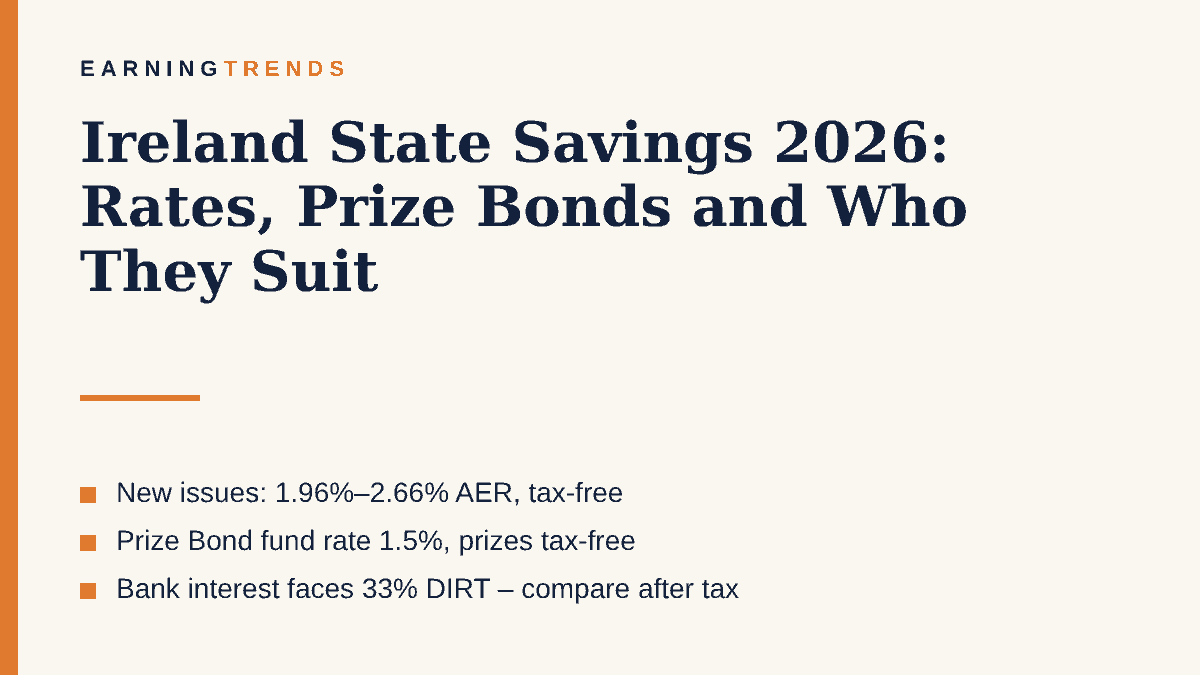
Ireland State Savings are savings products sold by the National Treasury Management Agency (NTMA) on behalf of the State. In August 2026 the NTMA raised rates for the first time in about three years: new fixed-term issues now pay between 1.96% and 2.66% AER, the returns are tax-free, and your capital is 100% State protected. They will not make you rich, but for low-risk money that you can leave alone for a few years, they are a simple option worth comparing with taxed bank deposits.
What changed in 2026
On 17 August 2026 the NTMA announced higher rates for new issues of its fixed-term products and for Post Office Savings Bank (POSB) deposit accounts, effective 30 August 2026. The Prize Bond fund rate followed on 1 September 2026. According to the Irish Times, it was the first increase since October 2023, and the State held about €23.9 billion in savings products at the end of June 2026.
The new rates only apply to new money placed in the current issues. If you already hold an older issue, it keeps the rate that applied when you bought it.
Current State Savings products and rates
These are the headline figures published on statesavings.ie for the issues on sale after the August 2026 change. Rates can change again, so check the official site before you invest.
| Product | Term | Total return at maturity | AER | Minimum | Maximum per person per issue |
|---|---|---|---|---|---|
| Savings Bonds (Issue 19) | 3 years | 6% | 1.96% | €50 | €120,000 |
| Savings Certificates (Issue 26) | 5 years | 12% | 2.29% | €50 | €120,000 |
| Instalment Savings (Issue 18) | 6 years | 13.5% | 2.33% | €25 per month | €1,000 per month |
| National Solidarity Bonds (Issue 10) | 10 years | 30% | 2.66% | €50 | €120,000 |
| Prize Bonds | Ongoing | Prize fund rate 1.5% | n/a | €25 (4 bonds) | €250,000 |
| POSB deposit account | Ongoing | Variable | 1.25% | Check product page | Check product page |
All of the fixed-term products above are described by the NTMA as tax-free, with no fees, charges or commissions.
How the fixed-term products work
3-year Savings Bonds
You invest a lump sum from €50. If you hold the bond for the full three years, €1,000 grows to €1,060. Cash in after two years and the published table shows €1,030; in the first year you get your money back but no interest.
5-year Savings Certificates
Same idea over five years. €1,000 becomes €1,120 at maturity. The interest is back-loaded: nothing in year one, €1,020 after two years, €1,032.50 after three and €1,060 after four. Most of the return arrives in the final year.
10-year National Solidarity Bonds
The longest product and the highest rate. €1,000 grows to €1,300 after ten years. Again the return is heavily weighted to the end: after five years the value is €1,060, after eight years €1,150, and the big jump comes in years nine and ten.
6-year Instalment Savings
You save a fixed amount each month, between €25 and €1,000, for 12 months. The total is then held for a further five years. Per €1,000 saved, the published value at the end of year six is €1,135. The AER assumes an average term of about five and a half years, because each monthly payment is held for a slightly different length of time.
Can you get your money out early?
Yes. The product pages state that you can cash in early and still receive your original savings back in full, plus any interest due for the time held. But because interest is back-loaded, an early exit costs you most of the return. Treat these as money you genuinely will not need before maturity.
Prize Bonds: savings or a lottery?
Prize Bonds pay no interest. Instead, the NTMA calculates a prize fund at a variable rate (1.5% from 1 September 2026) and pays it out as prizes in weekly draws. From the 2026 change, the weekly top prize doubled to €100,000, the monthly top prize stayed at €500,000, and the number of €1,000 weekly prizes increased. All prizes are tax-free.
You can start with €25 (four bonds) and hold up to €250,000. Repayment is possible any time after 90 days, and your capital is protected.
The trade-off is simple. The 1.5% is not your return; it is the size of the prize pool spread across all bondholders. Many holders will win nothing in a given year. If you want a predictable return, the fixed-term products are more suitable. If you like the chance of a large tax-free prize and accept that your money may earn nothing, Prize Bonds can make sense for a small part of your savings.
How State Savings compare with bank deposits
The key difference is tax. Interest on ordinary deposit accounts held by Irish-resident individuals is subject to Deposit Interest Retention Tax (DIRT), which Revenue currently lists at 33%. State Savings fixed-term products are tax-free, so their AER is what you keep.
That means a bank deposit needs a noticeably higher headline rate to beat a State Savings product after tax. As a rough illustration, a deposit paying 3% gross leaves about 2% after 33% DIRT. Bank rates change often, so compare the after-tax rate on the day you decide, for the same term. The POSB deposit account is the exception within State Savings: its interest is subject to DIRT.
For a wider look at savings options and how they fit with other income ideas, see our guide to high-yield savings accounts and certificates of deposit.
Who State Savings suit, and who they do not
They suit you if:
- You want a guaranteed, State-protected return with no market risk.
- You are a higher earner who would otherwise lose a third of deposit interest to DIRT.
- You are building a medium-term fund, for example a house deposit five or more years away, and will not touch it.
- You want a simple monthly savings habit (Instalment Savings).
They may not suit you if:
- You might need the money within a year or two, because early encashment gives up most of the interest.
- Your goal is long-term growth over 15+ years. Low-risk products have historically struggled to keep pace with inflation over long periods, and many people use a mix of savings and diversified investments for long horizons. Our overview of dividend stocks explains one higher-risk alternative.
Note also that Budget 2027 announced a new tax-advantaged personal investment account, with a target start date of 1 July 2027, and a cut in the exit tax rate on funds and life assurance products from 38% to 35% from 1 January 2027. Details still depend on the Finance Bill, so watch for the final rules if you are deciding between saving and investing.
How to buy State Savings
- Get a State Savings Customer Number (SSCN). All products require one before purchase.
- Choose the product and issue on statesavings.ie.
- Buy online through Ireland State Savings Online, at a Post Office, by phone or by post, depending on the product. Prize Bonds can also be bought by monthly Direct Debit, and Instalment Savings are paid monthly; check each product page for the current ways to apply.
- Keep your confirmation and note the maturity date. Repayments go to your nominated bank account.
Common mistakes
- Cashing in early. Interest is weighted towards the end, so breaking a 10-year bond after five years leaves only 6% total.
- Comparing gross bank rates with tax-free AER. Always compare after DIRT.
- Treating Prize Bonds as interest. The 1.5% prize fund rate is not a guaranteed return for you.
- Ignoring the per-issue limit. The €120,000 cap applies per person per issue.
- Locking away emergency money. Keep an accessible buffer before committing to a five or ten-year product.
This article is general information, not financial or tax advice. Check with a qualified financial advisor in Ireland about your own situation.
FAQ
Are State Savings tax-free?
The 3-year Savings Bonds, 5-year Savings Certificates, 6-year Instalment Savings and 10-year National Solidarity Bonds are described as tax-free, and Prize Bond prizes are tax-free. POSB deposit accounts are subject to DIRT.
Is my money safe?
The NTMA describes the products as 100% State protected, because they are backed by the Irish State.
Does the 2026 rate rise apply to bonds I already own?
No. New rates apply to new issues bought from 30 August 2026. Existing holdings keep their original terms.
What is the best product for a five-year goal?
The 5-year Savings Certificates are designed for that horizon. Which one is best for you depends on when you need the money and how current bank rates compare after tax.
Conclusion
The 2026 increase makes Ireland State Savings more competitive, especially for savers who pay 33% DIRT on bank interest. Choose a term you can commit to, keep an emergency fund elsewhere, and see Prize Bonds as a small, optional bet rather than income. If you want to compare with another government savings scheme in Europe, read our guide to Polish Treasury Bonds 2026.
Sources
- NTMA: NTMA to increase Ireland State Savings rates (17 August 2026)
- Ireland State Savings: products and current rates
- State Savings: Prize Bonds
- Revenue: What DIRT rate is applicable?
- Irish Times: State savings rates increased for first time in three years
- Maples Group: Irish Budget 2027 – implications for investors