Selling Second-Hand in the Netherlands (2026): Fees and Tax
Selling your own used clothes, books or furniture on Marktplaats or Vinted in the Netherlands is usually free for the seller and usually tax-free. Tax only comes into play when selling becomes a way to make a profit, for example buying items to resell. Platforms do report sellers above certain limits to the Belastingdienst under the EU’s DAC7 rules, but a report does not mean you owe tax. Here is how fees, reporting and tax work in 2026, and where the line sits between clearing out your home and running a side business.
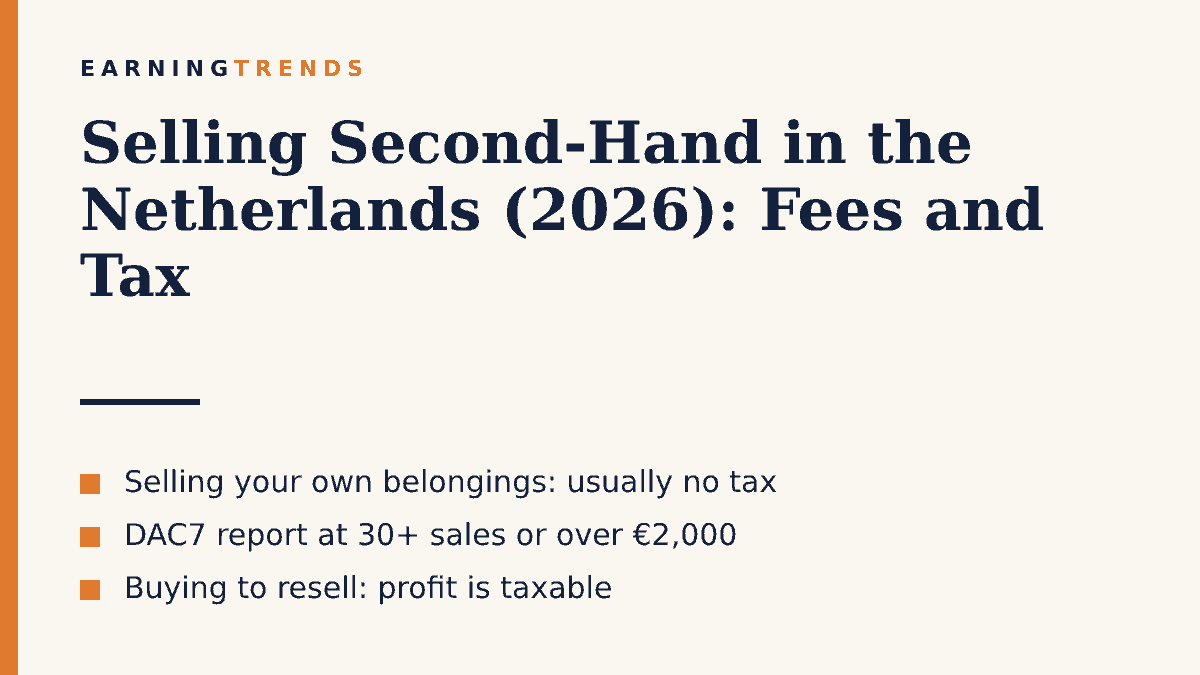
Where to sell second-hand in the Netherlands
| Platform | Best for | Cost to a private seller | Payment and shipping |
|---|---|---|---|
| Marktplaats | Almost everything, especially furniture, bikes, electronics and local pick-up | Listing is free in most categories; some categories and visibility boosts are paid | Optional Kopersbescherming (buyer protection) and “Verzenden via Marktplaats” with PostNL, DHL or Brenger; the buyer pays the protection fee |
| Vinted | Clothing, shoes, accessories, kids’ items, books, small home items | No selling fee for private sellers; the buyer pays a buyer protection fee | Prepaid shipping labels; payment held until the buyer confirms |
| Facebook Marketplace | Local sales and bulky items | Free to list when the sale happens off-platform | Usually cash or bank transfer on collection |
Marktplaats is the long-standing Dutch classifieds site and the default choice for anything big or local. Vinted is built for parcels and fashion and handles payment and labels for you. Many sellers use both: Vinted for clothes, Marktplaats for everything else.
What it costs to sell
Marktplaats
Placing a standard ad is free in most categories. Some categories, such as jobs, services and property, use paid ads, and you can pay for extra visibility like top placement. These options are optional, so check the price before you confirm. If you use Kopersbescherming, the buyer’s money is held by the payment partner Online Payment Platform (OPP) until the item is received, and the protection fee is paid by the buyer, not by you. The buyer has 48 hours after delivery to report a problem; otherwise you are paid automatically.
Vinted
Private sellers on Vinted do not pay a commission or listing fee. The buyer pays the item price plus Vinted’s buyer protection fee and shipping. You ship within the deadline shown in the app, and your money is released once the order is completed. Vinted offers an optional item verification service for some higher-value items; the extra cost of that service is also paid by the buyer.
Do you pay tax on what you sell?
Selling your own belongings: usually no tax
The Belastingdienst is clear that if you sell or rent out items as a hobby or in a private capacity, you usually do not pay income tax on it. Its examples include selling your family’s clothes on Vinted, old comics on Marktplaats, or your furniture before a move. In most of these cases you sell for less than you paid, so there is no profit anyway.
Buying to resell: taxable from the first euro of profit
The picture changes when you buy items in order to sell them at a profit, or when you offer paid services or regularly rent things out through a platform. The Belastingdienst then treats the activity as a “bron van inkomen” (source of income) and you pay income tax on the profit, with no minimum amount. Its own example: someone who buys vintage clothing at thrift shops for €1,000 a year and sells it for €2,100 has a source of income. Costs such as packaging and shipping are deductible.
DAC7 reporting: a report is not a tax bill
Under the EU directive DAC7, platforms must collect details such as your BSN and pass them to the Belastingdienst once you make 30 or more sales or sell for more than €2,000 in a calendar year. For rentals and services through a platform there is no lower limit. The Belastingdienst stresses that being reported does not automatically mean you owe tax: DAC7 changed reporting, not the tax rules.
| Situation | Reported under DAC7? | Income tax? |
|---|---|---|
| Clearing out your wardrobe, under 30 sales and €2,000 | No | No |
| Big clear-out, 40 sales of your own items | Yes | Usually no, if they are personal belongings sold at a loss |
| Buying thrift items to resell at a profit | Depends on volume | Yes, on the profit |
| Offering paid services through a platform | Yes, no lower limit | Usually yes |
When it becomes a business: KVK and VAT
If reselling turns into a real side business, two more questions come up.
- KVK registration. The Chamber of Commerce (KVK) has its own criteria for when you must register in the Handelsregister. They differ from the tax criteria, so you can owe income tax without having to register, or the other way round. The KVK website has a short check you can use.
- VAT (btw). As a business you are in principle VAT-liable. If your turnover stays at or below €20,000 a year, you can apply for the kleineondernemersregeling (KOR), which means you do not charge VAT and do not file regular VAT returns, but also cannot reclaim VAT on purchases. You apply through Mijn Belastingdienst Zakelijk, at least four weeks before you want it to start.
Step by step: selling safely and keeping it simple
- Decide what you are doing. Clearing out your own things and buying stock to resell are treated very differently.
- Pick the right platform for each item: Vinted for clothes and small parcels, Marktplaats for bulky or local items.
- Use the in-app payment and shipping where possible. Do not move to bank transfers or links sent by strangers, a common route for scams.
- Take clear photos and describe flaws honestly. Most disputes come from “not as described” claims.
- Keep simple records: what you sold, for how much, and, if you resell, what you paid. This makes a DAC7 report easy to explain.
- Review once a year. If you regularly buy to resell, treat it as income in your tax return and check the KVK and KOR rules.
Common mistakes
- Assuming a DAC7 notice means a tax bill. It does not; check whether you actually have a source of income.
- Assuming small amounts are always tax-free. If you buy to resell, there is no minimum profit before tax applies.
- Leaving the platform to pay. Off-platform payment removes buyer and seller protection.
- Not keeping receipts for stock. If you resell, you can only deduct costs you can show.
- Mixing personal sales and reselling in one account without records. It makes it hard to show which sales were private.
FAQ
Does Vinted charge sellers in the Netherlands?
Private sellers do not pay a selling fee. The buyer pays the buyer protection fee and shipping.
Is Marktplaats free?
Standard ads are free in most categories. Some categories and optional visibility features are paid, and buyers pay for Kopersbescherming if it is used.
I got a DAC7 message from Marktplaats or Vinted. What now?
Nothing changes automatically. If you were only selling your own belongings, you usually owe no income tax. If you bought items to resell, declare the profit in your income tax return.
Can I use the KOR for my Vinted side business?
If your activity is a business for VAT purposes and your turnover is no more than €20,000 a year, you can apply for the KOR. Check the conditions on the Belastingdienst website or with an adviser first.
Conclusion
For most people in the Netherlands, selling second-hand online is simple: free to list, protected payments and no tax on your own used belongings. The line to watch is buying to resell, which turns profit into taxable income from the first euro. Keep basic records, stay on the platforms’ payment systems and treat a DAC7 notice as a prompt to check, not a bill. Selling across borders? Compare the rules in our guides to selling second-hand in Belgium and selling second-hand in Germany.
This is general information, not tax advice. If you resell regularly, check with the Belastingdienst or a qualified tax adviser in the Netherlands.