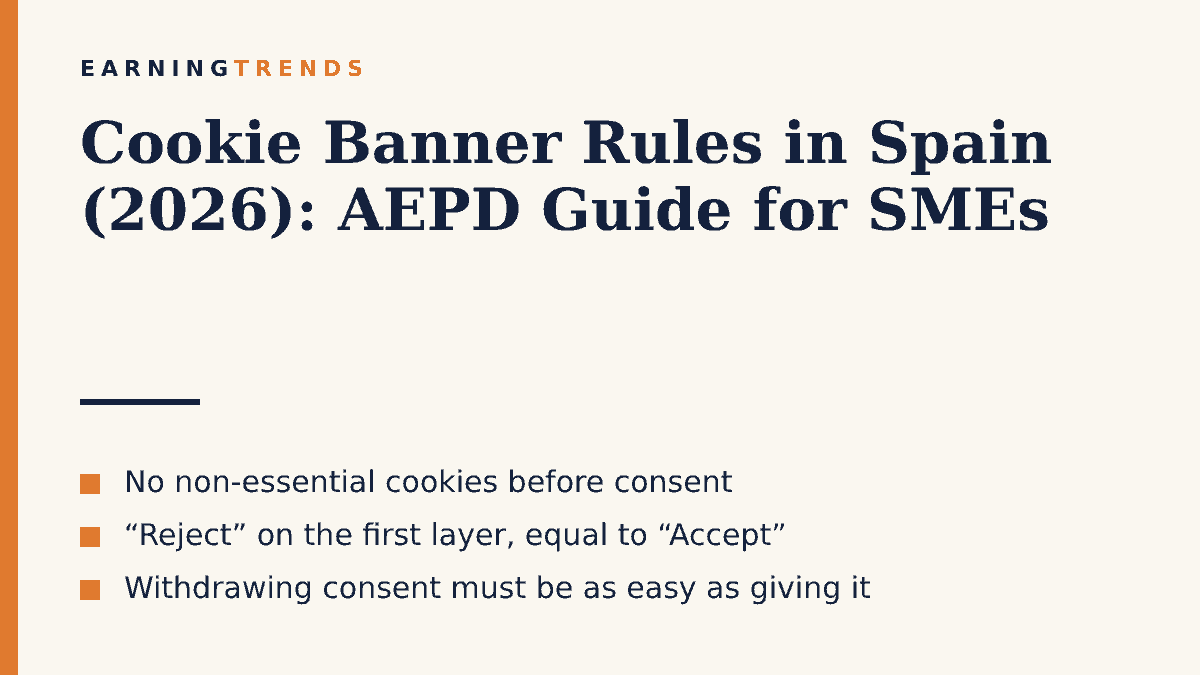
Cookie Banner Rules in Spain (2026): AEPD Guide for SMEs
If your website or online shop has visitors in Spain, your cookie banner must follow the Spanish data protection authority (AEPD) and its cookie guide. The short version: no non-essential cookies before consent, a “Reject” button on the first layer that is as easy to use as “Accept”, clear information about what each cookie does, and a simple way to change your mind later. This guide explains what that means in practice for small businesses in 2026, what the fines look like and how to check your own site.
The rules behind cookie banners in Spain
Three layers of law apply:
- Article 22.2 of the LSSI (Ley 34/2002 on information society services and e-commerce). This is Spain’s version of the EU ePrivacy rule: storing or reading information on a user’s device requires clear information and the user’s consent, unless the cookie is strictly necessary.
- The GDPR and Spain’s LOPDGDD, which apply whenever cookies process personal data and set the standard for what valid consent looks like.
- The AEPD’s “Guía sobre el uso de las cookies”, updated in July 2023 to follow the European Data Protection Board’s guidelines on deceptive design patterns. Its new banner criteria had to be in place by 11 January 2024, and the guide was updated again in May 2024.
The AEPD enforces the cookie rules, so its guide is the practical rulebook most Spanish businesses work from.
What a compliant cookie banner must do
1. Block non-essential cookies until the user chooses
Analytics, advertising and most third-party cookies must not load when the page opens. They can only be set after the user accepts. Loading tracking tags first and asking afterwards is one of the most common faults found in AEPD cases.
2. Put “Reject” next to “Accept”
Since January 2024 the AEPD expects the option to reject cookies to be offered in the first layer, in the same place and at the same level as the option to accept. If there is an “Accept” button, there should be a “Reject” button that looks similar. Hiding rejection in a settings panel, using a faint text link, or styling “Accept” much more prominently are treated as deceptive design.
3. Give the key information in the first layer
The first layer of the banner should tell users, briefly:
- who you are (the publisher)
- what the cookies are used for
- whether they are your own or third-party cookies
- whether profiles are built, in general terms, if that applies
- how to accept, configure or reject
- a visible link to the full cookie policy (the second layer)
4. No consent by scrolling or “continuing to browse”
Consent must be an active choice. Pre-ticked boxes, “by continuing you accept” wording and treating silence as consent are not valid.
5. Make withdrawal as easy as consent
Users must be able to withdraw consent at any time, and withdrawing should be as simple as giving consent. In practice that means a permanent link or icon, often in the footer, that reopens the settings.
6. Ask again periodically
The AEPD considers it good practice for consent to last no longer than 24 months before you ask again.
Which cookies need consent?
| Cookie type | Consent needed? | Notes |
|---|---|---|
| Strictly necessary (session, login, security, shopping cart) | No | General information in the cookie policy is still recommended |
| Personalisation chosen by the user (language, font size, contrast) | No | Only when the user picks the setting; not if you personalise on your own initiative |
| Analytics / audience measurement | Usually yes | A narrow exemption exists for strictly limited, first-party, anonymous statistics (see below) |
| Advertising, retargeting, social media pixels | Yes | Typically third-party cookies used for profiling |
The analytics exemption
In January 2024 the AEPD published a separate guide on audience measurement tools. It accepts that some analytics cookies can be exempt from consent, but only under strict conditions: the data must be used only to produce anonymous statistics for the publisher, must not be combined with other processing or passed to third parties, and the publisher has to apply specific safeguards and inform users. Standard set-ups of popular third-party analytics tools usually do not meet these conditions, so most small businesses should treat analytics as consent-based unless they have checked their configuration against the guide.
Cookie walls and “pay or accept”
The AEPD says cookie walls that block access without offering a genuine alternative to consent are not allowed. If you offer an alternative, it must be truly equivalent and provided by you, not by a third party. If you are thinking about a paid “no cookies” option, get specific advice first.
Fines and enforcement
Using cookies without giving the required information or obtaining consent is classed as a minor (“leve”) infringement under Article 38.4(g) of the LSSI, with fines of up to €30,000 under Article 39. Repeated offences can be treated as more serious, with higher fines. Larger brands have been fined: Spain’s National High Court upheld a €30,000 fine against Iberia over its cookie practices in 2024. For a small business the bigger cost is often the time spent responding to a complaint, so fixing the banner early is cheaper.
Step-by-step checklist for small businesses
- List every cookie and tag on your site. Use your browser’s developer tools or a cookie scanner, and include tags loaded through tag managers and plugins.
- Sort them into categories: necessary, preferences, analytics, advertising.
- Choose a consent management platform (CMP) that can block scripts until consent and show equal “Accept” and “Reject” buttons. Check that it is actually configured that way, not just installed.
- Connect your tags to consent. If you use Google Ads or GA4, make sure your consent set-up passes the user’s choice correctly, so tags respect a refusal.
- Write a clear cookie policy in Spanish covering each cookie’s purpose, provider and duration, and link it from the banner.
- Add a permanent “Cookie settings” link in the footer.
- Test in a private window: open the site, click “Reject”, and confirm that no analytics or advertising cookies are set.
- Review every few months and whenever you add a new plugin, pixel or marketing tool.
If you would rather have someone check this for you, our Digital Performance Audit reviews tracking and consent set-ups alongside site performance, and our Analytics & Reporting Setup helps you keep measuring within the consent you have.
Common mistakes
- Tags firing before the banner is answered. The banner looks fine, but analytics already ran.
- “Reject” hidden in a second layer or shown as small grey text while “Accept” is a bright button.
- “Strictly necessary” used as a catch-all. Labelling analytics or advertising cookies as necessary so they cannot be switched off is a known enforcement trigger.
- No way to change your mind after the first visit.
- A copied English-only policy that does not match the cookies your site really uses.
- Forgetting third-party embeds such as video players, maps and chat widgets, which often set their own cookies.
FAQ
Does Spanish cookie law apply if my business is outside Spain?
If you target users in Spain, the EU rules on cookies and the GDPR can apply to you. Your own national regulator may also be involved. The safest approach is to meet the strictest standard you face across your markets.
Can I use one banner for Spain and other EU countries?
Usually yes, if it meets the requirements in all of them. The core rules are similar across the EU, but regulators differ on details such as analytics exemptions. Compare with our guides to cookie banner rules in the Netherlands and cookie banner rules in Greece.
Do I need a cookie banner if I only use necessary cookies?
No consent banner is needed for strictly necessary cookies alone, although the AEPD recommends giving general information about them, for example in your cookie or privacy policy.
How often should I ask for consent again?
The AEPD considers it good practice not to keep consent for longer than 24 months, and you should ask again whenever you add new purposes.
Conclusion
Spain’s cookie rules are not complicated, but they are strictly enforced on the details: block before consent, put “Reject” next to “Accept”, explain clearly and let people change their mind. Most problems come from tags firing too early or a banner designed to steer users into accepting. Audit your site once, fix the set-up, and recheck whenever your marketing stack changes. If email is part of your marketing too, our guide to email marketing rules in Germany shows how strict EU consent rules work in practice.
This article is general information, not legal advice. For your specific set-up, check with a qualified data protection adviser in Spain.
Sources
- AEPD: Guía sobre el uso de las cookies (updated May 2024)
- AEPD: Guide on cookies for audience measurement tools (January 2024)
- BOE: Ley 34/2002 (LSSI), consolidated text
- Cuatrecasas: New AEPD cookie criteria in force (January 2024)
- Hosteltur: National High Court upholds €30,000 cookie fine against Iberia