Email Marketing Rules in Switzerland (2026): UWG Guide for SMEs
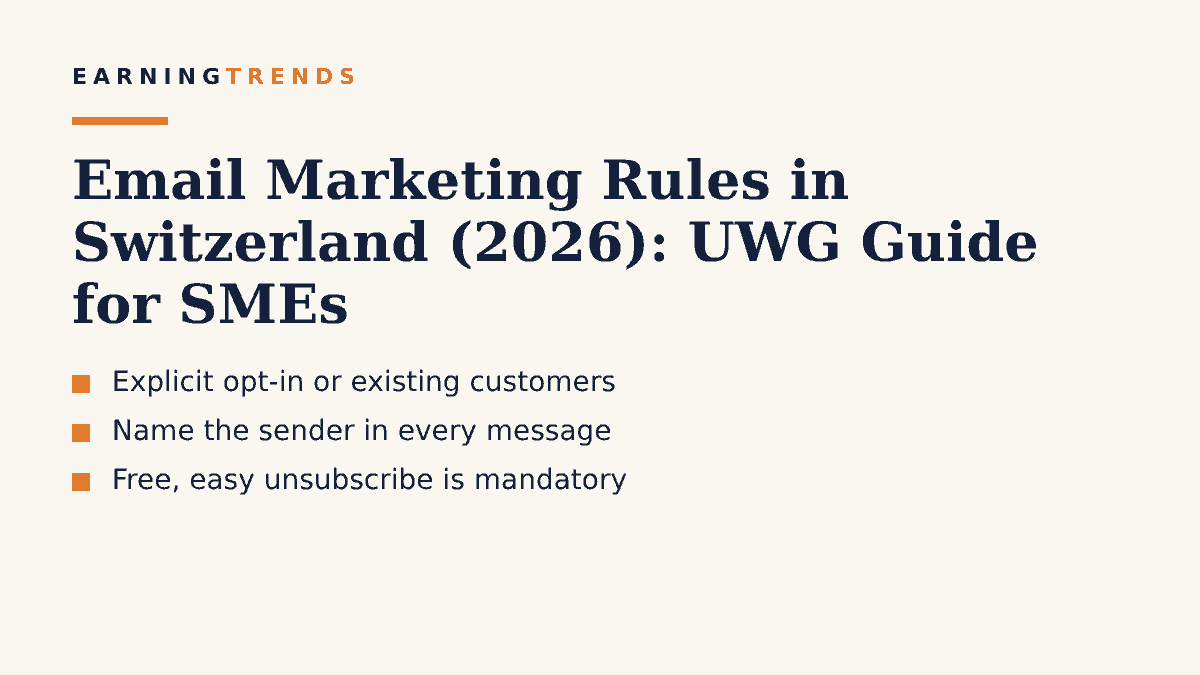
In Switzerland, sending marketing emails or SMS in bulk is only lawful if recipients have given explicit consent, or if they are existing customers receiving offers for your own similar products. Every message must name the sender clearly and include a free, easy way to unsubscribe. The main rule is Article 3(1)(o) of the Federal Act against Unfair Competition (UWG/UCA), backed by the revised Data Protection Act (FADP/nDSG). Here is what that means in practice for a small business.
Which laws apply
- UWG Art. 3(1)(o): the Swiss anti-spam rule, in force since 1 April 2007. It treats automated mass advertising by email, SMS, fax or automated calls as unfair competition unless the conditions below are met.
- UWG Art. 3(1)(u): covers ignoring the “asterisk” (Sterneintrag) in phone directories that marks people who refuse marketing calls.
- Federal Act on Data Protection (FADP), revised version in force since 1 September 2023: email addresses are personal data, so collection and use must be transparent and for a clear purpose.
If you also mail people in the EU, EU rules (GDPR and national ePrivacy laws) apply to those recipients. Our guides to email marketing rules in Germany and the UK’s PECR show how neighbouring markets handle it.
The three conditions every campaign must meet
According to the Federal Office of Communications (OFCOM/BAKOM), mass advertising by telecommunication is allowed only when all of the following apply:
- Consent or an existing customer relationship. Recipients must have explicitly agreed, or have given you their address when buying from you (then you may promote your own similar goods or services).
- Correct sender identification. The sender must be named and must not be hidden or falsified.
- A simple, free opt-out. Every message must offer an easy way to refuse future messages, and you must tell recipients it exists.
Getting consent that holds up
Swiss law does not prescribe a specific consent form, but practitioner guidance (for example from WEKA, a Swiss compliance publisher) sets out what works in practice:
- Ask for marketing consent separately, not hidden inside your terms and conditions.
- Do not use pre-ticked boxes.
- Say what you will send (for example, “monthly newsletter with offers”).
- Keep proof: date, time, source form and the text the person agreed to.
Is double opt-in required?
No Swiss statute requires double opt-in, but it is widely recommended as the safest way to prove consent. A confirmation email also protects you when someone enters another person’s address. If you collect sign-ups from Germany or Austria as well, double opt-in is effectively standard practice there.
The existing customer exception
If a customer gave you their email address during a purchase, you can send them advertising for your own similar products or services without separate consent. Guidance commonly adds two conditions: the customer should have been told about the opt-out when the address was collected, and the relationship should be reasonably recent. This exception does not cover buying lists, sharing addresses with partners or promoting unrelated products.
Allowed vs not allowed
| Situation | Allowed? |
|---|---|
| Newsletter to people who signed up with an unticked checkbox | Yes |
| Offer on similar products to a recent customer, with opt-out | Yes |
| Mailing a purchased or rented email list | No, unless each person consented to receive your advertising |
| Using a pre-ticked box at checkout | Not valid explicit consent |
| Email without a working unsubscribe link | No |
| Sender name or address hidden | No |
| Live sales call by a person to a number without the directory asterisk | Not spam under Art. 3(1)(o), but data protection rules still apply |
| Automated call that plays a recording | No |
What the revised FADP adds
The UWG decides whether you may send advertising. The FADP decides how you handle the addresses. For newsletters, that mainly means:
- A clear privacy notice linked from the sign-up form, explaining what you collect, why, and who processes it (including your email platform).
- Purpose limitation: addresses collected for order updates should not quietly be reused for marketing without meeting the UWG rules.
- Checking your providers: make sure your email service does not reuse or sell your list, and know where it stores data.
- Honest information: under Art. 60 FADP, private persons who wilfully give false or incomplete information when meeting their information duties can be fined up to CHF 250,000, on complaint.
What happens if you break the rules
Wilful violations of Art. 3 UWG are a criminal offence on complaint. Art. 23 UWG allows a custodial sentence of up to three years or a monetary penalty, and OFCOM states that the maximum fine can reach CHF 1,080,000. Recipients can also report spam to their provider (every Swiss provider must run a spam reporting centre), sue for an injunction and damages, or file a complaint with the cantonal police. In practice, small senders are more likely to face complaints, blocked sending domains and reputational damage than prison, but the legal risk is real.
A practical setup checklist for SMEs
- Add a separate, unticked marketing checkbox to sign-up and checkout forms.
- Turn on double opt-in in your email tool and store the confirmation logs.
- Tag contacts by source: “newsletter consent” vs “customer – similar products”.
- Put your company name, postal address and contact email in every footer.
- Add a one-click unsubscribe link that does not require a login, and process opt-outs promptly.
- Link an up-to-date privacy notice that names your email provider.
- Segment EU recipients and apply EU rules to them.
- Review the list once a year and remove long-inactive “existing customers”.
If you are unsure whether your forms, tracking and reporting are set up correctly, our Digital Performance Audit reviews your website and marketing funnel, and the Analytics & Reporting Setup helps you measure email results properly.
Common mistakes
- Treating every contact as a customer. A quote request or a trade-fair business card is not a purchase.
- Promoting unrelated products under the customer exception. It only covers your own similar offers.
- Unsubscribe links that require a login or send another promotional email as the “confirmation”.
- Assuming B2B is exempt. The wording of Art. 3(1)(o) does not distinguish between consumers and business recipients.
- No records of consent. If challenged, you must be able to show when and how someone agreed.
- Forgetting EU recipients on a Swiss list.
FAQ
Is there a minimum number of emails that counts as “mass” advertising?
No. OFCOM says there is no numeric threshold; courts decide case by case. Treat any automated marketing send as covered.
Do the rules apply to SMS and WhatsApp?
Art. 3(1)(o) covers mass advertising by telecommunication, which explicitly includes SMS. Apply the same consent, sender and opt-out rules to messaging apps used for marketing.
Do I need to re-collect consent I already have?
Not if the consent was valid and you still send the same kind of content for the same purpose. You do need to be able to prove it.
Does this apply to political or charity mailings?
OFCOM notes the UWG applies to commercial competition, so political or religious messages are generally outside it, but it recommends following the same rules. Data protection law still applies.
Conclusion
Swiss email marketing is simple to get right: explicit opt-in (or a genuine existing customer and similar products), a clearly named sender and a free unsubscribe in every message, plus a transparent privacy notice under the FADP. Build these into your forms and email tool once and every campaign inherits them.
This article is general information, not legal advice. For specific cases, check with a qualified Swiss lawyer.