Food Delivery Work in Austria (2026): Foodora, Wolt, Lieferando
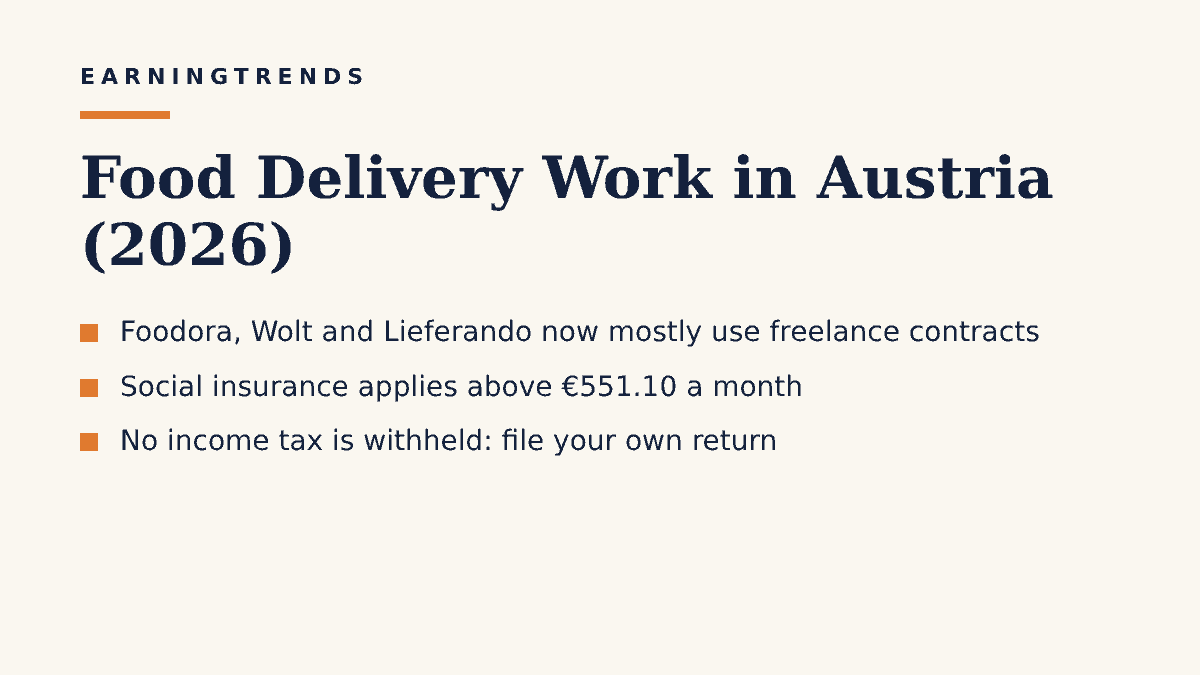
Food delivery in Austria is open to anyone over 18 with a bike or vehicle, a smartphone and the right to work in the country. The three big apps are Foodora, Wolt and Lieferando, and since spring 2025 most riders work as freie Dienstnehmer (freelance service contractors) rather than employees. Foodora advertises average freelance earnings of around €14 an hour in Vienna, but your real income depends on demand, distance, tips and what you pay in tax and social insurance.
Here is how the platforms compare in 2026, what the contracts mean for you, and what to know about tax and insurance.
The three main apps in 2026
Foodora
Foodora is the market leader in Austria. Its rider page offers two models. On the free contract, you choose your own hours and are paid per order plus a mileage allowance. Foodora says riders earn “on average 13,96€ per hour” and “up to 20€ per hour” when busy, plus tips. It also offers a fixed contract of 10 to 40 hours a week at €10–12 an hour regardless of order volume, with 13th and 14th salaries and paid holiday. Riders need a bike or e-bike; Foodora mentions bike rental through a partner, with €40 a month sponsored.
Wolt
Wolt’s Austrian courier FAQ says each order has individual pricing based on distance, order type, weather and possible bonuses, and you see the amount before accepting. Payment is monthly, on the 15th of the following month. Wolt works with freelancers (freie Dienstnehmer) and self-employed partners, and you can deliver by bicycle, scooter, motorbike or car. Wolt operates in Vienna, Salzburg, Graz, Linz, Villach and Klagenfurt. A one-time €100 deposit is deducted from your gross earnings when your account goes live.
Lieferando
Lieferando used to employ most of its Austrian riders under the bike-courier collective agreement. In March 2025 it announced a switch to freelance contracts. ORF reported that Lieferando expected to dismiss around 600 riders, while other reports put the number of notices at about 850. Lieferando now recruits freelance couriers who must be 18, own a bike or e-bike and have a smartphone with mobile data, according to Salzburg24. It did not publish a base rate per delivery at the time.
| Foodora | Wolt | Lieferando | |
|---|---|---|---|
| Main contract type | Free contract or fixed contract | Freelance or self-employed | Freelance (since 2025) |
| Pay model | Per order + mileage (free); hourly (fixed) | Individual price per order | Per order (rates not published) |
| Published pay figure | Avg. €13.96/h, up to €20/h (free); €10–12/h (fixed) | Shown per order in app | None published |
| Vehicles | Bike / e-bike | Bike, scooter, motorbike, car | Bike / e-bike |
| Payment | Via rider app | Monthly, on the 15th | Not stated |
Figures are the platforms’ own claims, gross, before tax and social insurance. They can change at any time.
What “freier Dienstnehmer” means for you
A freier Dienstvertrag sits between employment and full self-employment. You are flexible and can accept or reject orders, but you lose much of the protection employees have. The Vienna Chamber of Labour (AK) points out that there are no clear statutory pay rules for freie Dienstnehmer. There is no collective-agreement minimum wage, paid holiday or holiday bonus. By contrast, the bike-courier collective agreement had set a full-time gross monthly income of €1,730 for employees since 2023.
What you do keep: sickness benefit through social insurance, insolvency protection, and accident insurance. Wolt says it provides accident insurance for all courier partners. If you use a car or scooter, compulsory motor insurance is your responsibility.
Social insurance and tax in 2026
Social insurance
According to the Austrian Ministry of Finance, freie Dienstverträge are covered by the general social insurance act (ASVG) unless your earnings stay below the marginal-earnings limit (Geringfügigkeitsgrenze) of €551.10 per month in 2026. Above that, the platform withholds your employee share and pays it, together with its own share, to the Austrian Health Insurance Fund (ÖGK). Earnings from several contracts are added together, so two small delivery jobs can push you over the limit and trigger back payments.
Income tax
Platforms do not withhold income tax for freie Dienstnehmer. Wolt says this directly: it deducts social security but not taxes. You must register with the tax office (Finanzamt) and file an income tax return yourself. According to the Austrian Economic Chamber (WKO), the 2026 income tax brackets are:
| Taxable income per year (2026) | Rate |
|---|---|
| Up to €13,539 | 0% |
| €13,539 – €21,992 | 20% |
| €21,992 – €36,458 | 30% |
| €36,458 – €70,365 | 40% |
If you also have a regular job, your delivery income is added to your salary, which can push you into a higher bracket. Keep records of costs such as phone, bike repairs and equipment, since business expenses reduce your taxable income.
VAT
Most riders fall under the small-business VAT exemption (Kleinunternehmerregelung). For 2026 the WKO gives the turnover limit as €55,000. Delivery income alone rarely approaches this.
Tax and insurance outcomes depend on your total income and personal situation. For anything beyond the basics, check with a Steuerberater or the AK.
How to start: step by step
- Check your right to work. Foodora asks for free access to the Austrian labour market; Wolt asks for a work and residence permit where applicable.
- Get your documents ready. Wolt lists a tax number, e-card, registration confirmation (Meldezettel) and a bank account. You also need German or English at about A2 level for Wolt.
- Choose your vehicle. A bike or e-bike works for all three apps in cities. Using a car or scooter is possible on Wolt but adds fuel and insurance costs.
- Apply in the app and complete onboarding. Ask for the equipment you need (thermal bag, jacket, lights).
- Track every hour and order in a simple spreadsheet so you can calculate your real hourly earnings and prepare your tax return.
- Register with the Finanzamt once you start earning, and set money aside for income tax.
What you can realistically earn
Foodora’s published average of €13.96 per hour is a gross figure for its free contract, and busy lunch and dinner peaks pay best. Wolt says demand peaks around 11:00–13:00 and 17:30–21:00. Quiet afternoons, bad weather without bonuses and long waiting times at restaurants pull your hourly rate down. After social insurance, possible income tax and the cost of your bike or vehicle, net earnings will be noticeably lower than the headline figure. Running more than one app at once is common and can reduce idle time, but check each contract for restrictions.
Common mistakes
- Ignoring income tax. No tax is withheld on freelance delivery income. A large bill after your first year is the most common surprise.
- Forgetting the €551.10 limit applies across contracts. Combining apps can make you liable for social insurance contributions afterwards.
- Comparing gross per-hour claims with employee wages. Freelancers get no paid holiday or sick pay from the platform, so a higher hourly rate is not automatically better.
- Underestimating vehicle costs. Bike maintenance, e-bike batteries, fuel and insurance all come out of your pocket.
- Not keeping receipts. Without records, you cannot deduct work expenses.
FAQ
Do I need a trade licence (Gewerbe) to deliver food in Austria?
Not as a freier Dienstnehmer, which is the model Foodora, Wolt and Lieferando mainly use. Wolt also works with self-employed partners, whose obligations differ. Check which contract you are signing.
Can students deliver food in Austria?
Yes, if they are over 18 and have the right to work. Keep earnings in mind if you receive grants or family allowance, as income limits may apply.
Will the EU Platform Work Directive change this?
Possibly. EU countries must transpose the directive by December 2026, and it introduces a presumption of employment in certain cases. See our guide to the EU Platform Work Directive.
Which app pays best?
There is no reliable public comparison. Foodora publishes an average hourly figure, Wolt shows the price of each order before you accept it, and Lieferando has not published rates. Trying two apps for a few weeks and tracking your own numbers is the most accurate test.
Conclusion
Food delivery in Austria is easy to start and flexible, but it is now mostly freelance work. Treat it like a small business: track your hours and costs, understand the €551.10 social insurance limit, and set aside money for income tax. If you want more security, Foodora’s fixed contract is one of the few employee-style options left.
Compare with food delivery work in Poland and gig work in France.
Sources
- Austrian Ministry of Finance (BMF): Social insurance for freie Dienstverträge
- WKO: EPU-Neuerungen 2026 (tax brackets and limits)
- Arbeiterkammer Wien: Freie Dienstnehmer:innen
- Foodora Austria: Become a rider
- Wolt Austria: Courier partner FAQ
- ORF Wien: Lieferando switches to freelance contracts (March 2025)