Selling Second-Hand Online in Italy (2026): Vinted, eBay, Subito
If you want to sell clothes, electronics or household items you no longer use in Italy, the three main options are Vinted, eBay and Subito. In 2026 all three are free for private sellers on most transactions: the buyer pays a protection fee instead. The bigger questions are which platform suits what you sell, how payouts work, and what happens with tax now that platforms report active sellers to the Agenzia delle Entrate under the EU’s DAC7 rules.
This guide compares the platforms and explains the tax position at a high level.
Vinted, eBay and Subito at a glance
| Vinted | eBay.it | Subito (TuttoSubito) | |
|---|---|---|---|
| Best for | Clothing, shoes, accessories, kids’ items | Electronics, collectibles, branded goods, wider audience | Local sales, furniture, bulky items, shipped items |
| Seller fee (private) | No commission | No fees since 1 Sept 2026 (exceptions apply) | No seller commission listed |
| Buyer fee | €0.70 + 5% of price | €0.10 + 2–7% of price | Small % for buyer protection |
| Shipping | Paid by buyer at checkout | Set by seller | Shown before purchase; Poste Italiane, InPost, BRT, UPS |
| Payout | After buyer confirms; bank transfer in ~2–3 working days | Via eBay’s payment system | 3 days after delivery if no issue; PayPal in 1 working day, bank in up to 3 |
Fees are as reported by the sources below at the time of writing; always check the platform’s current terms before you list.
Vinted: best for fashion
Vinted is the go-to app for second-hand clothing in Italy. According to Money.it, sellers pay no commission. The buyer pays a buyer protection fee of €0.70 plus 5% of the item price, so on a €20 item the buyer pays €1.70 on top, plus shipping. Once the buyer confirms receipt, they have two days to report a problem; after that the money goes to your Vinted balance. Transfers to your bank account take on average 2–3 working days.
Optional paid features, such as Boost for individual items and a promoted wardrobe, can increase visibility. They are rarely worth it for low-priced items.
eBay: zero fees for private sellers since September 2026
On 1 September 2026, eBay removed selling fees for private sellers in Italy, as reported by SmartWorld. The cost moved to the buyer as a buyer protection fee of €0.10 per item plus 2% to 7% of the item value, shown in the price before purchase.
There are exceptions. Sellers with more than 150 listings a month, or selling to buyers outside the eurozone or Sweden, may face other commissions. Vehicles, classified ads and some boat categories are excluded. eBay’s strength is its reach: it suits branded electronics, collectibles and items that interest buyers across Europe.
Subito: local buyers and shipped sales
Subito is Italy’s big classifieds site. You can sell for cash on collection, or use TuttoSubito for paid, shipped orders with buyer protection. According to Aranzulla, the protection fee is a small percentage of the price paid entirely by the buyer. After payment, you have six days to hand the parcel to the carrier. Funds are held by Subito and released three days after delivery if the buyer reports no problems (ten days if you ship independently). Money reaches PayPal within one working day or a bank account within three working days.
For cash sales on collection, meet in a public place and avoid requests to pay or be paid outside the platform’s system.
Taxes: when second-hand sales matter to the Agenzia delle Entrate
DAC7 reporting is not a new tax
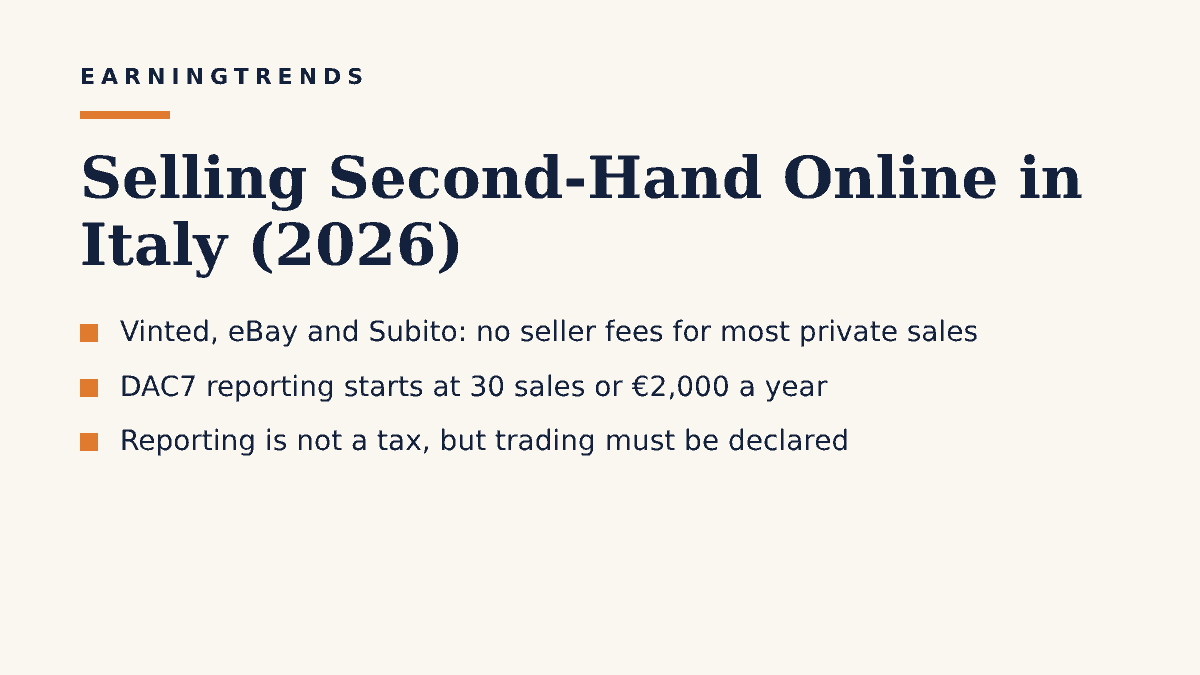
Italy implemented the EU’s DAC7 directive with Legislative Decree 32/2023, in force since 1 January 2023, according to LentePubblica. Platforms such as Vinted, eBay and Subito must report sellers who in a calendar year make 30 or more sales or receive more than €2,000. As Fiscozen explains, the €2,000 is gross receipts, not profit, and the report is “non è una nuova tassa”: it only informs the tax authority about your sales.
If you cross a threshold, the platform will ask for your tax code (codice fiscale) and other details. If you do not respond, the platform can restrict your account until you do. The Agenzia delle Entrate exchanges this information with other EU tax authorities.
Selling your own used items vs trading
Selling your own used belongings usually does not produce a gain, because you typically sell for less than you paid. The line is crossed when you buy items to resell, or sell continuously in an organised way. In that case, the income must be declared, and if the activity is regular you may need a VAT number (partita IVA). There is no single number that defines “regular”: the frequency, organisation and intent to make a profit all matter.
This is general information, not tax advice. If you sell often or buy to resell, check with a commercialista before you scale up.
How to sell well: step by step
- Pick the right platform for the item. Clothing on Vinted, electronics and collectibles on eBay, furniture and bulky goods on Subito.
- Photograph in daylight against a plain background, showing labels, defects and measurements.
- Price by checking sold listings, not asking prices. Buyers see the protection fee on top of your price.
- Ship quickly and with tracking. Use the platform’s integrated labels so you stay covered by buyer and seller protection.
- Keep a simple record of what you sold, for how much and, where you know it, what you originally paid. This helps if the Agenzia ever asks questions after a DAC7 report.
Common mistakes
- Taking payment outside the app. You lose protection, and it is a classic scam pattern.
- Panicking about DAC7. Being reported does not mean you owe tax. It means the Agenzia knows your sales volume.
- Buying stock to resell as a “private” seller. That is a commercial activity and needs to be declared properly.
- Ignoring the 30-sale threshold. Many small items can trigger reporting even if your total receipts are well under €2,000.
- Ignoring the buyer fee when pricing. On eBay and Vinted the buyer’s total is higher than your listed price, which affects how competitive you look.
FAQ
Do I pay tax when I sell my old clothes on Vinted in Italy?
Usually not, if you are selling your own used items without making a profit. Income must be declared if you buy to resell or sell continuously.
What happens if I make more than 30 sales a year?
The platform reports your data to the Agenzia delle Entrate under DAC7. It is a reporting rule, not a tax.
Is selling on eBay really free for private sellers?
Since 1 September 2026, yes, for most categories and sellers. The buyer pays a protection fee. High-volume sellers and some categories are treated differently.
Which platform sells fastest?
It depends on the item. Fashion moves fastest on Vinted; local, bulky items on Subito; and niche or branded goods often find buyers on eBay.
Conclusion
Selling second-hand online in Italy is cheap for sellers in 2026, as buyers carry the protection fees on Vinted, eBay and Subito. Choose the platform by item type, use the built-in shipping and payment, and keep simple records. If your sales grow into a regular activity, get advice on whether you need a partita IVA.
For other countries, see our guides to Wallapop vs Vinted in Spain and selling on Vinted in Poland.
Sources
- Agenzia delle Entrate: DAC7 information exchange press release (Nov 2023)
- LentePubblica: Online second-hand sales and DAC7 obligations
- Fiscozen: DAC7 clarifications from the Agenzia delle Entrate (Oct 2024)
- SmartWorld: eBay removes fees for private sellers (Sept 2026)
- Money.it: How Vinted works
- Aranzulla: How TuttoSubito works