Gig Work in Estonia (2026): Entrepreneur Account and Taxes
Doing gig work in Estonia, such as food delivery, ride-hailing, cleaning, tutoring or small creative jobs, is legal and fairly simple, but the tax setup you choose decides how much you keep. Most people use one of three routes: a natural-person contract where the platform pays your taxes, an entrepreneur account (ettevõtluskonto) at LHV Bank that automatically takes a flat 20%, or registering as a sole proprietor (FIE) or company. This guide explains how each one works in 2026, what it costs and who it suits.
How gig income is taxed in Estonia
The Estonian Tax and Customs Board (EMTA) is clear that money earned through a platform or app is taxable. Active income from your own work, as a courier or driver for example, is subject to all labour taxes (income tax and social tax). Rental income through a platform, such as short-term accommodation, is subject to income tax only.
Who actually pays the tax depends on how you work:
- As a private person without a business form: if the app is run by an Estonian company and pays you directly, the app owner withholds income tax and pays social tax and other contributions on your earnings through its monthly TSD return.
- With an entrepreneur account: LHV Bank holds back the tax from every payment and forwards it to EMTA. You file nothing extra for that income.
- As an FIE or through a private limited company (OÜ): you handle your own taxes, keep records and file returns.
Platform operators also report sellers’ and service providers’ income to EMTA once a year under the EU’s DAC7 rules. You can check what has been reported about you in the “My income” service in e-MTA. That makes undeclared side income easy to spot, so it is worth getting the setup right from day one.
The entrepreneur account: Estonia’s simplest option
The entrepreneur account is a special current account, regulated by the Simplified Business Income Taxation Act and currently available only at LHV Bank. EMTA says it suits people who provide services through platforms (food delivery, ride sharing, translation and similar), babysitters, home tutors, gardeners, people selling crafts they make themselves at low material cost, and people renting out property for short periods.
Tax rate in 2026
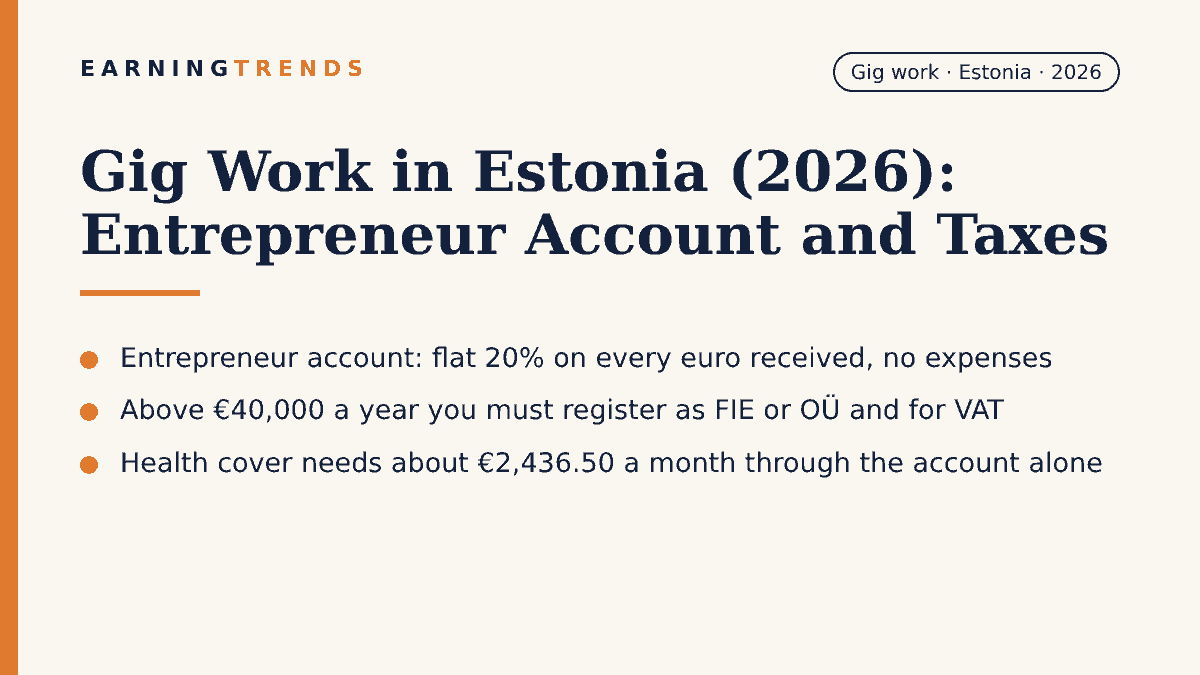
The business income tax is 20% of every euro that lands in the account. If you have joined the funded (second pillar) pension, the rate rises by your chosen contribution: 22% at a 2% contribution, 24% at 4% and 26% at 6%. The old 40% rate on higher amounts no longer applies since 1 January 2025. EMTA splits what the bank collects into income tax, social tax and, where relevant, the pension contribution.
For example, if you receive €1,000 for deliveries in a month and have not joined the funded pension, €200 goes to tax and €800 stays in your account. With a 2% pension contribution, €220 is held back.
Limits and trade-offs
- No expenses: the tax is on gross receipts. You cannot deduct fuel, a bike, a phone or materials, and you cannot use tax incentives such as the basic exemption on this income.
- €40,000 ceiling: if receipts exceed €40,000 in a calendar year, you must register as an FIE or OÜ in the commercial register and as a VAT payer.
- No VAT and no invoices while you stay within the scheme.
- No unemployed status: having an entrepreneur account counts as employment, so you cannot register as unemployed.
- Same-field restriction: LHV states you cannot be VAT-liable or operate as an FIE in the same or a similar area of activity while using the account.
Health insurance through the account
You get state health insurance only if enough social tax is paid for you. In 2026 the minimum social tax liability is €292.38 per month. If the entrepreneur account is your only income and you have not joined the funded pension, EMTA calculates that you need at least €2,436.50 in a calendar month to reach that level. Social tax from a job or a services contract counts towards the minimum too, so many people combine the account with other income. Cover starts the day after the social tax reaches EMTA and lapses after a month if the minimum is not met.
Working for companies
You can sell to both private customers and businesses, but when an Estonian company pays you for a service, the company owes extra income tax at 22/78 on that payment. You must tell the payer you are using an entrepreneur account (it can check in EMTA’s public search). If you don’t, the payer has to treat the fee like a salary and pay full labour taxes. This does not apply to sales of goods. Platforms where a private customer orders the service, such as delivery and ride-hailing apps, do not owe that extra tax.
How to open one
- Become an LHV private customer if you are not one already.
- Log in to LHV internet banking and sign the entrepreneur account agreement.
- Give the new IBAN to your platform or clients and use it only for business receipts. Keep everyday money in a normal account, because anything paid into the entrepreneur account gets taxed.
Opening and closing are free. LHV’s price list shows no management fee for turnover up to €500 a month and €5 a month above that.
Example: delivering with Wolt in Estonia
Wolt’s Estonian courier guide shows how these routes look in practice. You must be at least 18, have a suitable vehicle (car, motorbike, e-bike or bicycle) and pass identity checks. Non-EU applicants need an Estonian-issued residence or work permit valid for the whole partnership. All contract types need an Estonian personal ID code (isikukood). Wolt offers three contracts:
- Natural Person: Wolt pays the statutory taxes, including social tax, and transfers your net earnings twice a month. You can ask Wolt to apply your basic exemption (up to €700 a month).
- LHV Entrepreneur Account: gross earnings go to your entrepreneur account and LHV deducts the tax automatically.
- Company: gross earnings go to your company, which handles its own taxes and VAT.
Wolt does not publish a fixed hourly rate. It says fees depend on the distance to pickup, the delivery distance, order size and real-world conditions such as weather and traffic. It recommends the 11:00–13:00 and 17:00–20:00 peaks. In-app tips go 100% to the courier and are taxable income. LHV also promotes its entrepreneur account to Bolt Food couriers. Check the current terms in each partner app before you sign.
Comparison: which route fits you?
| Route | Tax | Expenses deductible? | Admin | Best for |
|---|---|---|---|---|
| Natural-person contract via platform | Platform withholds income tax and pays social tax | No | Minimal; check your annual return | Occasional gigs with one Estonian platform |
| Entrepreneur account (LHV) | 20% of receipts (22–26% with funded pension) | No | None; tax handled by the bank | Low-cost services, several platforms or private clients, under €40,000 a year |
| Sole proprietor (FIE) | Income tax 22%, social tax 33%, funded pension 2% | Yes | Annual return (form E), quarterly social tax advances | Higher earners or work with real costs (car, equipment) |
| Private limited company (OÜ) | Corporate tax on distributed profit; payroll taxes on salary | Yes | Monthly returns and annual report | Growing businesses, several workers or larger B2B clients |
The key question is your costs. Delivering by bicycle with almost no expenses, the flat 20% is hard to beat. Driving your own car for a ride-hailing app, fuel, insurance and depreciation can eat much of your income, and an FIE that deducts them may come out ahead. EMTA lists FIE social tax advance payments of €877.14 per quarter in 2026, so check whether your income justifies that fixed cost. Other jobs and pension choices change the maths too, so check with an Estonian tax advisor or EMTA before choosing. This article is not tax or legal advice.
If you are comparing countries, we have covered similar schemes elsewhere, such as light entrepreneurship and invoicing services in Finland and the trade licence and flat tax for gig workers in Czechia.
Common mistakes
- Mixing personal money into the entrepreneur account. Every incoming euro is taxed, including a friend paying you back. Refunds for mistaken transfers need a written request to EMTA.
- Ignoring costs. The flat 20% applies to gross receipts, so a car-based gig with high running costs can be taxed more heavily than it first appears.
- Assuming you have health cover. Small monthly amounts through the account do not reach the €292.38 social tax minimum on their own.
- Not telling business clients about the account. If they don’t know, they must tax your fee as employment income, which causes confusion and corrections.
- Crossing €40,000 without registering. Track your yearly total and plan the switch to FIE or OÜ, plus VAT registration, before you reach it.
- Never checking e-MTA. Compare the “My income” data with your own records once a year.
FAQ
Can foreigners use an entrepreneur account in Estonia?
You need to be able to become an LHV customer, and platforms such as Wolt also require an Estonian personal ID code and, for non-EU citizens, an Estonian residence or work permit. Your tax residency matters too, so check your situation with EMTA if you are not an Estonian resident.
Do I need to file a tax return for entrepreneur account income?
No separate filing is needed for that income because LHV pays the tax automatically. You still file your normal annual income tax return (due 30 April) if you have other income to declare, but you cannot claim deductions against the entrepreneur account income.
Can I have a full-time job and an entrepreneur account?
Yes. Many people use it for side income alongside a job. Social tax from your salary also counts towards the health insurance minimum.
Will new EU platform work rules change this?
Member states have to apply the EU Platform Work Directive, which deals with employment status and algorithmic management, not tax rates. See our explainer on the EU Platform Work Directive for gig workers.
Conclusion
Estonia makes gig work unusually easy to start. If your costs are low and your income stays under €40,000 a year, the LHV entrepreneur account handles the tax for you at a flat 20%. If you only work for one platform now and then, its natural-person contract may be enough. Once your expenses or income grow, an FIE or OÜ is usually the better long-term setup. Whichever you choose, keep business money separate, track your yearly total and check your health insurance status.
Sources
- Estonian Tax and Customs Board: Entrepreneur account
- Estonian Tax and Customs Board: Income from platform work
- Estonian Tax and Customs Board: Social tax for self-employed persons
- LHV: Entrepreneur account and price list
- Wolt Estonia: Guide for new courier applicants
- Wolt Estonia: Earnings and payments FAQ