Selling Second-Hand Online in Sweden (2026): Fees and Tax
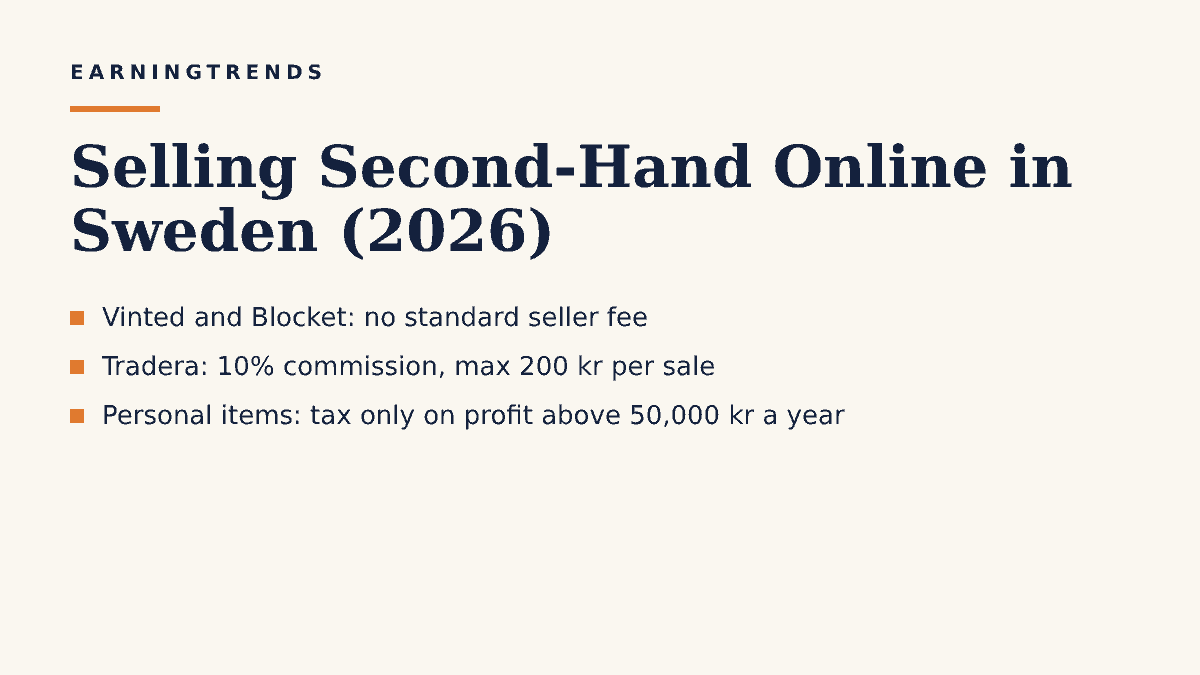
Selling used clothes, electronics and furniture online is one of the easiest ways to make extra money in Sweden. The short answer to the two questions most people have: Vinted and Blocket charge private sellers no standard selling fee, Tradera takes 10% (capped at 200 kr per sale), and if you are clearing out things you have used yourself, you only pay tax on profit above 50,000 kr per year. Most people never get close, because used items usually sell for less than they cost. This guide covers the main platforms, their fees, how Skatteverket sees your sales and the mistakes worth avoiding.
Where to sell second-hand online in Sweden
Sweden has a mature resale market with a handful of platforms that each suit different items. Choosing the right one matters more than the fee alone: a platform with zero commission is not better if your item sells for less there, or does not sell at all.
Tradera
Tradera is Sweden’s large auction and “Buy now” marketplace. It works well for collectibles, electronics, branded items and anything where bidding can push the price up. According to Tradera’s own price page, the seller pays a commission of 10% of the sale price, minimum 3 kr and maximum 200 kr. You pay nothing if the item does not sell. Optional add-ons cost extra (Highlight 15 kr, Rank up 45 kr, reserve price 40 kr) and are charged whether or not the item sells. If you upload more than 500 ads in a month, unsold ads from number 501 cost 3–10 kr each depending on category.
Because the fee stops at 200 kr, Tradera becomes relatively cheap for expensive items: a 10,000 kr sale costs the same 200 kr as a 2,000 kr sale. Note that to be covered by Tradera’s seller protection, items over 200 kr must be shipped with tracking and insurance.
Blocket
Blocket is the classic Swedish classifieds site and the first stop for furniture, bikes, tools and other bulky items that buyers collect locally. Private ads in the everyday “Torget” categories have no standard seller fee, and local pickup means no shipping either. Paid visibility boosts and certain categories (such as vehicles) can have different pricing, so check the price shown when you create the ad. Expect more haggling than on auction sites.
Vinted
Vinted is the go-to app for clothes, shoes, accessories and children’s items. Private sellers pay no selling fee; instead the buyer pays shipping plus a buyer protection fee at checkout. That makes it very attractive for low-priced clothing, but remember the buyer sees your price plus those costs, which affects what they are willing to pay.
Plick and Sellpy
Plick is a Swedish fashion resale app. According to a 2026 comparison by Hurbra, its seller protection is free on sales under 200 kr and costs 5% above that. Sellpy works differently: you send a bag of items, and Sellpy photographs, lists and ships them. The same comparison reports that sellers receive 40% of the sale price up to 500 kr and 70% of the amount above 500 kr, minus 12 kr per item put on sale. You keep much less, but you do almost no work.
Seller fees compared
| Platform | Best for | Private seller fee | Who handles shipping |
|---|---|---|---|
| Tradera | Collectibles, electronics, branded items | 10% of sale price (min 3 kr, max 200 kr); optional add-ons | You (Tradera shipping options available) |
| Blocket | Furniture, bikes, bulky items, local sales | No standard fee for private Torget ads; paid boosts optional | Usually local pickup |
| Vinted | Clothes, shoes, kids’ items | No seller fee (buyer pays protection fee and shipping) | You, using Vinted’s shipping labels |
| Plick | Fashion | Free under 200 kr, 5% above | You |
| Sellpy | People with no time to list | You receive 40% up to 500 kr, 70% above; 12 kr per item | Sellpy |
If you have sold second-hand in other countries, the picture is similar but the platforms differ. Compare our guides to selling second-hand online in Germany and selling second-hand in the Netherlands.
Tax on second-hand sales in Sweden
Selling your own used things: the 50,000 kr rule
Skatteverket treats things you have used yourself (clothes, furniture, electronics, a lawnmower) as personliga tillgångar, personal assets. If you sell them occasionally, you only need to declare anything if your total profit for the year is more than 50,000 kr. Profit means the sale price minus selling costs (such as platform commission) minus what you originally paid. Only the part above 50,000 kr is taxed, as capital income, which Skatteverket notes is taxed at 30%. You do not add VAT (moms) to these private sales.
Skatteverket’s own example: Anna sells used clothes through an app for 20,000 kr in a year. The platform reports her sales to Skatteverket and she can see the figure in her tax return, but since she made no profit, she owes nothing. If you did make a profit above the limit, it goes under point 7.5 of the income tax return. The 50,000 kr deduction applies per owner. If you sell art, jewellery or watches that have risen in value, read Skatteverket’s guidance on calculating the gain.
Reselling regularly is different
The 50,000 kr rule is for clearing out your own belongings. If you regularly buy items to resell them, Skatteverket says the income is taxed as business income (näringsverksamhet), and you are as a rule required to report VAT. If you sell things you make yourself as a hobby, any surplus is taxed as income from employment (tjänst). Skatteverket also states that if you sell goods regularly, you must report the income regardless of how much you sold. Where the line falls depends on how often you sell, the purpose and the scale, so it varies from person to person. Running a resale business usually means registering for F-skatt or FA-skatt.
Platforms report your sales (DAC7)
Since 1 January 2023, digital platforms must report certain sellers to Skatteverket under the EU’s DAC7 rules, implemented in Sweden by law (2022:1681). For goods, a seller is exempt if they made fewer than 30 sales and received no more than €2,000 on that platform in the calendar year. Above that, the platform reports your identity, number of sales, amounts and fees. You can see what was reported in Skatteverket’s Mina inkomstuppgifter service. Reporting does not change how you are taxed, and platforms do not withhold tax, so if you owe tax you have to pay it yourself.
This is general information, not tax advice. If you sell high-value items or are unsure whether your selling counts as business activity, check with Skatteverket or a qualified tax advisor in Sweden.
How to start selling: practical steps
- Sort by item type. Clothes to Vinted or Plick, bulky items to Blocket, valuable or collectible items to Tradera, and the rest to Sellpy if you lack time.
- Research real prices. Look at completed sales rather than asking prices. On Tradera you can follow ended auctions, which gives a more honest picture of value.
- Take good photos. Daylight, a plain background, every flaw shown. Clear photos reduce disputes later.
- Write honest descriptions. Between private persons the Sale of Goods Act (köplagen) applies, not consumer law, but a buyer can still claim a fault if the item differs from what was described.
- Use the platform’s payment and shipping. It is where buyer and seller protection apply, and it keeps a record of the deal.
- Keep simple records. Note what you sold, for how much, and what you paid if you know it. This helps if Skatteverket ever asks, or if you sell something valuable.
Common mistakes
- Following links from “buyers”. Sweden’s Stöldskyddsföreningen (SSF) warned in 2026 about well-made phishing attacks against Blocket sellers. Never log in with BankID through a link sent in a chat, and never pay a “shipping” or “insurance” fee to receive money.
- Taking payment outside the platform. You lose seller protection and make fraud easier.
- Shipping valuable items without tracking. On Tradera, items over 200 kr need tracked and insured shipping to be covered.
- Assuming everything is tax-free. The 50,000 kr rule covers personal belongings sold occasionally. Buying to resell is a business.
- Ignoring the DAC7 report. If you sell 30 or more items on one platform, expect Skatteverket to receive your figures. Check them in Mina inkomstuppgifter and make sure they match your own records.
FAQ
Do I pay tax when I sell my old clothes on Vinted in Sweden?
Almost certainly not. You only pay tax if your total profit on personal belongings is above 50,000 kr in a year, and used clothes rarely sell for more than you paid.
Will Skatteverket know about my sales?
If you make 30 or more sales, or receive more than €2,000, on one platform in a calendar year, the platform reports you under DAC7. Being reported does not mean you owe tax.
Which platform is cheapest for sellers?
Vinted and Blocket charge no standard seller fee. Tradera costs 10%, but the 200 kr cap makes it cheap for expensive items, and auctions can lift the final price.
When does reselling become a business?
When you regularly buy items in order to sell them on. Skatteverket then treats the income as business income, usually with VAT. The assessment depends on your situation.
Conclusion
For most people in Sweden, selling second-hand online is simple: pick the platform that fits the item, use its payment and shipping, and keep a basic record. Your own belongings are tax-free up to 50,000 kr of profit a year, while buying to resell turns into a business with its own rules. If you build up savings from your sales, our guide to the ISK investment savings account in Sweden explains one common next step.
Sources
- Skatteverket – Sälja och hyra ut på nätet
- Skatteverket – Andra tillgångar (personal assets)
- Skatteverket – Loppmarknader (flea markets and resale)
- Riksdagen – Lag (2022:1681) on platform operators’ reporting
- Tradera – How much does it cost to sell on Tradera?
- Hurbra – Vilken second hand-app ger mest betalt 2026?