Gig Work in Czechia (2026): Trade Licence, Flat Tax and Pay
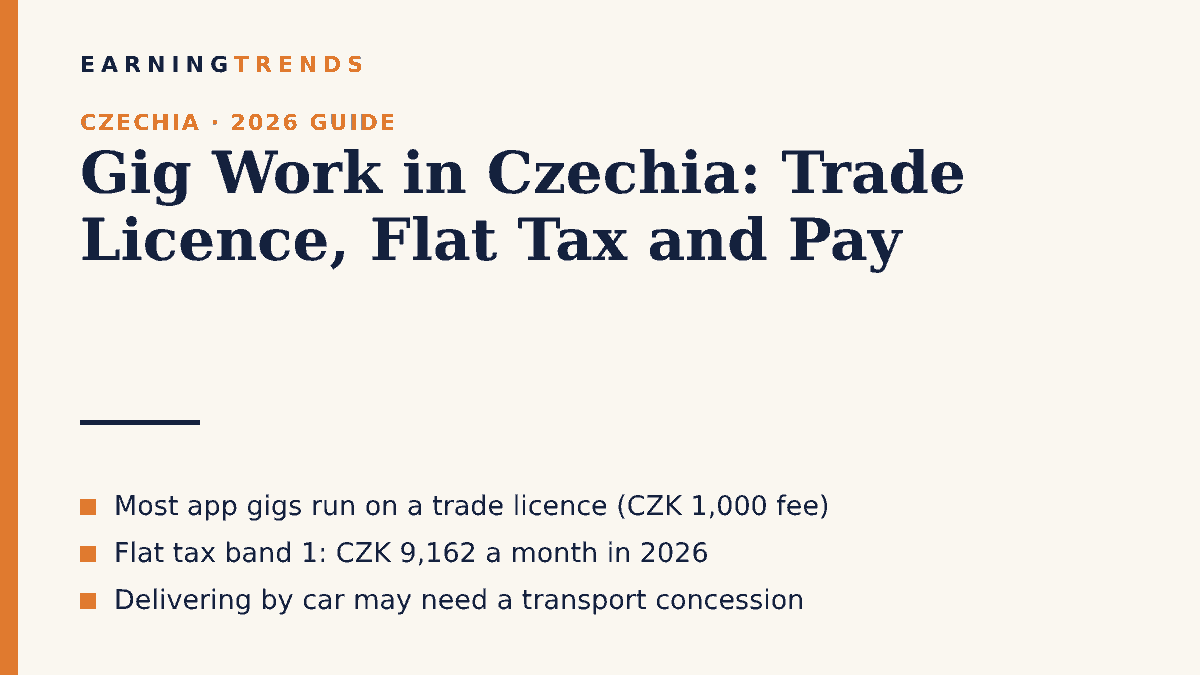
Most app-based gig work in Czechia, from food delivery on Wolt or Bolt Food to freelance tasks, is done as a self-employed person (OSVČ) on a trade licence (živnostenský list). Registering a free trade costs CZK 1,000, and many small earners then choose the flat-tax regime (paušální daň), which in 2026 costs CZK 9,162 a month in the first band and covers income tax, pension and health insurance in one payment. Earnings vary widely; one Wolt courier interviewed by CzechCrunch averaged about CZK 100 per delivery.
Below you will find the steps to start legally, what the flat tax and minimum insurance payments look like in 2026, what couriers report earning, and the mistakes that cost new gig workers money. Rules depend on your personal situation (for example, whether you also have a job or study), so treat this as a starting point and check details with the tax office or a Czech tax adviser.
Which gigs need a trade licence?
Delivery platforms in Czechia generally work with couriers as independent contractors rather than employees. Wolt, for example, lists a trade licence (or an agreement through a partner fleet) among its courier requirements, together with your own vehicle (bike, scooter or car), a smartphone with data, and Czech, Slovak or English language skills. EU citizens can work without a permit; others need a valid work or residence permit.
The type of licence depends on what you do:
| Gig type | Usual licence | Notes |
|---|---|---|
| Delivery by bike, e-bike or on foot | Free trade (živnost volná) | Simplest option, CZK 1,000 fee |
| Delivery by car | Possibly a concession for road motor transport (vehicles up to 3.5 t) | Check with your trade office before you start |
| Ride-hailing (Uber, Bolt, Liftago) | Concession for small passenger transport | Also a taxi driver card and a registered vehicle |
| Online freelancing, tutoring, design | Usually a free trade | Some professions are regulated |
If you plan to deliver by car or drive passengers, confirm the exact licence with the trade licensing office (živnostenský úřad) first. These concessions take longer and have extra conditions.
How to register: step by step
- Fill in the Unified Registration Form (JRF). You can complete it online or as a PDF. It takes about 5 to 30 minutes, and one form can also notify the tax office, the Czech Social Security Administration (ČSSZ) and your health insurer.
- Pay the fee. Registering a free trade costs CZK 1,000. Adding another free trade later costs CZK 500, so list all relevant activities at once. Filing via Czech POINT adds CZK 50.
- Submit it. Any municipal trade office accepts it in person, by post, via your data box or with a recognised electronic signature.
- Wait for registration. If everything is in order, you are entered in the trade register within five working days.
- Register for insurance and tax. If you did not use the JRF for this, register with ČSSZ and your health insurer within eight days of starting, and with the tax office within 15 days of registration.
- Decide on flat tax. New businesses can join the flat-tax regime when they register; existing ones must apply by the January deadline.
Flat tax (paušální daň) in 2026
The flat-tax regime replaces separate income tax, pension insurance and health insurance advances with one monthly payment due by the 20th. You also skip the annual tax return and insurance overviews, which is why it is popular with couriers and freelancers.
| Band | Monthly payment 2026 | Who typically fits |
|---|---|---|
| 1 | CZK 9,162 | Income up to CZK 1 million (higher limits apply for activities with 80% or 60% expense rates) |
| 2 | CZK 16,745 | Income roughly CZK 1 to 1.5 million, depending on activity |
| 3 | CZK 27,139 | Income up to CZK 2 million not covered by bands 1 or 2 |
The first band originally cost CZK 9,984 a month in 2026. After pension contributions for the self-employed were cut retroactively from 1 January 2026, the Financial Administration lowered it to CZK 9,162 from July. People who paid the higher amount from January to June overpaid CZK 4,932 in total, which can be offset against later 2026 advances or reclaimed after the year ends.
To use the regime you must, among other conditions, not be a VAT payer, have annual income of no more than CZK 2 million, and have no employment income except income taxed at source. For 2027, the first band rises to CZK 9,662 a month, and the deadline to join, switch bands or leave is Monday 11 January 2027.
If you stay outside the flat tax
Without the flat tax, you pay income tax (15% for most people) on profit, plus social and health insurance advances. Most free trades can deduct a flat expense allowance of 60% of income instead of proving real costs (80% for crafts).
For self-employment as your main activity, the minimum monthly advances in 2026 are:
- Social (pension) insurance: CZK 5,005 from 1 July 2026, down from CZK 5,720. ČSSZ recalculates January to June automatically and credits any overpayment.
- Health insurance: CZK 3,306.
If gig work is a secondary activity (for example, alongside a job or full-time studies), you pay social insurance only if your annual profit exceeds the decisive amount, which is CZK 117,521 for 2026. Health insurance for secondary activity is based on actual income rather than a monthly minimum.
Casual agreements as an alternative
If a business hires you directly for occasional work, a DPP agreement (dohoda o provedení práce) may be simpler. In 2026, DPP earnings below CZK 12,000 a month from one employer are not subject to social or health insurance, with a standard limit of 300 hours a year per employer. Platforms usually do not offer this, but some delivery fleets and local businesses do.
What gig workers actually earn
Pay is per task, so hourly income depends on city, time of day, distance, tips and bonuses. Two data points:
- CzechCrunch (December 2024, a Wolt-sponsored piece): one Prague courier averaged about CZK 100 per delivery and CZK 2,200 to 2,500 for a 10-hour day, with tips under 5% of income. Wolt also ran a bonus of CZK 1,000 per 100 deliveries for couriers doing at least 450 a month.
- Recruitment ads for Wolt couriers on Czech job boards advertise earnings of “typically over CZK 300 per hour” in Prague and lower figures in smaller towns. Treat these as marketing, not guarantees.
From that gross figure, subtract your flat tax or insurance advances, fuel or vehicle costs, phone data and equipment. A courier earning CZK 25,000 a month gross in band 1 would pay CZK 9,162 of it in flat tax, so check that the numbers work before you commit.
Common mistakes
- Starting before registration. Working for a platform without a valid trade licence can lead to fines and back payments.
- Delivering by car on the wrong licence. Car delivery may need a transport concession, not just a free trade.
- Missing the flat-tax deadline. Late applications for the next year are not accepted.
- Forgetting the July 2026 change. Many band 1 payers kept paying CZK 9,984 by standing order.
- Ignoring secondary-activity rules. Students and employees often pay less than they think, or wrongly assume they pay nothing.
- Not tracking costs. Even with flat tax, knowing your real costs per delivery shows whether a shift is worth it.
FAQ
Do I need a trade licence to deliver for Wolt or Bolt Food in Czechia?
Usually yes. Couriers typically work as self-employed people on a trade licence, or through a partner fleet that contracts them.
How much is the flat tax in Czechia in 2026?
CZK 9,162 a month in band 1 (after the July 2026 reduction), CZK 16,745 in band 2 and CZK 27,139 in band 3.
Can students do gig work on a trade licence?
Yes. It usually counts as secondary activity, so social insurance applies only if annual profit exceeds CZK 117,521 in 2026. Check health insurance rules with your insurer.
Can I join the flat tax for 2027?
Yes, by Monday 11 January 2027, provided you meet the conditions, including not being a VAT payer and earning no more than CZK 2 million a year.
Conclusion
Gig work in Czechia is easy to start but works best when you set it up properly: register the right trade, decide early whether the flat tax suits your income, and track what each shift really earns after costs. Tax and insurance rules depend on your situation, so check with a qualified Czech tax adviser before making big decisions. This article is general information, not tax or legal advice. For more context, read our guides to the EU Platform Work Directive, food delivery work in Austria and gig work in France.
Sources
- Finanční správa: Paušální daň 2026, novinky a termíny
- Finanční správa: Lower first-band flat-tax payment from July 2026
- ČSSZ: Change to pension insurance for the self-employed from 1 July 2026
- Průvodce podnikáním: How to set up a trade licence
- Banky.cz: Flat tax 2027 and entry deadline
- CzechCrunch: Half a day with a Wolt courier (December 2024)