How to Lower Your Heating Bill When You’re Home All Day With Kids
When you’re home all day with the kids, the heat runs all day too, and the usual “turn it down while you’re at work” advice doesn’t fit your life. This post gives you a stay-home thermostat schedule, a draft-stopping checklist you can finish for about $30, and the math to decide whether a space heater actually saves you money. The cost and savings figures come from current US government sources, so you can plan your winter budget with real numbers.
What heating will likely cost you this winter
Your bill depends mostly on the fuel that heats your home. The US Energy Information Administration’s (EIA) 2026–27 Winter Fuels Outlook forecasts average household spending from November through March like this:
| Main heating fuel | Forecast Nov–Mar total | About per month | vs. last winter |
|---|---|---|---|
| Natural gas | $640 | $128 | down 9% |
| Electricity | $1,196 | $239 | up 4% |
| Propane | $1,246 | $249 | down 3% |
| Heating oil | $2,115 | $423 | up 21% |
Find the line for your fuel and write down the monthly number. If you keep a utilities sinking fund, that’s the amount to save toward. It’s also the baseline for checking whether the steps below are working.
Step 1: Use a thermostat schedule built for a stay-home day
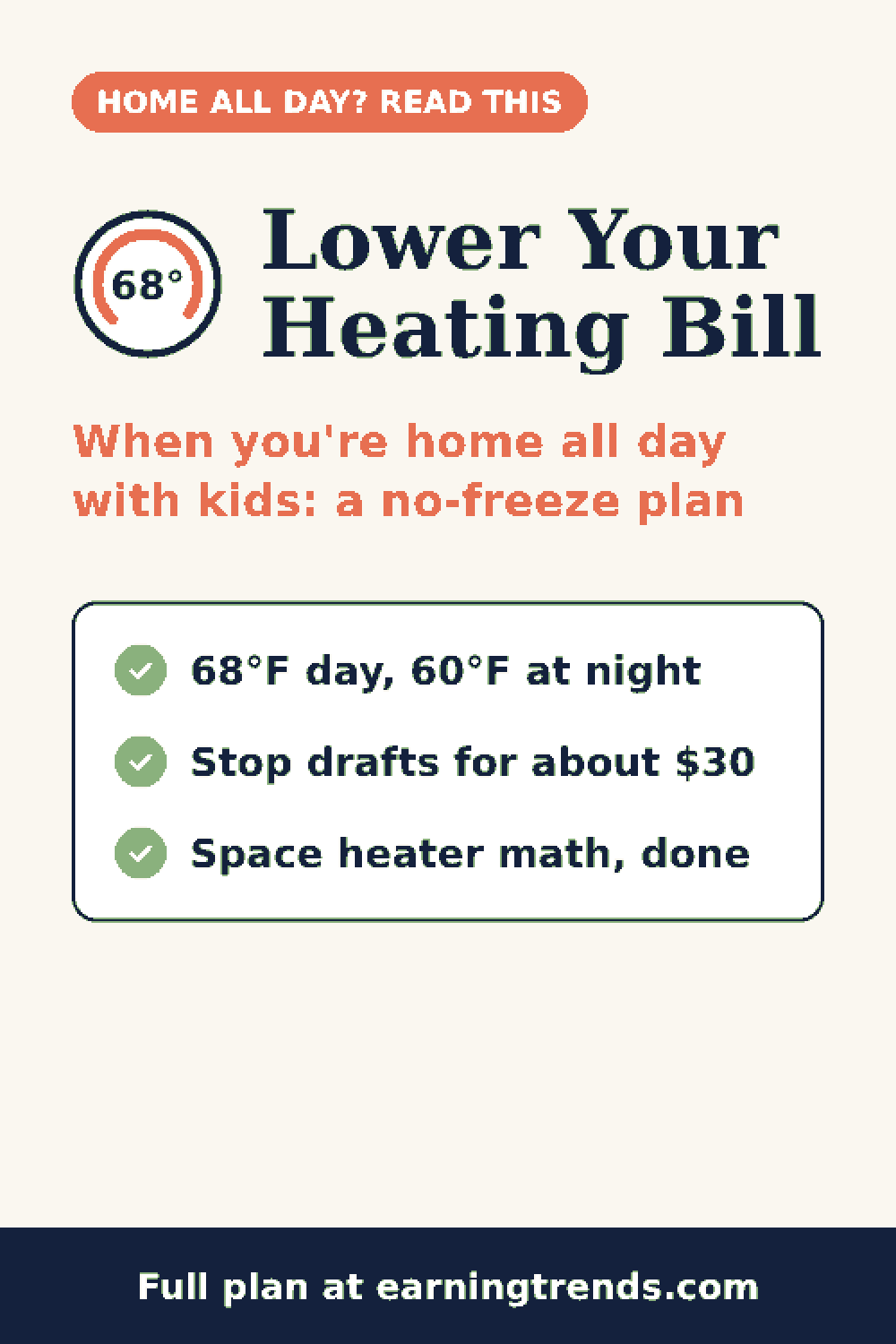
The Department of Energy (DOE) says you can save as much as 10% a year on heating and cooling by turning your thermostat back 7–10°F for 8 hours a day from its normal setting. It suggests about 68°F while you’re awake. Most guides assume those 8 hours happen while the house is empty. In your house, they happen at night.
| Time | Setting | Why |
|---|---|---|
| 5:30–9:30 pm | 68°F | Dinner, bath, bedtime |
| 9:30 pm–5:30 am | 60°F | Your 8-hour setback while everyone is under blankets |
| 5:30–6:30 am | 68°F | The house warms up before anyone gets out of bed |
| Daytime | 67–68°F | Layers, slippers and closed doors do the rest |
A few practical notes:
- No programmable thermostat? Set a phone alarm for bedtime and change it by hand. The savings are the same.
- Have a baby? Ask your pediatrician what nursery temperature they recommend before you lower the night setting, and dress your baby for that temperature.
- Heat pump, steam radiators or radiant floors? These systems respond slowly or work differently with deep setbacks. Check the DOE thermostat page (linked in Sources) before you copy the schedule.
Step 2: Heat the rooms you actually use, safely
During the day, you and the kids probably live in two rooms: the kitchen and the playroom or living room. Shut the doors to rooms nobody uses during the day, like a guest room or home office, and keep everyone in the warm zone. Throw blankets on the sofa, keep slippers by the door and make a warm drink at nap time, and 67°F feels fine.
If you add a space heater, follow the US Fire Administration’s rules every time, especially with little ones around:
- Keep it at least 3 feet from anything that can burn: curtains, bedding, toys and kids.
- Plug it straight into a wall outlet. Never use an extension cord or power strip.
- Set it on a solid, flat surface, and choose a model with automatic shut-off.
- Turn it off when you leave the room or go to bed.
Step 3: Stop drafts for about $30
The DOE calls caulking and weatherstripping simple, effective air-sealing jobs that often pay for themselves in a year or less. Caulk seals cracks that don’t move, like gaps around window and door frames. Weatherstripping seals the parts that do move, like the edges of doors and windows that open.
The 15-minute draft hunt: on a windy day, hold a damp hand or a thin strip of tissue near window frames, door edges, outlets on outside walls and the attic hatch. If your hand gets cold or the tissue flutters, you’ve found a leak. Then:
- Put self-stick foam weatherstripping on the door that leaks most. It’s usually the one you use with the stroller.
- Run a bead of caulk wherever a window or door frame has a gap against the wall.
- Fit a door sweep, or roll a towel along the bottom of the door for a free draft stopper.
- Close the fireplace damper whenever there’s no fire.
A roll of weatherstripping, a tube of caulk and a basic door sweep often add up to $30 or less at a hardware store. If you rent, removable weatherstripping and fabric draft stoppers won’t damage anything, but check with your landlord before you caulk.
Step 4: Make your windows work for you
Windows lose heat at night but can let heat in on a sunny day. The DOE recommends opening window coverings on sunny winter mornings so the sun warms the room, and closing them when it gets dark. It also says tightly installed cellular shades can cut heat loss through windows by 40% or more, which works out to about 10% in heating energy savings. You don’t need new shades this week, though. Closing the curtains you already have at sunset is the free version.
Your winter heat-saving checklist
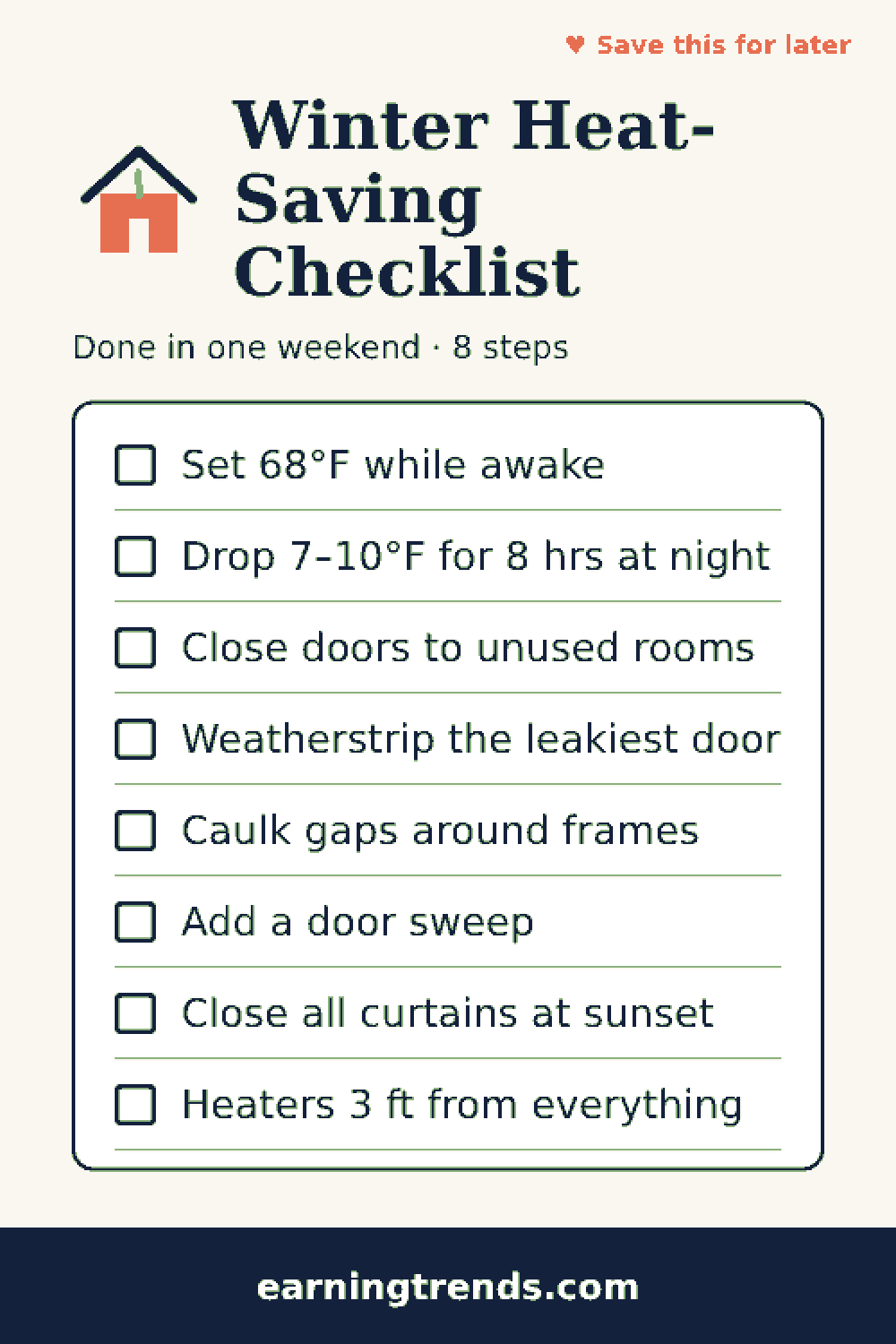
Here are Steps 1–4 on one list. You can tick them all off in a weekend:
- Set 68°F while you’re awake
- Drop it 7–10°F for 8 hours overnight
- Close doors to rooms you don’t use
- Weatherstrip your leakiest door
- Caulk gaps around window and door frames
- Add a door sweep or a rolled towel
- Open sunny-side curtains during the day
- Close every curtain at sunset
- Keep space heaters 3 feet from everything
Save this checklist to your Pinterest board for later.
Bonus editorial: what most guides get wrong about space heaters
“Use a space heater and save” is everywhere. But a space heater only saves money if it lets your main heat run a lot less. Here’s the math with real numbers.
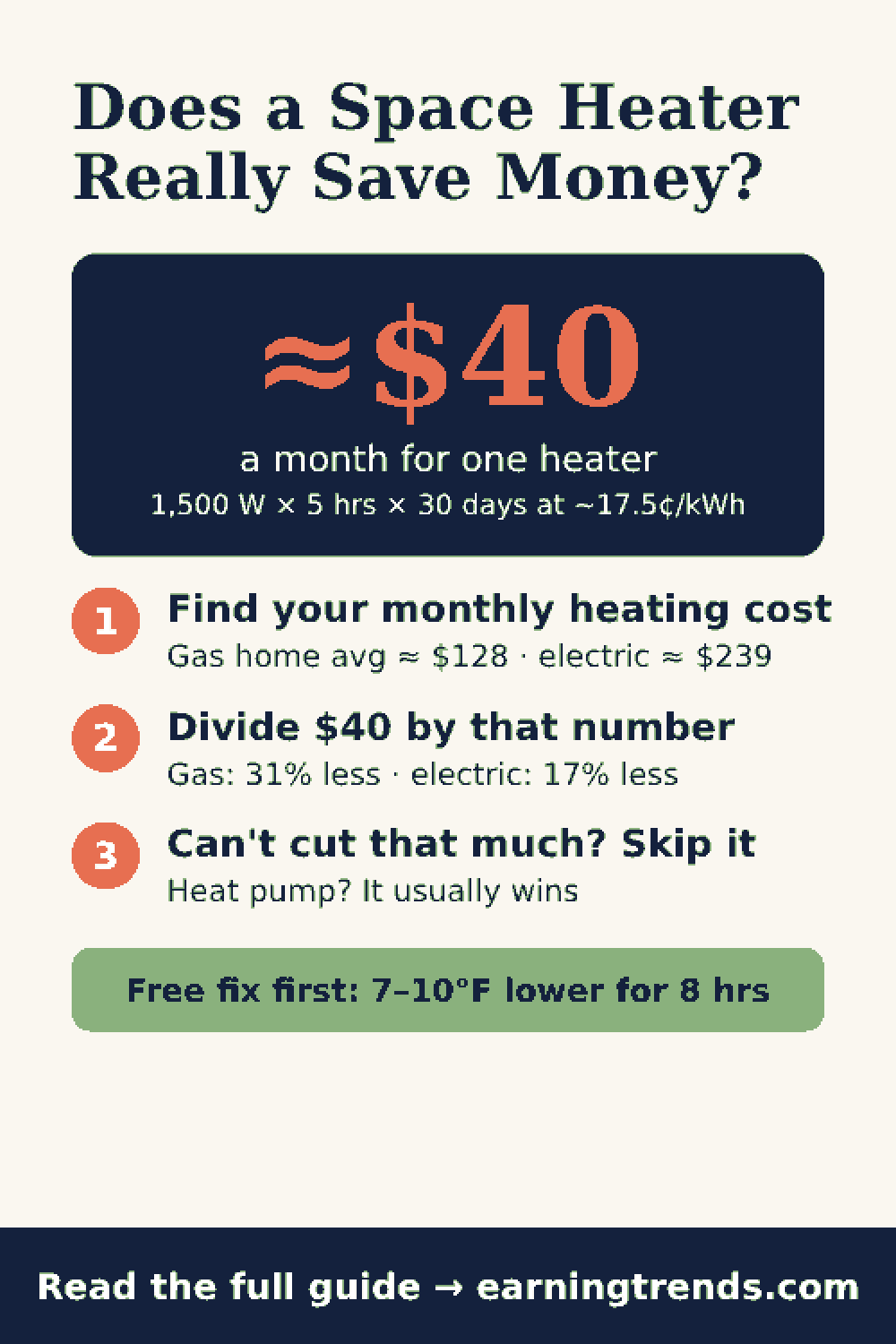
A typical space heater uses 1,500 watts on high. Run it 5 hours a day for 30 days and it uses 225 kWh. EIA data puts the average US residential electricity price at roughly 17–18 cents per kWh, so that’s about $40 a month added to your electric bill.
- Gas-heated home: the average forecast is about $128 a month this winter. To break even on that $40, your furnace would have to use about 31% less ($40 ÷ $128). That only happens if you turn the whole-house thermostat down several degrees and keep the heater in one closed room.
- Electric-heated home: about $239 a month on average, so the heater has to cut your central heating by about 17% ($40 ÷ $239) to break even. If your central system is a heat pump, it usually gets more heat out of each kWh than a plug-in heater, which turns one kWh of electricity into exactly one kWh of heat. In that case the “savings” can disappear completely.
- What actually wins: the night setback from Step 1 costs nothing. Using the averages above, “up to 10%” is at most about $64 over the season for a gas home or $120 for an electric home, with no new appliance. Since those totals include hot water too, think of these numbers as upper limits.
Bottom line: do the free steps first. Add a space heater only if you also turn down the main thermostat, and compare your next bill to the baseline you wrote down to see whether it really helped.
If the bill is already too high, ask for help
The Low Income Home Energy Assistance Program (LIHEAP) helps eligible households pay heating bills. States and local offices run it, so rules, dates and amounts depend on where you live. In Pennsylvania, for example, you don’t have to be on other public assistance or behind on your bill, and you can rent or own. HHS estimates the average heating benefit at about $662, but your amount depends on your location, income and household size. Qualifying doesn’t guarantee you’ll receive help, because funding is limited.
- Call the National Energy Assistance Referral hotline at 1-866-674-6327 (weekdays, 9 am–7 pm Eastern) or visit energyhelp.us to find your local office.
- Ask your utility whether it offers budget billing (the same payment every month) or a payment plan, so January doesn’t wreck your one-income budget.
- Apply early. Some programs only pay out until the money runs out.
Reading from the UK? LIHEAP and the US dollar figures don’t apply to you, but the thermostat, draft and window steps work in any home.
FAQ
Is it cheaper to keep the heat steady all day or turn it down?
Turning it down saves more. The DOE explains that a cooler house loses heat more slowly, so the energy you save while it’s cooler is more than the energy it takes to warm back up. You don’t need to switch it off completely, which can make the house too cold for kids. A 7–10°F setback is the sweet spot.
What temperature should I set when I’m home with kids all day?
The DOE suggests about 68°F while everyone is awake, then 7–10°F lower overnight. Dress the kids in layers and adjust one degree at a time until it feels right for your family.
Can renters do any of this?
Yes. The thermostat schedule, closing off unused rooms, curtains, removable weatherstripping and draft stoppers all work without changing the property. Renters can also apply for LIHEAP, and some states, such as Illinois, accept applications even when heat is included in the rent.
Start today
Tonight at bedtime, turn the thermostat down to 60°F and set a reminder to put it back to 68°F when you wake up. That one change costs nothing. This weekend, do the 15-minute draft hunt. For more ways to stretch one paycheck, see 25 frugal habits that make one income work. If this winter feels tight, start a $1,000 emergency fund so the next surprise bill doesn’t end up on a credit card.
Sources
- EIA: Winter Fuels Outlook 2026–27
- EIA: Electricity Monthly Update, average residential prices
- DOE Energy Saver: Programmable thermostats
- DOE: Sealing your home
- DOE Energy Saver: Energy-efficient window attachments
- US Fire Administration: Heater fire safety
- HHS ACF: LIHEAP
- HHS ACF: LIHEAP FAQs for consumers
- Pennsylvania DHS: Apply for LIHEAP
- Illinois DCEO: How to apply for LIHEAP
- NCOA: What is LIHEAP?