Selling on eMAG Marketplace in Romania (2026): Fees and Taxes
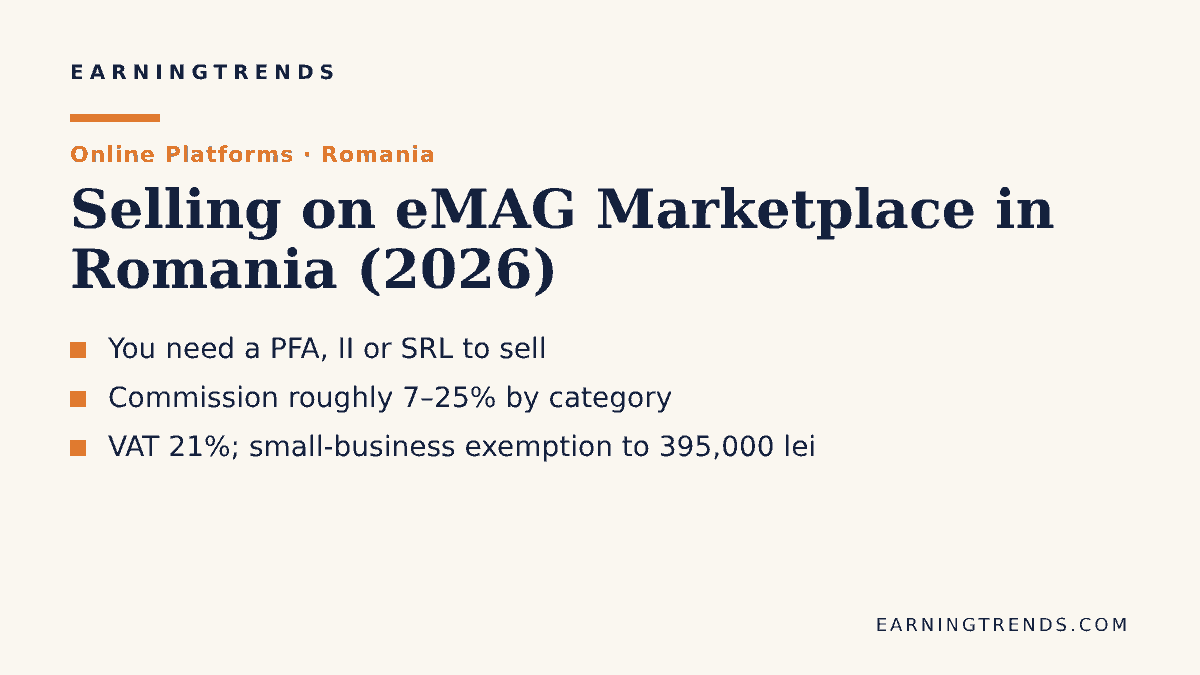
Yes, you can sell on eMAG Marketplace from Romania in 2026, but not as a private individual: you need a registered business such as a PFA, an II or an SRL, because every sale needs a proper invoice. eMAG charges no sign-up or monthly fee for a standard seller account. You pay a commission on each sale, roughly 7% to 25% depending on the category, plus optional costs for fulfilment and ads. This guide covers how it works, what it costs and which Romanian tax rules matter once the orders start coming in.
Why eMAG matters for Romanian sellers
eMAG is the largest online retailer in Romania, and the third-party Marketplace sits next to eMAG’s own stock. According to Ziarul Financiar, the Marketplace has grown to more than 64,000 sellers since it launched about 15 years ago. At its Sellers’ Day 2026 event, eMAG said the platform now lists more than 46 million offers and that the number of sellers expanding into its other markets (Bulgaria and Hungary) grew by 25% in a year.
That reach is the main reason to list there: you get traffic, payments and, if you want it, logistics without building your own shop first. The flip side is heavy competition on price, since the same product can be offered by many sellers on the same page.
Who can sell: legal form first
eMAG’s onboarding asks for company details, bank details and company documents. Seller guides published in 2026 consistently say that SRL, SA and PFA (and II) forms are accepted, and that a person without a registered business cannot sell. The usual choice for a side business is:
- PFA or II – quicker and cheaper to set up, taxed on your net income as an individual. Good for testing demand.
- SRL – limited liability and, if it qualifies, the micro-company regime. More paperwork and accounting cost.
Which is cheaper overall depends on your margins, expenses and whether you also have a salary, so get an accountant’s view before you register. Many first-time sellers also use a monthly invoicing and accounting app to handle e-Factura and the annual tax return.
eMAG Marketplace fees in 2026
For a standard seller account there are no listing, subscription or account-management fees. Costs come from each sale and from the extras you choose:
| Cost | How it works | Typical range |
|---|---|---|
| Sales commission | Percentage of the selling price excluding VAT, set per category in your contract | About 7% to 25% |
| VAT on commission | eMAG’s commission invoices carry VAT | 21% of the commission |
| Shipping commission | Commission is also taken on the delivery fee the customer pays | Category rate |
| Fulfilment by eMAG (optional) | Storage fee plus a processing fee per unit, by size and weight | Varies by product |
| eMAG Ads (optional) | Pay-per-click promotion inside the site | Your budget |
The exact commission grid for each category appears in your Marketplace contract before you sign, and you can check it later in your seller account. Guides from Startarium and 3dsellers both describe the 7%–25% range, with fashion and some lifestyle categories near the top and electronics lower. eMAG has also run discounts on commission for new sellers in their first months; check what is on offer when you apply.
One more change affects your buyers rather than you: since 17 April 2026, eMAG adds an “operational services” charge to every order, equal to 1% of the product value with a minimum of 1.49 lei and a maximum of 3.99 lei (VAT included). It applies to Marketplace orders too, so factor it into how price-sensitive your customers are.
How to start selling, step by step
- Register your business (PFA, II or SRL) and open a business bank account.
- Apply on the eMAG Marketplace seller portal with company and bank details and the requested documents. You choose up to five product categories at sign-up.
- Read the commission grid for your categories before signing, and calculate margins with commission, VAT on commission and shipping included.
- List products with EAN codes, good photos and complete specifications. Thin listings lose the “buy box” to better-documented offers.
- Choose logistics: ship yourself with a courier, or send stock to Fulfilment by eMAG if speed and Genius delivery matter for your product.
- Set up invoicing and e-Factura so every order gets a compliant invoice on time.
- Track payouts. eMAG deducts commission automatically before paying out your sales proceeds.
If you are comparing marketplaces in different countries, our guide to Allegro, Amazon.pl and OLX in Poland shows how a similar dominant local platform compares with Amazon.
Romanian taxes for eMAG sellers (high level)
Tax depends on your legal form and your personal situation. The headline numbers for 2026:
VAT
The standard VAT rate has been 21% since 1 August 2025, with a reduced 11% rate for some goods. Small businesses can stay outside VAT while annual turnover stays under 395,000 lei; once you exceed it you must register. Note that marketplace commissions come with VAT, which a non-VAT-registered seller cannot reclaim.
PFA or II
- Income tax: 10% of net income (income minus deductible costs and contributions).
- CASS (health, 10%): generally due once net income reaches 6 minimum gross salaries (24,300 lei for 2026 income, based on the 4,050 lei minimum wage in force on 1 January 2026), capped at 72 minimum salaries.
- CAS (pension, 25%): due if net income reaches 12 minimum salaries (48,600 lei), calculated on a base of 12 or 24 minimum salaries.
- You declare and pay through the annual Declarația Unică (D212), due by 25 May of the following year.
SRL
From 1 January 2026 the micro-company regime is limited to companies with revenue up to the equivalent of 100,000 euros, and the micro tax rate is a single 1% of revenue (the 3% rate was removed). Other conditions apply, including rules on employees and linked companies. Above the ceiling, the company moves to 16% profit tax. Dividends paid out in 2026 are taxed at 16%.
These rules change often and depend on your situation, so check the current figures with a Romanian accountant (contabil) or ANAF before you choose a structure. This is general information, not tax or legal advice.
Is eMAG worth it? A quick margin check
Before listing a product, work out the real margin on one unit:
- Selling price excluding VAT
- minus product cost and packaging
- minus commission (your category rate) and the VAT on that commission if you cannot reclaim it
- minus shipping cost (and commission on the shipping fee)
- minus fulfilment, ads and an allowance for returns
If the result is thin at today’s price, assume it will get thinner when other sellers undercut you. Products with clear differentiation, your own brand or bundles tend to hold their price better than identical items that many sellers stock.
Common mistakes
- Pricing from the gross price. Commission is applied to the price without VAT, but the commission invoice itself carries VAT. Model both.
- Forgetting the shipping commission. Charging the buyer for delivery does not mean you keep all of it.
- Ignoring the VAT threshold. Fast-growing sellers can pass 395,000 lei in a year without noticing. Track turnover monthly.
- Weak listings. Missing EANs, specs or photos cost visibility and conversions.
- Relying on one channel. Policy or fee changes can hit you overnight. Many sellers also build their own shop or list elsewhere, as we discuss for Etsy sellers in Poland.
- No returns budget. EU consumer rules give online buyers a right to withdraw, so returns are a cost of doing business.
FAQ
Can I sell on eMAG as a private person?
No. You need a registered legal form such as a PFA, II or SRL, because each sale needs an invoice. For occasional second-hand sales, classifieds platforms are the usual route instead; see our look at Wallapop and Vinted in Spain for how that model works.
Is there a monthly fee?
Not for a standard seller account. You pay commission per sale. Third-party integration tools and Fulfilment by eMAG have their own costs.
Do I have to be VAT registered?
Only once your turnover exceeds 395,000 lei a year, unless you choose to register earlier. Below that you invoice without VAT but cannot reclaim VAT on costs, including eMAG’s commission.
Can I sell to Bulgaria and Hungary too?
eMAG operates marketplaces in both countries and says a growing share of sellers use them. Cross-border selling adds VAT, language and returns questions, so start in Romania and expand once your process works.
Conclusion
eMAG Marketplace is the fastest way to put products in front of Romanian online shoppers, with no fixed fee to start. The real costs are commission (about 7%–25%), VAT on that commission, shipping and the taxes that come with running a PFA or SRL. Register the right legal form, read your category’s commission grid, model one unit’s margin honestly and track your turnover against the VAT threshold.
Sources
- Startarium – Cum vinzi pe eMAG: comisioane și sfaturi
- 3dsellers – Selling on eMAG: fees, how to start and FAQ
- StartupCafe – eMAG operational services charge from 17 April 2026
- Ziarul Financiar – eMAG Marketplace sellers
- Fiscalitatea – Plafoane fiscale 2026 (micro, VAT)
- Permis de Antreprenor – Taxe PFA 2026: impozit, CAS, CASS