Investment Account in Latvia (2026): How Tax Deferral Works
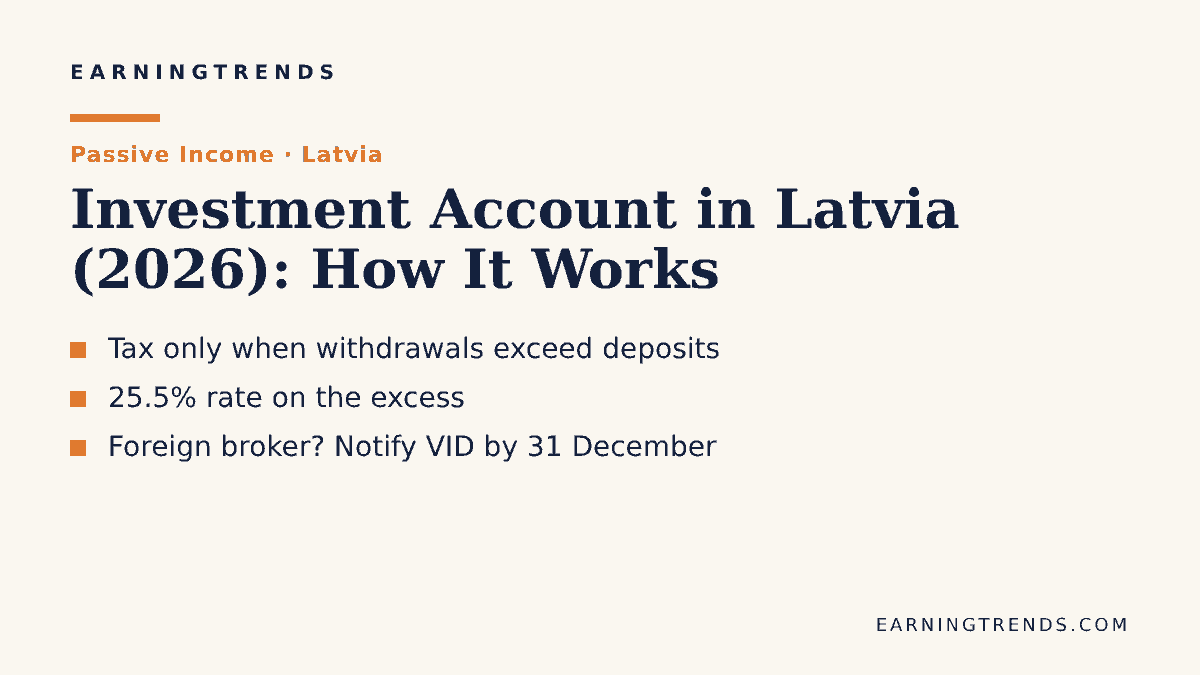
Latvia’s investment account (ieguldījumu konts) lets you buy and sell shares, funds and bonds without paying tax on each trade. Personal income tax is only due when the total you take out of the account exceeds the total you have paid in, and the excess is taxed at the capital income rate of 25.5%. You can use it at a Latvian bank or a foreign broker, but a foreign account must be reported to the State Revenue Service (VID) by 31 December of the year you give it investment-account status. Here is how it works in 2026.
What the investment account is
Since 2018, Latvia’s Law on Personal Income Tax has offered a simplified way to tax income from financial instruments held in an investment account. It is not a special product you buy. It is a tax status that you give to an ordinary brokerage or financial instrument account, together with the cash account linked to it.
Inside the account you can trade, collect dividends and interest, and reinvest the proceeds without declaring each transaction. Tax only becomes relevant when money leaves the account. It is the Latvian cousin of Nordic wrappers such as Sweden’s ISK and Norway’s aksjesparekonto, but with a different logic: there is no annual flat-rate tax and no deposit cap, just deferral.
How the tax is calculated
The rule is simple: income arises on the day the total amount withdrawn from the investment account exceeds the total amount paid in. Only the excess is taxable, at the capital income rate of 25.5% that has applied since 1 January 2025.
Example: you pay €10,000 into the account over several years and the portfolio grows to €13,000. You withdraw €8,000: no tax, because withdrawals (€8,000) are still below deposits (€10,000). Later you withdraw another €3,000. Total withdrawals are now €11,000, which is €1,000 more than you paid in. That €1,000 is taxable income, and the tax is €255 (25.5%).
Because gains and losses inside the account simply change its value, you do not need to match each sale with its purchase price or offset losses manually.
Investment account vs standard regime
| Investment account | Standard securities account | |
|---|---|---|
| When tax arises | When total withdrawals exceed total deposits | On each profitable sale (capital gain) |
| Tax rate | 25.5% on the excess | 25.5% on the capital gain |
| Declaring trades | Not per transaction | Each disposal is calculated by you |
| Declaration | Annual income declaration, only if withdrawals exceed deposits | Quarterly if quarterly gains exceed €1,000; otherwise by 15 January of the next year |
| Who prepares figures | Provider issues an investment account statement | You calculate gains yourself |
| Moving securities | Only to another investment account | No restriction |
Under the standard regime, VID’s rules say that if your income from transactions with capital assets exceeds €1,000 in a quarter, you file a capital gains declaration by the 15th of the month after the quarter and pay by the 23rd. If it stays under €1,000, you declare by 15 January and pay by 23 January of the following year. Active traders in a standard account can face several filings a year; the investment account removes that.
Declaring and paying
- If withdrawals exceeded deposits during a year, you declare the income in your annual income declaration in the VID Electronic Declaration System (EDS), attaching the investment account statement prepared by your provider.
- The annual declaration is submitted between 1 March and 1 June of the following year, and VID’s guidance sets payment of the calculated tax by 23 June.
- If withdrawals never exceed deposits, there is nothing to pay for that account.
How to set one up
At a Latvian bank or broker
Ask your provider to give your account investment-account status (or open a new one with that status). Banks such as Citadele, Swedbank and Luminor offer it and report the information to VID automatically, so you do not need to notify VID yourself. You will need both the investment account and a linked financial instrument account to trade.
At a foreign broker
If your provider has no branch in Latvia, you must inform VID yourself through EDS by the end of the calendar year in which the account gets investment-account status. You provide the provider’s details (including its SWIFT/BIC code, if it has one), the account currency and the date the account was opened. The provider must also meet the conditions set out in the law, and for a foreign account VID makes clear that the investor is responsible for checking this. Keep the year-end statements: you need them to show deposits and withdrawals.
Who it suits
- Long-term investors who reinvest dividends and rebalance, and do not plan to withdraw more than they paid in for years.
- People who trade more than occasionally and want to avoid quarterly declarations.
- Anyone building passive income from dividend stocks or funds who prefers one simple annual check over tracking every transaction.
It suits less well if you need to withdraw more than your deposits soon, since the deferral advantage then disappears, or if you want to move individual securities freely between brokers.
Common mistakes
- Missing the 31 December notification for a foreign broker account. Without it, the account may not qualify for the regime.
- Transferring securities to a normal account. Securities held in the account can only be transferred to another investment account, not to an ordinary securities account.
- Counting withdrawals per year. The comparison is cumulative: all deposits ever made versus all withdrawals ever made.
- Forgetting linked accounts. Payments out of the cash accounts linked to the investment account also count as withdrawals.
- Assuming “tax-free”. It is tax-deferred. The 25.5% applies once withdrawals exceed deposits.
FAQ
Is there a limit on how much I can deposit?
None of the official and bank sources we reviewed mention a deposit cap for the investment account regime. That is a key difference from capped wrappers such as Denmark’s aktiesparekonto.
What tax rate applies?
25.5%, the rate for income from capital and capital gains since 1 January 2025. Before that it was 20%, which is why some older guides show the lower figure.
Can I use Interactive Brokers or another EU broker?
Many Latvian residents use foreign brokers with the regime, but you must notify VID yourself by 31 December and make sure the provider meets the legal conditions. Check VID’s methodological material on investment account income before you rely on it.
Do I declare dividends received inside the account?
Not separately. Dividends and interest that stay in the account are part of its value, and tax is only assessed through the withdrawals-versus-deposits test.
Conclusion
For most long-term investors in Latvia, the investment account is the simplest way to hold shares and funds: no tax and no declarations while you buy, sell and reinvest, and 25.5% only on what you take out above what you put in. Use a Latvian provider for automatic reporting, or notify VID by 31 December if you use a foreign broker. Tax rules can change and your situation may differ, so check with a qualified Latvian tax adviser or VID before making decisions. This article is general information, not financial or tax advice.
Sources
- State Revenue Service (VID) – Income tax on capital gains
- Citadele – Financial instrument account or investment account? (PDF)
- Citadele – Tax rate on income from capital
- LV portāls – Foreign investment accounts must be reported to VID
- Luminor – Information about income tax (standard vs investment account regime)
- PwC Worldwide Tax Summaries – Latvia, individual income determination