European Accessibility Act: What Small Online Shops Must Do
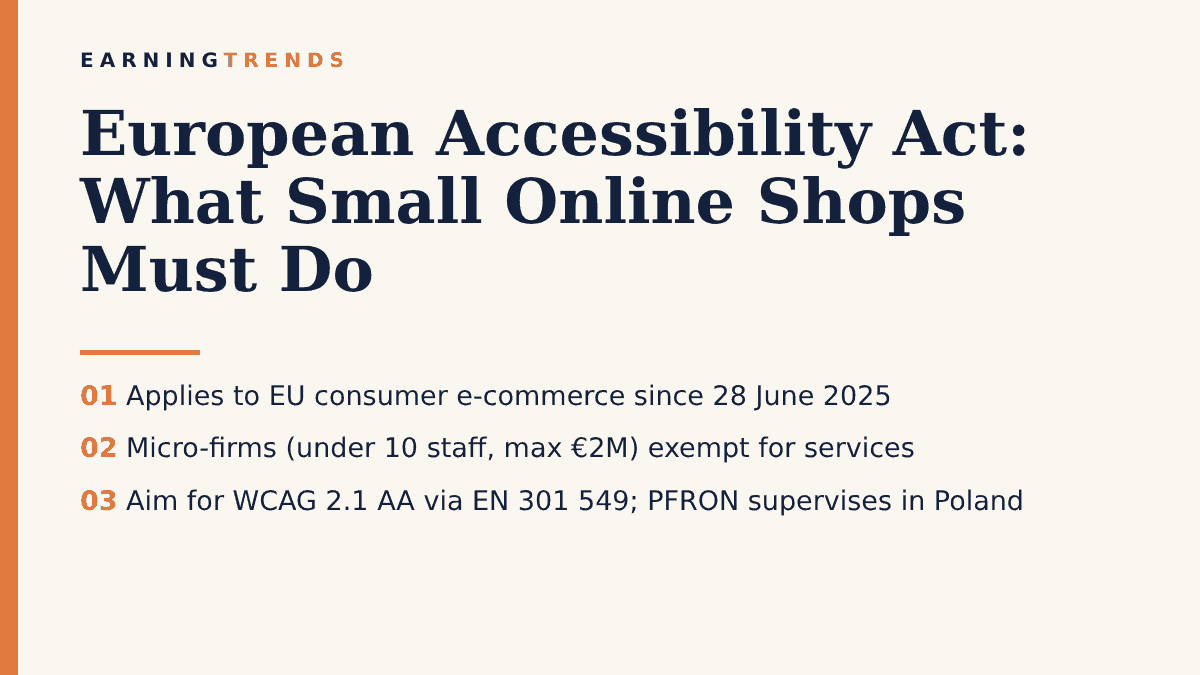
Since 28 June 2025, the European Accessibility Act (EAA) has required many businesses that sell to consumers online in the EU to make their websites, apps and checkout processes accessible to people with disabilities. If you run a small online shop or a service website, the key questions are simple: does the law apply to you, and if so, what do you have to fix? In short, micro-enterprises that provide services (fewer than 10 employees and no more than €2 million in annual turnover or balance sheet) are exempt. Most other businesses selling to consumers online are covered. In Poland, the PFRON president supervises the rules, and fines can reach ten times the average monthly salary.
What the European Accessibility Act is
The EAA is EU Directive 2019/882. It sets common accessibility requirements for a list of products and services, so that people with visual, hearing, motor or cognitive impairments can use them on equal terms. Each member state has turned it into national law, and the obligations have applied since 28 June 2025.
The law covers products such as computers, smartphones, e-readers, ATMs and payment terminals. It also covers services, including telecoms, banking, e-books, passenger transport and e-commerce. For most small businesses, e-commerce is the part that matters.
What counts as an e-commerce service?
E-commerce services are interpreted broadly. They include selling any product or service online to consumers, through a website or an app, covering every step towards the purchase, not just the checkout. Product pages, search, filters, the basket, account sign-up, payment and order confirmation are all in scope. The rules also apply to businesses outside the EU that sell to EU consumers.
Purely B2B sales are generally outside the e-commerce rules, because the EAA protects consumers. If consumers can in practice buy from you, however, a note in your terms saying “business customers only” is unlikely to be enough.
Who is exempt: the micro-enterprise rule
The EAA exempts micro-enterprises that provide services. A micro-enterprise employs fewer than 10 people and has an annual turnover, or annual balance-sheet total, of no more than €2 million. Poland’s implementing law contains the same exemption for service providers.
Keep in mind three limits:
- It covers services, not products. A micro-shop can be exempt for running its website but still have obligations if it sells covered products, such as e-readers or computers.
- Growth ends it. Once you pass the employee or financial threshold, the exemption no longer applies, so plan ahead if you are growing.
- Platforms may still expect it. Marketplaces and shop platforms are covered themselves and are improving accessibility. Your listings and content benefit from following the same practices.
Even if you are exempt, accessibility is good business. Clear layouts, readable text and forms that work with a keyboard help every customer, and they often improve conversions and SEO too.
How the EAA works in Poland
Poland implemented the directive through the act of 26 April 2024 on ensuring that certain products and services meet accessibility requirements (ustawa o zapewnianiu spełniania wymagań dostępności niektórych produktów i usług przez podmioty gospodarcze), often called the Polish Accessibility Act. It has applied since 28 June 2025.
- Supervision: the President of the PFRON Management Board is the main market-surveillance authority, alongside sector bodies such as the President of UKE and the Financial Ombudsman.
- Service provider duties: assess whether your service meets the requirements, publish information about its accessibility, and keep it compliant over time.
- Consumer complaints: consumers can complain directly to the business, which must respond within 30 days. If it does not, the complaint is treated as accepted.
- Penalties: administrative fines of up to ten times the average monthly salary in the national economy for the previous year, but no more than 10% of the company’s turnover in that year. Based on the 2024 average salary, the ten-times figure was roughly 81,800 zł.
Other EU countries have their own authorities, fines and procedures, so check the national rules if you sell into Germany, France or elsewhere.
The technical standard: EN 301 549 and WCAG
The EAA describes accessibility in functional terms. Your website or app must be perceivable, operable, understandable and robust, and information must be available through more than one sensory channel. In practice, businesses use the European standard EN 301 549 to meet these requirements. For web content, EN 301 549 relies on the Web Content Accessibility Guidelines (WCAG), and WCAG 2.1 level AA is the usual target.
Using a harmonised standard is voluntary, but it is the most practical way to show your site meets the law. The European Commission has asked for EN 301 549 to be updated to cover all EAA requirements, so watch for revisions.
Exempt or covered: quick comparison
| Micro-enterprise (services) | Other business selling online to consumers | |
|---|---|---|
| Size | Fewer than 10 staff and up to €2M turnover or balance sheet | Above either threshold |
| EAA duties for its website or app | Exempt | Must meet accessibility requirements |
| Accessibility information | Not required (recommended) | Required |
| Selling covered products (e.g. e-readers) | Product rules still apply | Product rules apply |
| Risk of fines in Poland | Low for the service itself | Up to 10× average monthly salary, max 10% of turnover |
Practical accessibility checklist for small shops
You do not need to rebuild your site to make real progress. Work through these steps, starting with the pages that make you money.
- Check whether you are covered. Count employees and check turnover. Write down your conclusion and the figures behind it.
- Run an automated scan. Free tools such as WAVE, Lighthouse in Chrome or axe flag missing alt text, low contrast, empty buttons and form errors. They catch only part of the issues, but they are a quick start.
- Test with a keyboard only. Go from the home page to a finished order using Tab, Enter and the arrow keys. Every menu, filter, pop-up and payment field should be reachable, with a visible focus outline.
- Fix images and media. Add descriptive alt text to product photos, mark decorative images as decorative, and add captions or transcripts to videos.
- Improve contrast and text. WCAG AA requires a contrast ratio of at least 4.5:1 for normal text. The page should still work when text is enlarged to 200%.
- Label forms clearly. Every field needs a visible label, and error messages should explain what went wrong in words, not just with a red border.
- Review your theme, plugins and payment provider. Ask your platform, theme developer and payment provider what they have done for EAA compliance. Many issues sit in third-party code.
- Publish accessibility information. Explain how your service meets the requirements, any known limitations and how customers can contact you for help.
- Repeat after changes. Recheck after redesigns, new plugins or new checkout steps, because accessibility can break quietly.
Many of these issues overlap with the conversion problems we covered in 7 hidden website flaws killing your sales. If you want a structured review of your site’s usability, tracking and SEO in one go, our Digital Performance Audit is a good starting point. It complements a dedicated accessibility audit rather than replacing it.
Common mistakes to avoid
- Relying on an “accessibility overlay” widget. A toolbar plugin does not fix the underlying code and is not a substitute for meeting WCAG.
- Assuming you are exempt without checking. Both the employee and the financial thresholds matter.
- Testing only the home page. Checkout, account creation and cookie banners are where shoppers most often get stuck.
- Ignoring third-party tools. Payment widgets, chat pop-ups and review plugins are part of your service in the customer’s eyes.
- Treating it as a one-off project. Every new product page and campaign landing page needs the same basics.
FAQ
Does the European Accessibility Act apply to my small online shop?
It applies if you sell online to consumers in the EU and you are not a micro-enterprise. Businesses with fewer than 10 staff and no more than €2 million turnover or balance sheet are exempt for their services.
Which standard should my website meet?
Most businesses use EN 301 549, which relies on WCAG 2.1 level AA for web content. Meeting it is the most practical way to show compliance.
Who enforces the rules in Poland and what are the fines?
The President of PFRON is the main supervisor. Fines can reach ten times the previous year’s average monthly salary, capped at 10% of the company’s turnover.
Is an accessibility plugin enough?
No. Overlays can help some users adjust the display, but they do not fix missing labels, keyboard traps or poor structure in your site’s code.
Conclusion
The European Accessibility Act is now in force, and for most online shops above micro size it is a legal requirement, not a nice-to-have. Start by checking whether you are covered, then work through the checklist on your key pages, ask your platform and plugin providers about their compliance, and publish clear accessibility information. Even micro-businesses that are exempt can gain from a site that every customer can use. For broader site improvements, see also how a digital performance audit uncovers hidden growth blocks.
This article is general information, not legal advice. Requirements and penalties differ between EU countries, so check with a qualified lawyer or accessibility specialist about your situation.
Sources
- PARP – New accessibility rules for products and services (Dec 2025)
- Infor.pl – Fines under the Polish Accessibility Act
- Bird & Bird – EAA guide for online retailers and platforms
- European Commission – European accessibility standards
- Xictron – EAA exemptions for micro-enterprises (2026)
Images: EarningTrends graphic.