Side Hustles You Can Do During Nap Time (No Startup Money)
Nap time is often the only quiet hour in your day, and most “work from home” ideas assume you have a full afternoon or money to invest. This guide gives you six side hustles that cost nothing to start, a 60-minute nap-time work plan, and honest numbers on what each one pays and what it takes in fees. Pick one, try it for two weeks, and keep what fits your baby’s schedule.
How much time do you really have?
A nap that lasts 60 minutes does not give you 60 minutes of work. You need a few minutes to settle the baby, a few to switch your brain on, and a few to wrap up. In practice, plan for about 40 focused minutes per nap.
| Naps you use per week | Focused minutes each | Real work time per week |
|---|---|---|
| 3 | 40 | 2 hours |
| 5 | 40 | about 3 hours 20 minutes |
| 7 | 40 | about 4 hours 40 minutes |
That is why the best nap-time hustles are ones you can stop in the middle without losing money or upsetting a client. If the baby wakes after 20 minutes, you close the laptop and pick it up tomorrow.
The 60-minute nap-time work plan
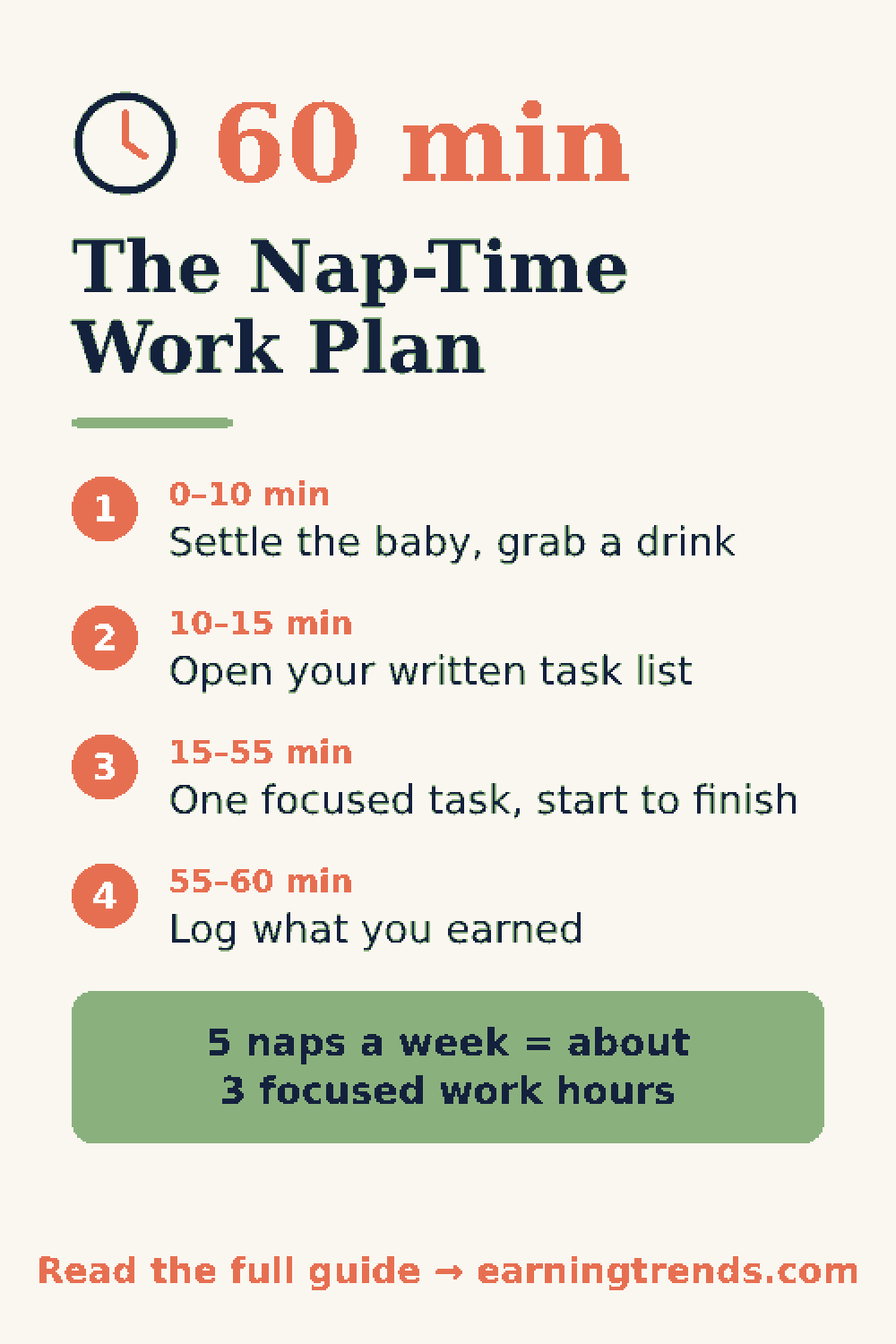
- Minutes 0–10: Settle the baby, grab a drink, sit down. Don’t open email or social media.
- Minutes 10–15: Open the task list you wrote the night before. One line per task, smallest first.
- Minutes 15–55: Do one task from start to finish: a research study, one listing, one client deliverable.
- Minutes 55–60: Write down what you earned and what’s next. This takes two minutes and saves ten tomorrow.
Keep a “15-minute task” ready for short naps, such as answering a buyer message or taking photos of one item to sell. Short naps still count.
6 nap-time side hustles that cost $0 to start
1. Paid research studies
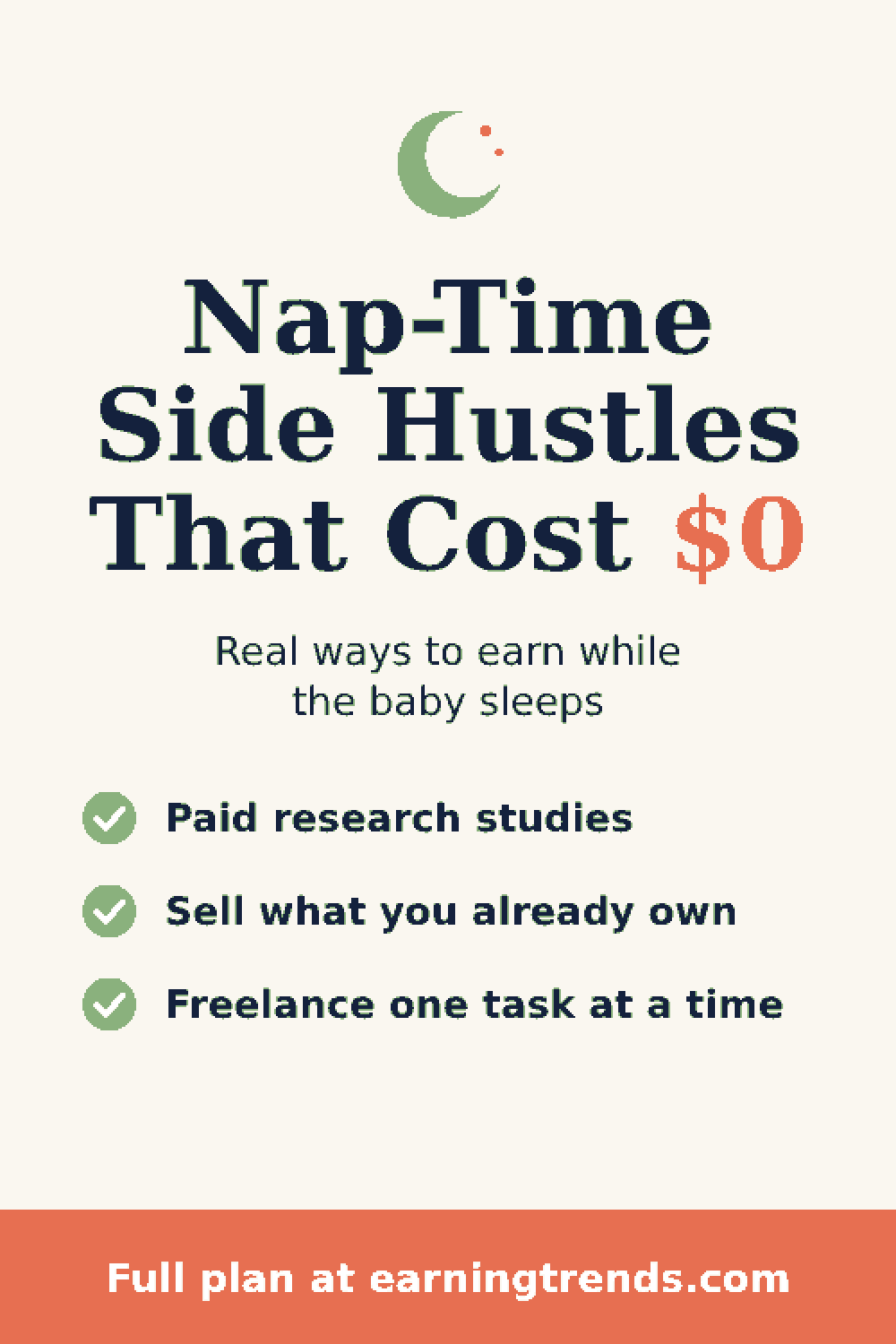
Academic and company researchers pay people to answer surveys and do short tasks. On Prolific, researchers must pay at least $8 (£6) per hour, and the platform recommends $12 (£9) per hour or more. Each study shows the pay and estimated time before you start, so you can pick ones that fit a single nap.
Good to know: studies fill up quickly and are not available all the time, so treat this as occasional extra money, not a steady wage. You may join a waitlist first.
2. Website and app testing
Companies pay testers to use a website or app while speaking their thoughts out loud. UserTesting does not publish a fixed rate: pay depends on the test type and customer demand, and your test feed shows the amount before you start. Payments go to PayPal, usually about 14 days after a completed test.
Nap tip: you need a working microphone and a quiet room, so this suits naps when no one else is home. Tests do not come every day, and you have to pass a short practice test to join.
3. Sell what you already own
Outgrown baby gear, toys and clothes are the easiest money in the house. Facebook Marketplace charges no fee for local pickup sales; shipped orders paid through Facebook have a selling fee of 10% (minimum $0.80). Use nap time for the slow parts: cleaning items, taking photos near a window, writing listings and answering messages.
Nap tip: schedule pickups for when your partner is home, meet in a public place if you prefer, and only hand over items after you’re paid.
4. Freelance one small task at a time
If you have a skill from before kids, such as proofreading, formatting resumes, writing product descriptions or bookkeeping, you can sell it as a small, fixed-price job. On Fiverr, the platform keeps 20% of each order, including tips, so a $50 job pays you $40.
Nap tip: offer small jobs with long delivery times (three to five days). That way one sick day never puts you behind.
5. Printables and digital downloads
Meal planners, chore charts and budget sheets can be made once and sold many times. On Etsy, each listing costs $0.20 for four months, and a sale costs a 6.5% transaction fee plus payment processing (3% + $0.25 in the US). Etsy may also charge a one-time shop setup fee depending on your location, so check before you open a shop.
Good to know: this is the slowest hustle on the list. Expect weeks of building listings before regular sales, if they come at all.
6. Behind-the-scenes help for a local business
Small businesses near you (a hair salon, a cleaner, a church office) often need someone to answer emails, update a booking calendar or schedule social posts. None of this has to happen live. Agree a price per task up front, in writing, and only take work that can wait a few hours for a reply.
Side-by-side: fees and pay timing
| Hustle | Startup cost | Platform fee | Can you stop mid-task? |
|---|---|---|---|
| Research studies (Prolific) | $0 | None to participants | Usually no – finish the study |
| App testing (UserTesting) | $0 (needs a microphone) | None to testers | No – needs a quiet block |
| Selling your things (Marketplace) | $0 | 0% local, 10% shipped | Yes |
| Freelance tasks (Fiverr) | $0 | 20% of each order | Yes, with long deadlines |
| Printables (Etsy) | $0.20 per listing | 6.5% + payment processing | Yes |
| Local business help | $0 | None | Yes |
Bonus editorial: what most nap-time hustle lists get wrong
Most lists count your whole nap as paid time and then multiply by an hourly rate. Here is the honest math.
Say you use five naps a week and get 40 focused minutes from each. That’s about 3.3 hours. If every one of those hours went into research studies paying Prolific’s $8 minimum to the recommended $12, you’d earn roughly $27 to $40 a week. But studies are not always there when your baby sleeps, so the real number is usually lower.
The lesson: choose your hustle by how well it survives interruptions, not by the top hourly rate. A listing you write in three short bursts still sells. A freelance job with a five-day deadline still gets done. A live call that the baby interrupts does not. Combining two pause-friendly options, such as selling what you own plus one freelance service, tends to beat chasing the highest-paying gig.
Your nap-time side hustle checklist
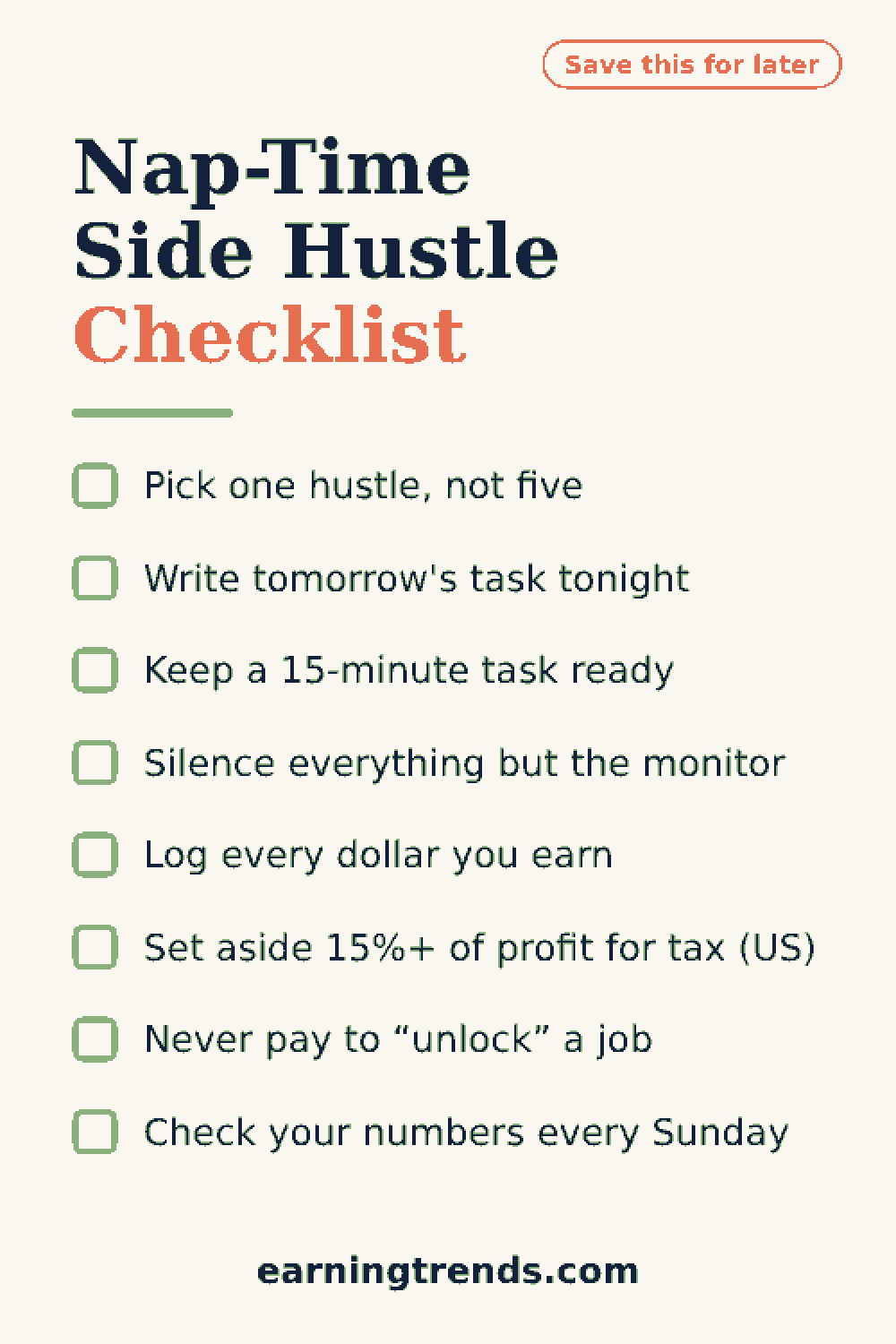
- Pick one hustle, not five. Add a second only after two weeks.
- Write tomorrow’s task list tonight.
- Keep a 15-minute task ready for short naps.
- Silence everything except the baby monitor.
- Log every dollar you earn in one simple note or spreadsheet.
- Set aside 15% or more of your profit for taxes (US).
- Never pay to “unlock” a job or buy a starter kit.
- Check your numbers every Sunday and drop what isn’t working.
Save this checklist to your Pinterest board for later.
Taxes and scams: the part that protects your money
US: if your net earnings from self-employment reach $400 or more in a year, you must file and pay self-employment tax. The rate is 15.3% (12.4% Social Security plus 2.9% Medicare), applied to 92.35% of your net earnings, which works out to about 14.1% of your profit before any income tax. That’s why the checklist says to set aside 15% or more. Payment apps and marketplaces only have to send you a Form 1099-K if you receive more than $20,000 across more than 200 transactions in a year, but your income is taxable even without that form.
UK: the trading allowance lets you earn up to £1,000 a year of trading income tax-free. Check the GOV.UK guidance if you go over that amount.
Scam check: real platforms pay you; they don’t charge you to start. Walk away from anyone who asks for a fee, a starter kit, your bank login, or to “reship” packages.
Give every extra dollar a job
Side money disappears fastest when it lands in your everyday account. Decide now where it goes. A good first target is a small cushion, and this $1,000 emergency fund plan for one-income families shows how to build it. After that, send it to the sinking fund categories that usually catch you off guard, like car repairs and birthdays. If you don’t have a budget yet, start with how to budget on one income with kids.
FAQ
How much can I realistically make during nap time?
With about three focused hours a week, most people start with tens of dollars a week, not hundreds. Selling items you already own often pays the most in the first month, because the stock is free. Earnings from studies and tests depend on what’s available when you’re free.
What if my baby’s naps are short or unpredictable?
Stick to hustles you can pause: selling items, printables, and freelance work with long deadlines. Keep a list of 15-minute tasks so even a short nap moves something forward.
Do I have to pay tax on small side income?
In the US, self-employment tax applies once your net self-employment earnings reach $400 in a year, and you report your income even if you don’t get a 1099 form. In the UK, the £1,000 trading allowance covers small amounts. When in doubt, ask a tax professional.
Start today
Tonight, walk through one room and pick three things your kids have outgrown. Tomorrow at nap time, photograph them and post one listing. That’s your first nap-time hustle, started for $0.
Sources
- Prolific – payment model and minimum rate
- UserTesting – contributor FAQ
- Etsy – fee basics
- LitCommerce – Facebook Marketplace selling fees (10% shipped, from April 2024)
- Wise – Fiverr seller fees
- IRS – Topic 554, self-employment tax
- IRS – Form 1099-K threshold FAQs
- GOV.UK – tax-free trading allowance