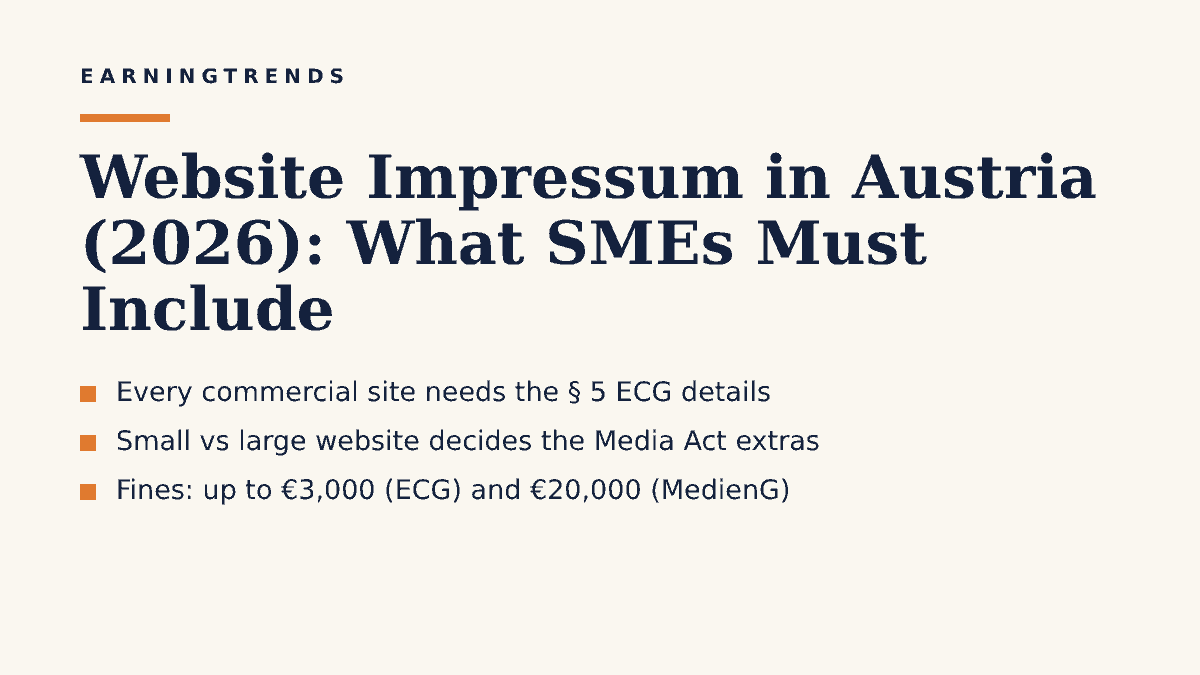
Website Impressum in Austria (2026): What SMEs Must Include
If you run a business website, webshop, blog or even a business social media profile in Austria, you need an Impressum (legal notice). Austria has no single “Impressum law”: the required details come from four different sources, the E-Commerce Act (ECG), the Commercial Code (UGB), the Trade Regulation Act (GewO) and the Media Act (MedienG). This guide explains which rules apply to a small business, what to list, and how to avoid the most common gaps.
Which Austrian laws require an Impressum?
According to the Austrian Economic Chamber (WKO), each law has its own scope, and most small businesses are covered by at least three of them at once:
| Law | Who it applies to | What it adds |
|---|---|---|
| § 5 E-Commerce Act (ECG) | All commercial websites, whether you sell online or only present your business | Address, contact details, chamber membership, supervisory authority, professional rules, VAT ID |
| § 14 Commercial Code (UGB) | Businesses registered in the company register (Firmenbuch) | Company name, legal form, registered seat, register number and court |
| § 63 Trade Regulation Act (GewO) | Tradespeople not registered in the Firmenbuch | Name and location of the trade licence |
| § 25 Media Act (MedienG) | All websites, private and commercial | Disclosure of the media owner; more details for “large” websites |
The WKO also points out that these duties apply to any form of electronic content, so they cover social media profiles and apps as well as classic websites.
What a small business Impressum must include
Basic company details (UGB or GewO)
- Name, or company name as registered in the Firmenbuch (for sole traders, both if they differ)
- Legal form (only for businesses in the Firmenbuch)
- Registered seat, or the location of your trade licence
- Company register number and register court, if you have them
- If you mention share capital at all: the share or nominal capital and any unpaid contributions
E-Commerce Act details (§ 5 ECG)
- Full geographic address of your actual place of business (one that works for official and court mail, so a P.O. box is not enough)
- Contact details including e-mail so users can reach you quickly and directly. The WKO recommends at least two channels, for example e-mail plus phone or a web form. Webshops must show a phone number and an e-mail address under the Distance and Off-Premises Contracts Act (FAGG).
- Membership of the Chamber organisation (for example the WKÖ and your regional chamber or guild)
- Supervisory authority, if your activity is subject to official supervision. The WKO recommends always naming your trade authority, such as your district authority (Bezirkshauptmannschaft).
- Applicable trade or professional rules (usually the GewO) and access to them, for example a link to the federal legal database at ris.bka.gv.at
- If applicable: your regulated professional title and the country where it was granted
- Your VAT identification number (UID), if you have one
Media Act disclosure (§ 25 MedienG)
On top of the above, every website needs a media owner disclosure. For a small website this is short:
- Name or company of the media owner (usually the site owner)
- Business purpose (Unternehmensgegenstand)
- Place of residence or registered seat
You can publish these Media Act details together with the ECG and UGB/GewO information in one Impressum page.
Small vs large website: why your blog matters
The Media Act separates “small” and “large” websites. A site is large when its content goes beyond presenting the company and is capable of influencing public opinion. Sites that only promote the business, its products or its services are small, and a simple webshop without editorial articles counts as small.
The WKO’s own examples are useful: a carpentry webshop that only advertises its products is small, but if it starts publishing general opinion pieces, for instance criticising the use of certain types of wood, it becomes large. Product reviews or a guestbook for customer feedback do not make a site large. A hotel website that also writes about regional sights is a borderline case, and the WKO suggests linking to other pages rather than writing your own articles if you want to stay small.
If you run a company blog with general industry commentary, assume you may have a large website. Large websites must additionally disclose:
- A statement of the site’s basic direction (Blattlinie), for example “information about the company’s goods and services and promotion of their sale”
- For companies: the persons authorised to represent it (such as managing directors or board members) and supervisory board members
- For companies: all direct and indirect shareholders with their stakes and voting rights, including trust arrangements and silent partnerships
- Any media companies in which these persons hold a stake
- For associations: the board and the association’s purpose; for foundations: founders and beneficiaries
Step by step: setting up your Impressum
- Identify your situation. Are you in the Firmenbuch (e.U., OG, KG, GmbH, AG) or a trade licence holder without registration? That decides whether UGB or GewO details apply.
- Decide small or large. Look honestly at your blog, newsletter archive and social posts.
- Collect the data. Register number and court, UID, trade authority, chamber memberships, professional title.
- Create one clearly labelled page. Call it “Impressum” and link it from every page, typically in the footer, and from your social profiles.
- Optionally use the WKO ECG service. Chamber members can fill in the “E-Commerce-Gesetz (ECG)” section of their free entry in the WKO Firmen A-Z directory and link to it. The WKO stresses this is an add-on: the Impressum should still be published directly on your own site.
- Add a separate privacy policy. See the next section.
- Review once a year and whenever your address, legal form, ownership or UID changes.
Related duties people often mix up
Privacy policy (GDPR and TKG 2021)
Operators of commercial websites must tell users which personal data they collect, process and transfer, on what legal basis, for what purpose and for how long (§ 165 TKG 2021, plus the GDPR). The WKO advises putting this in a separate privacy policy rather than hiding it inside the Impressum, noting that the European Data Protection Board considers a mention in the Impressum alone insufficient. If you use cookies or tracking, our guide to cookie banner rules covers the consent side in a neighbouring EU market.
The old ODR link can go
The EU Online Dispute Resolution Regulation was repealed with effect from 20 July 2025. According to the WKO, the former mandatory notice and link to the EU ODR platform should be removed from websites.
Professional liability insurance details
Under the Services Act (DLG), a few regulated trades with mandatory professional liability insurance (for example master builders, real estate agents, financial advisers and insurance intermediaries) must give insurer details to clients. This does not have to sit in the Impressum, but it must be easy to find.
Fines and other risks
- E-Commerce Act: breaching the general information duties of § 5 ECG is an administrative offence with a fine of up to €3,000 (§ 26 ECG).
- Media Act: failing to publish the required Impressum or disclosure, or giving incomplete or incorrect details, can be fined up to €20,000 (§ 27 MedienG).
- Competitors: missing information can also be challenged under unfair competition law (UWG), with injunction claims that can be costly to defend.
Selling across borders
Under the country-of-origin principle (§ 20 ECG), Impressum rules follow the law of the country where the site operator is established. Still, the WKO recommends also checking the rules of countries you deal with often. Germany, for example, has similar rules but requires naming the managing director even on small websites, so Austrian businesses selling into Germany are advised to list their managing directors or board anyway. If you also run newsletters, read our overview of email marketing rules in Germany, and webshops should check the European Accessibility Act duties for small online shops.
Common mistakes
- Copying a German Impressum template without the Austrian items (chamber membership, trade authority, applicable rules with RIS link, Media Act disclosure).
- Listing only a contact form, or a P.O. box instead of a full street address.
- Forgetting the Impressum on Instagram, Facebook, LinkedIn or in an app.
- Adding a blog with opinion pieces but keeping a “small website” disclosure.
- Relying only on the WKO Firmen A-Z link instead of publishing the details on your own site.
- Leaving the outdated ODR platform link on the page.
- Not updating the page after moving, changing legal form or adding shareholders.
A legal notice is only one piece of a trustworthy website. If you want an outside check of your site, tracking and conversion setup, our Digital Performance Audit reviews it end to end.
FAQ
Do I need an Impressum if I only have a one-page site?
Yes. The ECG duties apply to every commercially operated website, even one that only presents your business without selling anything, and the Media Act disclosure applies to all websites.
Does a private hobby blog need one?
The ECG rules target commercial sites, but the WKO notes that the Media Act disclosure applies to private websites too. What exactly a private site must show depends on its content, so check the official Media Act guidance if you are unsure.
Can I put the Impressum on my social media profile?
The duties apply to social media as well. In practice, many businesses add a clearly labelled “Impressum” link in the profile that leads to the full page on their website.
Is a master craftsman title a required professional title?
No. The WKO sample notices show the master title, but state that it is not a professional title you are obliged to list under the ECG.
Conclusion
For most Austrian small businesses, a compliant Impressum is a one-time job of an hour or two: combine the § 5 ECG details, your UGB or GewO company data and a Media Act disclosure on one page, link it everywhere you publish, and keep your privacy policy separate. The real risk is drift, so review the page whenever your business details or content strategy change. This article is general information, not legal advice; for complex ownership structures or regulated professions, check with your regional chamber or a qualified lawyer in Austria.
Sources
- WKO: Das korrekte Website Impressum (brochure, status August 2025)
- WKO: Informationspflichten nach dem E-Commerce-Gesetz
- USP (Austrian business service portal): Impressumspflicht gemäß § 24 Mediengesetz
- RIS: § 27 Mediengesetz (version in force from 1 May 2026)
- RIS: E-Commerce-Gesetz (ECG), current version