Selling Second-Hand Online in Lithuania (2026): Vinted and Tax
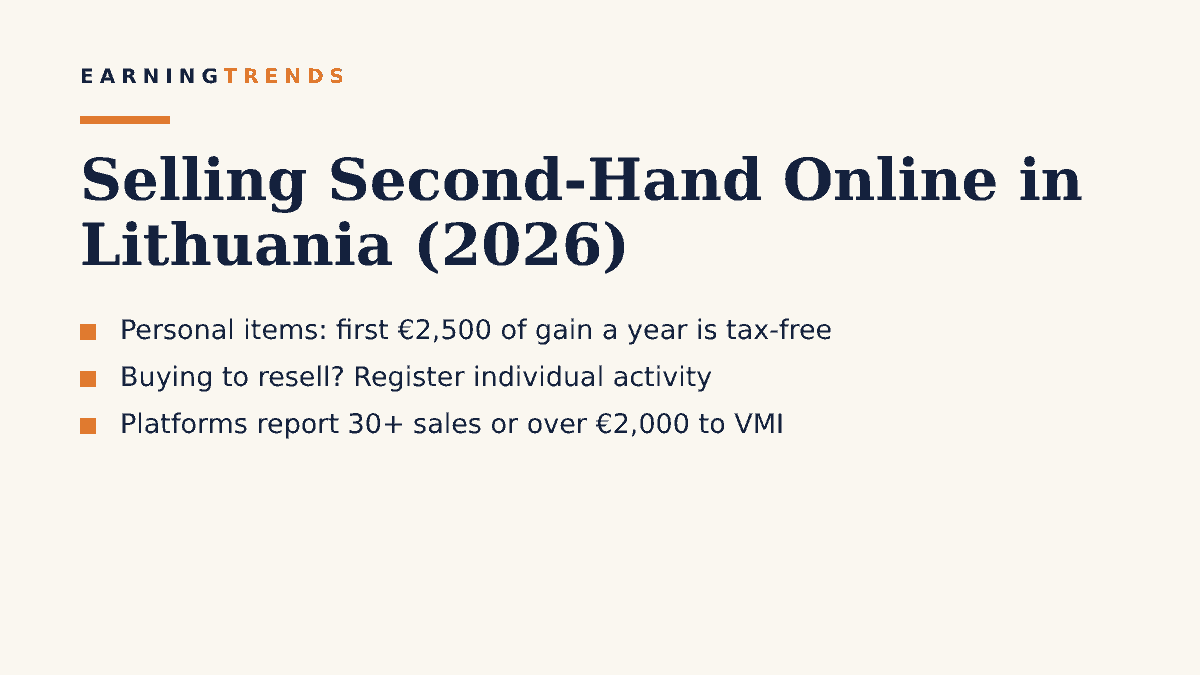
Selling your own used clothes, books or gadgets online in Lithuania is usually tax-free. Lithuania’s tax authority, VMI (Valstybinė mokesčių inspekcija), only taxes the gain on such “other property” above €2,500 a year. Most people sell below what they paid, so they have no gain at all. The picture changes if you buy items to resell. That is business activity, and you need to register it and pay tax. Since DAC7, platforms such as Vinted also report sellers with 30 or more sales, or more than €2,000 in sales a year, to VMI. Here is how it works, and how to choose where to sell.
Where Lithuanians sell second-hand online
Vinted
Vinted was founded in Lithuania, and its contracting company, Vinted UAB, is based in Vilnius. Its Lithuanian site says uploading items is free and there are no selling fees, so the seller keeps the full item price. The buyer pays a separate Vinted fee at checkout. Sellers drop parcels at a parcel locker within 5 days of a sale, and payment is released once the buyer confirms everything is fine. Buyers have 2 days from delivery to report a problem. Vinted works best for clothing, shoes, children’s items, books and small home goods.
Skelbiu.lt and other classifieds
Skelbiu.lt is a large Lithuanian classifieds portal for almost every category, from furniture to electronics and cars. Its FAQ says listings are paid for legal entities and for private individuals whose listings relate to commercial activity. Private sellers of personal items can therefore usually post without paying. Optional paid “stars” move a listing higher in the results. Classifieds suit bulky items, local pickup and higher-value goods where buyers want to see the item first. Payment and delivery are arranged between buyer and seller, so there is no built-in buyer protection.
Specialist and international platforms
For cars there are portals such as Autoplius.lt. For collectibles or international buyers, eBay and Etsy also reach Lithuanian sellers. If you plan to sell handmade or vintage items abroad, our guide to selling on Etsy from Poland explains how Etsy fees and payouts work for sellers in the region.
Platform comparison
| Platform | Best for | Seller fees | Buyer protection | Shipping |
|---|---|---|---|---|
| Vinted | Clothing, kids’ items, books, small goods | No selling fee (buyer pays Vinted fee) | Yes, for purchases via “Buy” | Prepaid label, parcel lockers |
| Skelbiu.lt | Furniture, electronics, bulky or local items | Free for private personal listings; paid boosts | No built-in protection | Arranged by seller and buyer |
| Autoplius.lt | Cars and vehicles | Basic listing; paid upgrades | No | In person |
| eBay / Etsy | Collectibles, vintage, international buyers | Listing and transaction fees | Platform-dependent | International shipping |
Fees can change, so check each platform’s current price list before you list.
Taxes: when you owe nothing and when you do
Selling your own personal items
VMI classes used personal belongings (clothes, books, furniture and so on) as property “not subject to registration”. Its rules:
- If your income from selling such property in a year does not exceed €2,500, there is no personal income tax to pay.
- Above that, tax is calculated on the gain: sale proceeds minus purchase price minus compulsory selling costs, minus €2,500. The result is taxed at 15%.
- The €2,500 limit covers all sales of this kind of property in the year combined. It also includes, for example, sales of standing timber.
In plain terms, most people clearing out their wardrobe sell for less than they paid, so there is no gain to tax. VMI’s deputy head Martynas Endrijaitis told Lithuanian media that people who simply sell their own unneeded things owe no tax unless their gain for the year exceeds €2,500. Vinted’s Lithuanian tax page says the same.
From 2026, Lithuania introduced progressive income tax rates. VMI guidance says non-employment income up to 12 average monthly wages a year (€27,745.80 in 2026) is taxed at 15%, with higher rates on amounts above that. That only matters for very large sales.
Cars and other registered property
Cars and other movable property that must be registered work differently. VMI says the sale is tax-free if you owned it for at least 3 years. If the property is registered in an EEA country and you owned it for 3 years or more, you don’t even have to declare the sale. Otherwise the gain is taxed and must be declared.
Buying to resell is a business
If you buy items specifically to sell them on, whether new stock, charity-shop finds or bulk lots, this is no longer selling personal property. Lithuanian media coverage of VMI guidance is clear: a person who buys new items specifically to sell on Vinted must register individual activity (individuali veikla) and pay the taxes that come with it. You can get an individual activity certificate through the My VMI portal. VMI also points out that for tax purposes it makes no difference whether you sell in person, online or through a platform. If your turnover grows large, VAT registration may also apply. VMI uses a €45,000 annual threshold.
DAC7: what Vinted and others report to VMI
Under the EU DAC7 directive, platforms report sellers to tax authorities once a year. Vinted’s Lithuanian help page says it will contact you, and ask you to complete a short report, if in a calendar year you:
- made 30 or more sales, or
- sold more than €2,000 worth of items.
Being reported does not mean you owe tax. VMI pre-fills platform data into the annual income tax return (form GPM311). Its DAC7 guidance repeats that the difference between sale price and purchase price for “other property”, up to €2,500 a year, is not taxed, even when the data appears in your return. Check the pre-filled figures and correct them if needed. Keep receipts or other proof of what you paid for valuable items.
The annual return is normally due by 1 May of the following year. VMI data reported by LRT shows that about 6,800 residents declared income from selling other property for 2024.
Step by step: selling safely and staying compliant
- Sort what you sell. Keep personal clear-out sales separate from anything you bought to resell.
- Choose the platform. Use Vinted for small items you can ship. Use Skelbiu.lt or a specialist portal for bulky, local or high-value goods.
- Price realistically. Check sold listings for similar items. Remember that Vinted buyers pay the item price, shipping and the Vinted fee.
- Keep records. Save purchase receipts for valuable items and export your sales history at year-end.
- Watch the thresholds. If you get close to 30 sales or €2,000 on one platform, expect a DAC7 request. If your gain may exceed €2,500, plan to declare it.
- Register if you trade. If you are buying to resell, register individual activity before you scale up.
Common mistakes
- Assuming a DAC7 report means you owe tax, or ignoring it. Complete it, then check your pre-filled return.
- Treating resale stock as “personal items” to stay under the €2,500 rule.
- Not keeping proof of purchase price for expensive items such as designer goods or electronics.
- Paying outside the platform. On Vinted, buyer protection only covers purchases made with the “Buy” button.
- Forgetting the 3-year rule when selling a car.
FAQ
Do I pay tax on Vinted sales in Lithuania?
Usually not, if you sell your own used items. Tax applies only if your gain on such sales exceeds €2,500 in a year, or if you buy items to resell, which is business activity.
Does Vinted report me to VMI?
Yes, if you reach 30 sales or more than €2,000 in a calendar year on the platform, under DAC7. Reporting alone does not create a tax bill.
Is Skelbiu.lt free for private sellers?
According to its FAQ, paid listings apply to companies and to individuals selling as part of commercial activity. Optional boosts cost extra.
What counts as “individual activity”?
Regular, profit-seeking selling, such as buying stock to resell or making and selling products. Register it with VMI before you start trading.
Conclusion
Lithuania is one of the easiest places in Europe to sell second-hand online. Vinted charges sellers nothing, classifieds are free for personal listings, and the €2,500 annual allowance on gains means most people owe no tax. Keep personal sales separate from any reselling side hustle, keep basic records, and check your pre-filled return every spring. For comparison with other countries, see our guides to selling second-hand in Belgium and selling second-hand in Italy.
This article is general information, not tax advice. Tax rules depend on your own situation, so check with a qualified tax advisor in Lithuania, or with VMI, if you are unsure.