PEA in France (2026): Tax, Ceilings and How It Works
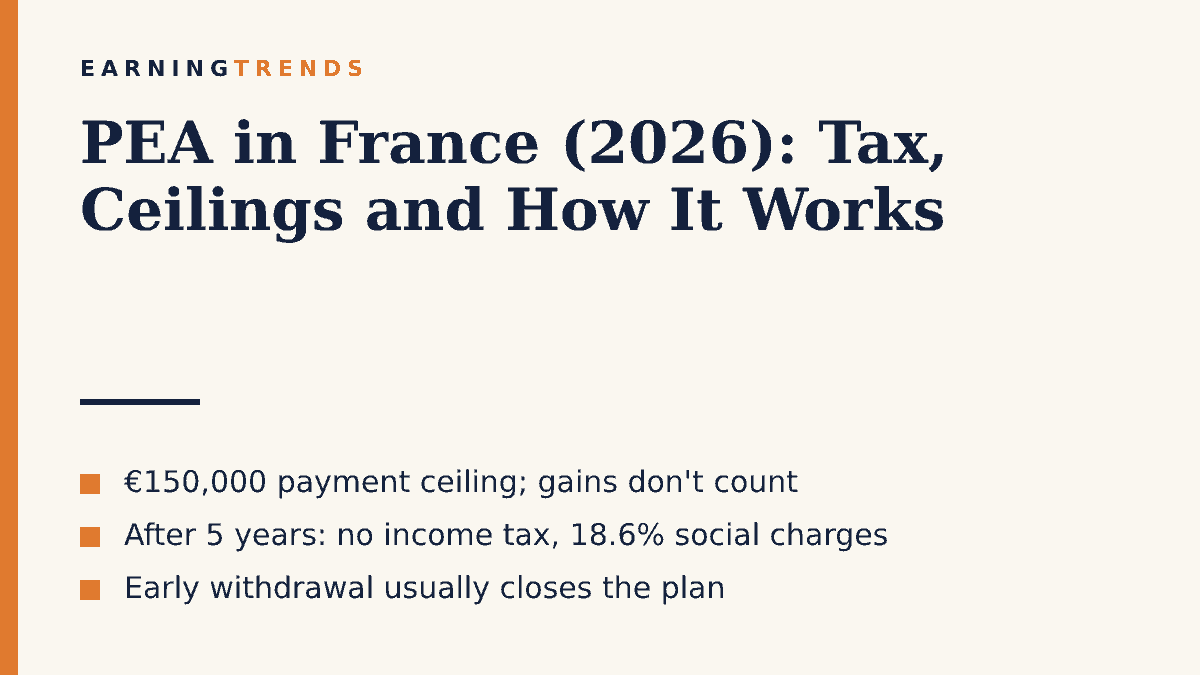
If you are a tax resident in France and want to invest in shares for the long term, the Plan d’épargne en actions (PEA) is usually the first account to look at. Gains inside it are not taxed while they stay invested, and after five years your withdrawals are free of income tax. Only social charges remain, and they rose to 18.6% on 1 January 2026. Here is how the PEA works in 2026, what it costs you in tax, and how to avoid the mistakes that cancel out its advantage.
What a PEA is (and who can open one)
A PEA is a regulated French savings wrapper for buying shares of European companies and eligible funds. Banks and online brokers offer it as a PEA bancaire, and insurers offer it as a capitalisation contract (PEA assurance). Whichever form you choose, the ceilings and the tax rules are the same.
To open one you must:
- be an adult (18 or over)
- be tax-domiciled in France (nationality does not matter)
- not already hold another classic PEA, because the law allows only one per person
A PEA is always individual. Joint accounts are not allowed, but each spouse or PACS partner in the same tax household can open their own. The plan’s official start date is the date of your first payment, and that date starts the five-year clock.
The key numbers for 2026
| Item | Rule in 2026 |
|---|---|
| Classic PEA payment ceiling | €150,000 (gains do not count toward it) |
| PEA-PME-ETI ceiling | €225,000, shared with the classic PEA |
| PEA for young adults attached to their parents’ tax household | €20,000 while attached |
| Number of classic PEAs | One per person |
| Withdrawal after 5 years | No income tax on gains; 18.6% social charges |
| Withdrawal before 5 years | Plan closes (limited exceptions); gains taxed at 12.8% + 18.6% |
The €20,000 version is aimed at adult children who are still attached to their parents’ tax household, typically students up to age 25. Once they are no longer attached, the plan becomes a normal PEA and the €150,000 ceiling applies.
How PEA tax works in 2026
The logic is simple once you separate what happens inside the plan from what happens when money comes out.
Inside the plan: no tax while you reinvest
Dividends and capital gains that stay in the PEA are not taxed. You can sell one fund and buy another without triggering anything. Tax is only calculated when you withdraw. There are special rules for dividends from unlisted shares held in a PEA, which can be partly taxable.
Withdrawals after five years
Once the plan has passed its fifth anniversary, your gains are exempt from income tax. You still pay social charges (prélèvements sociaux) on the gain portion of each withdrawal. The 2026 Social Security financing law raised the CSG on capital income from 9.2% to 10.6%, which lifts total social charges from 17.2% to 18.6%. Partial withdrawals after five years do not close the plan, and you can keep paying in afterwards up to the ceiling.
Withdrawals before five years
In principle, any withdrawal before the end of the fifth year closes the whole plan. The gains are then taxed under the flat tax: 12.8% income tax plus 18.6% social charges, a combined 31.4% in 2026. A partial early withdrawal does not close the plan in a few cases, including dismissal, invalidity or early retirement of the holder or their spouse or partner, removing shares of a company in liquidation, and money taken out to create or take over a business (reinvested within three months).
A quick example
Say you paid in €20,000 and the plan is worth €30,000 after six years. If you take everything out, the gain is €10,000. In a PEA you would owe 18.6% social charges, about €1,860. The same gain in an ordinary securities account taxed at the 31.4% flat tax would cost about €3,140. The gap grows the longer you hold and the larger the gains.
What you can hold in a PEA
The PEA is built around European equity. Eligible investments include:
- shares of companies with their registered office in the EU or EEA
- funds (OPCVM, SICAV, ETFs) that keep more than 75% of their assets in eligible European shares
- certain other vehicles listed in the Monetary and Financial Code, such as qualifying ELTIFs
Bonds, most non-European shares and many international funds are not eligible. Some ETFs that track global or US indices are still labelled “PEA-eligible” because of how they are structured, so do not assume either way: check that the fund’s documentation or your broker’s product page marks it as eligible before you buy.
The PEA-PME-ETI is a separate plan focused on small and mid-sized companies. It has its own list of eligible securities and shares the €225,000 overall cap with your classic PEA.
How to open and use a PEA: step by step
- Compare providers. Look at custody fees, transaction fees and the range of eligible ETFs. Online brokers and traditional banks can differ a lot on costs.
- Open early, even with a small amount. Because the five-year clock starts with your first payment, many people open a PEA with a modest deposit just to start the timer.
- Confirm you have no other PEA. Your provider will ask; holding two classic PEAs breaks the rules.
- Pay in cash only. You cannot move shares you already own in an ordinary account into a PEA. Payments must be in money.
- Choose eligible investments. A low-cost diversified ETF is a common core holding for people building passive income over time.
- Leave it alone for five years. Keep emergency savings elsewhere so you never need to touch the PEA early.
If you are comparing wrappers across Europe, the idea is similar to the Swedish ISK and the Norwegian ASK, although the tax mechanics differ in each country.
PEA vs ordinary securities account (CTO)
| PEA | Compte-titres ordinaire (CTO) | |
|---|---|---|
| Ceiling | €150,000 in payments | None |
| Investment universe | Mainly EU/EEA shares and eligible funds | Almost anything |
| Tax on gains held 5+ years | 18.6% social charges only | 31.4% flat tax (or progressive scale on option) |
| Tax while you reinvest inside | None | Each sale with a gain is taxable |
| Flexibility | Early withdrawals normally close the plan | Withdraw any time |
Many French investors use both: the PEA for European equity and eligible ETFs, and a CTO for anything the PEA cannot hold.
Common mistakes
- Withdrawing in the first five years. Even a small withdrawal normally closes the whole plan, and a new plan starts its clock from zero.
- Buying something ineligible. Check eligibility before each purchase, especially for international ETFs.
- Thinking “tax-free” means zero tax. Social charges still apply after five years, and that rate rose in 2026.
- Ignoring fees. A high annual custody fee or expensive trades can eat much of the tax advantage on a small portfolio.
- Opening too late. Every year you wait is a year longer before the income tax exemption applies.
- Expecting a guarantee. The PEA is an envelope, not an investment. Your capital can fall with the markets.
FAQ
Do gains count toward the €150,000 ceiling?
No. The ceiling applies to the money you pay in. If €150,000 of payments grows to €220,000, you are still within the rules.
Can I have a PEA and a PEA-PME-ETI at the same time?
Yes. You can hold one of each, but combined payments cannot exceed €225,000, and the classic PEA alone stays capped at €150,000.
What happens to a PEA when the holder dies?
The plan is closed. Gains are not subject to income tax even if the plan is less than five years old, but the bank deducts social charges.
Can I open a PEA if I do not live in France?
You need to be tax-domiciled in France to open and hold one. If your residence is about to change, ask your provider and a tax adviser before making decisions.
Conclusion
For French tax residents, the PEA remains one of the most efficient ways to build long-term wealth in shares: no tax while you reinvest and no income tax on gains after five years. The 2026 rise in social charges makes it slightly less generous, but the gap with an ordinary account is still large. Open early, stick to eligible low-cost investments and plan your cash so you never have to dip in before year five. For more on investing for regular payouts, see our guide to dividend stocks.
This article is general information, not financial or tax advice. Rules change and your situation may differ, so check with a qualified financial or tax adviser in France before acting.