Where to Sell Kids’ Clothes and Toys for the Most Money
Kids outgrow clothes and toys faster than you can fold them, and that bin in the closet is money sitting still. This guide shows you exactly where each kind of item sells for the most, what every app or store keeps from your sale, and a simple rule for deciding what is worth listing at all. You’ll also get a prep checklist and a worked example with real numbers.
The quick answer: what each place keeps from your sale
The “most money” place depends on the item, not the app. Here is what each option costs you as of November 2026 (US unless noted). Fees change, so glance at the platform’s fee page before you price.
| Where | What it costs you | Best for | How fast you get paid |
|---|---|---|---|
| Facebook Marketplace (local pickup) | $0 | Bulky gear, toy lots, clothing bundles | Cash at pickup |
| Facebook Marketplace (shipped) | 10% of the order, $0.80 minimum | Small items buyers can’t find locally | After delivery |
| Poshmark | $2.95 on sales under $15; 20% on sales of $15+ | Name-brand clothes and shoes | After delivery |
| Mercari | 10% of item price plus buyer-paid shipping | Toys, sets, small gear | After delivery |
| eBay | About 13.6% of the total sale plus $0.40 per order in most categories | Collectible or complete toy sets | After delivery |
| Once Upon a Child (resale store) | No fee; the store makes an offer | In-season clothes when you need cash now | On the spot |
| Just Between Friends (consignment event) | You usually keep 60% (70% if you work a shift), minus a small sign-up fee | Big volume, twice a year | After the event |
| ThredUp Clean Out kit | Payout of 3–15% on items that sell for $5–$19.99; $14.99 standard service fee taken from earnings | Leftovers you don’t want to handle | After items sell, often weeks |
In the UK, Vinted charges sellers no fee (the buyer pays a Vinted fee at checkout), and eBay UK removed selling fees for private sellers in most categories, so both are strong first stops there.
Sort first: the 3-pile method (15 minutes per bin)
Before you open any app, set a 15-minute timer and split one bin into three piles. This decides where everything goes and stops you from photographing items that will never pay for your time.
- List alone: name brands, shoes in great shape, complete toy sets, gear like strollers or high chairs. Anything that should net $10 or more after fees.
- Bundle: plain basics (leggings, onesies, graphic tees), sorted by size and season into lots of 10 or more pieces.
- Store or donate: small items, mismatched pieces, anything with light wear that won’t photograph well.
Prep checklist that gets higher offers
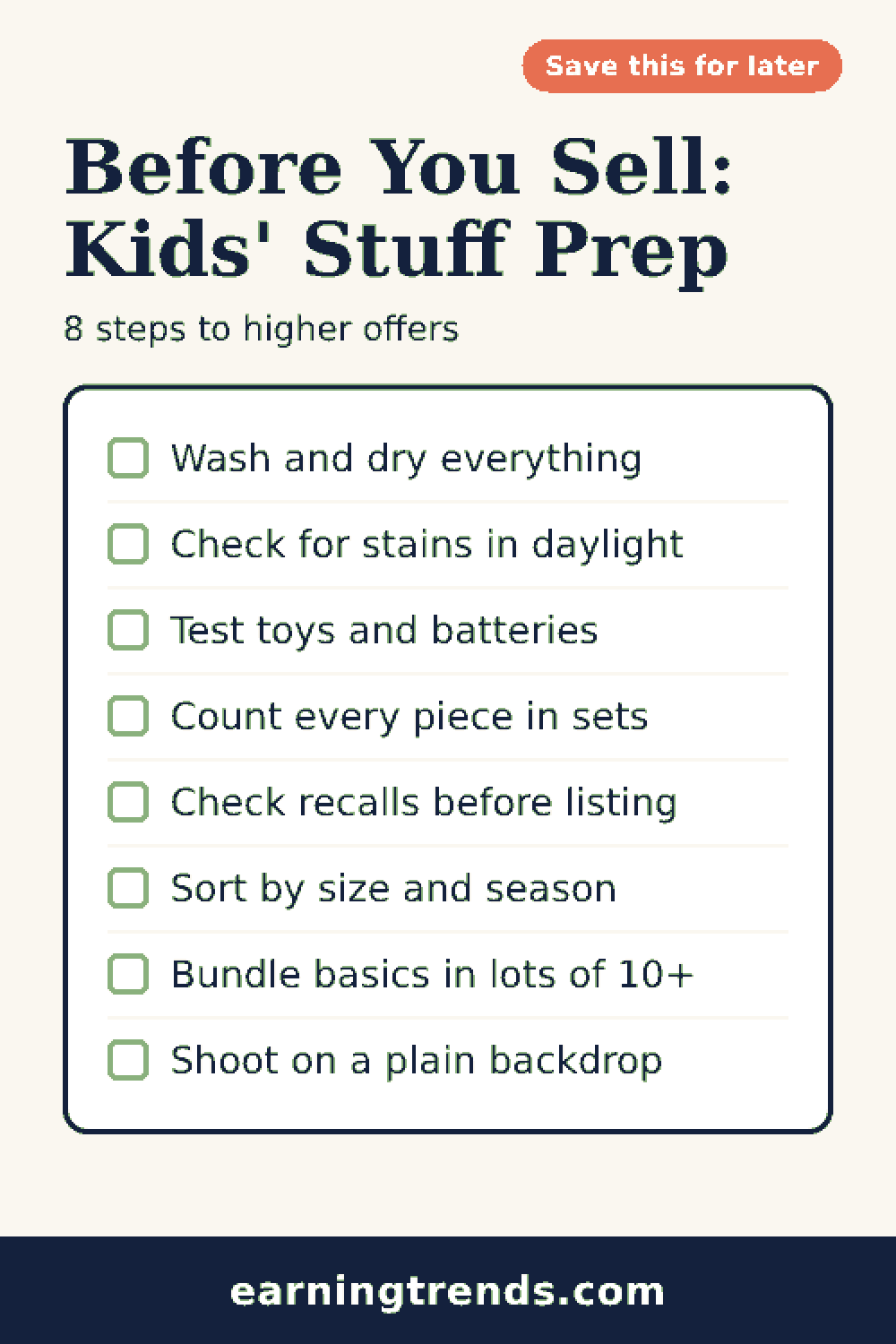
- Wash and fully dry everything. Resale stores ask for freshly laundered clothes.
- Check for stains in daylight, not under a lamp.
- Test toys and put in fresh batteries.
- Count every piece in puzzles, games and building sets, and say “complete” in the listing.
- Check every baby item and toy against the recall list at cpsc.gov/Recalls.
- Sort by size and season so buyers can grab a whole lot.
- Bundle basics into lots of 10+ pieces.
- Photograph on a plain backdrop in daylight: front, back, tag, any flaw.
- For store visits, bring clothes laid flat in a bin or laundry basket. Some stores say wrinkled items from bags lower your offer.
Save this checklist to your Pinterest board for later.
Where each kind of item sells best
Name-brand clothes and shoes: Poshmark or Mercari
Shoppers on these apps search by brand and size, so a single well-photographed item gets seen. Watch Poshmark’s price break: a $14 sale pays you $11.05 (after the $2.95 flat fee), while a $15 sale pays you $12.00. Price at $15 or more, or bundle smaller pieces into one listing. Mercari’s 10% is lower, but it is charged on shipping the buyer pays too.
Everyday basics: size lots on Facebook Marketplace
Plain leggings and onesies rarely sell one by one. A lot like “Girls 4T fall/winter, 15 pieces” saves a parent hours of shopping, and local pickup costs you nothing in fees or postage. Search sold or recent listings near you to price, and meet in a public spot or porch pickup.
Big baby gear: local only
Strollers, high chairs, bouncers and play yards are expensive to ship, so sell them locally. It is illegal to sell a recalled product, so check the model number on cpsc.gov first. The CPSC also warns that cribs made or sold before its June 2011 crib standard are very likely noncompliant and illegal to resell. Many resale stores won’t buy car seats at all; if you sell one locally, include the manufacture and expiration dates printed on the seat.
Toys and building sets: Mercari or eBay when complete
Complete sets, with every piece and the instructions, are what national buyers pay for. Mixed bins of toys sell better as one local lot. Ship small, light items only; a heavy box can eat most of your profit.
Cash this week: a kids’ resale store
At Once Upon a Child you bring items in with no appointment, the store reviews them (some locations quote an average wait of about 20 minutes) and pays on the spot if you accept. Each store is independently owned and prices by style, condition and current demand, so offers vary. You will earn less per item than selling yourself, which some stores say openly, but you trade that for zero listing and shipping time.
A whole season at once: consignment events
Just Between Friends runs local sales, usually in spring and fall. You tag and price your items at home, drop them off and keep about 60% of what sells (70% at many locations if you work a volunteer shift), minus a per-sale fee around $15–$20 depending on the location. Tagging takes time, but it suits a garage full of outgrown gear.
ThredUp: only for true leftovers
ThredUp sends a bag, you fill it and ship it free, and it handles everything else. The trade-off: payouts on items under $20 are 3–15% of the sale price, and a $14.99 standard service fee comes out of your earnings after items sell. Some brands get no payout at all. Treat it as a tidy way to clear the closet, not a money plan.
Bonus editorial: what most guides get wrong
Most “where to sell” lists compare fees only. The number that matters for a busy mom is what you earn per hour of your time. Here is a worked example with one bin of 30 items (example prices; check sold listings in your area):
- 6 name-brand pieces listed alone at $20 each on Poshmark: you keep $16 each, $96 total. About 10 minutes to list and 10 minutes to pack and drop off each = 2 hours. That’s about $48 an hour if all sell.
- 20 basics as two size lots at $20 each, local pickup: $40 total, no fees. About 30 minutes to photograph and list, plus two 10-minute handoffs = 50 minutes. Also about $48 an hour.
- One $6 basic tee listed alone on Poshmark: you keep $3.05 for roughly 20 minutes of work. That’s about $9 an hour, and it takes the same effort as the $20 item.
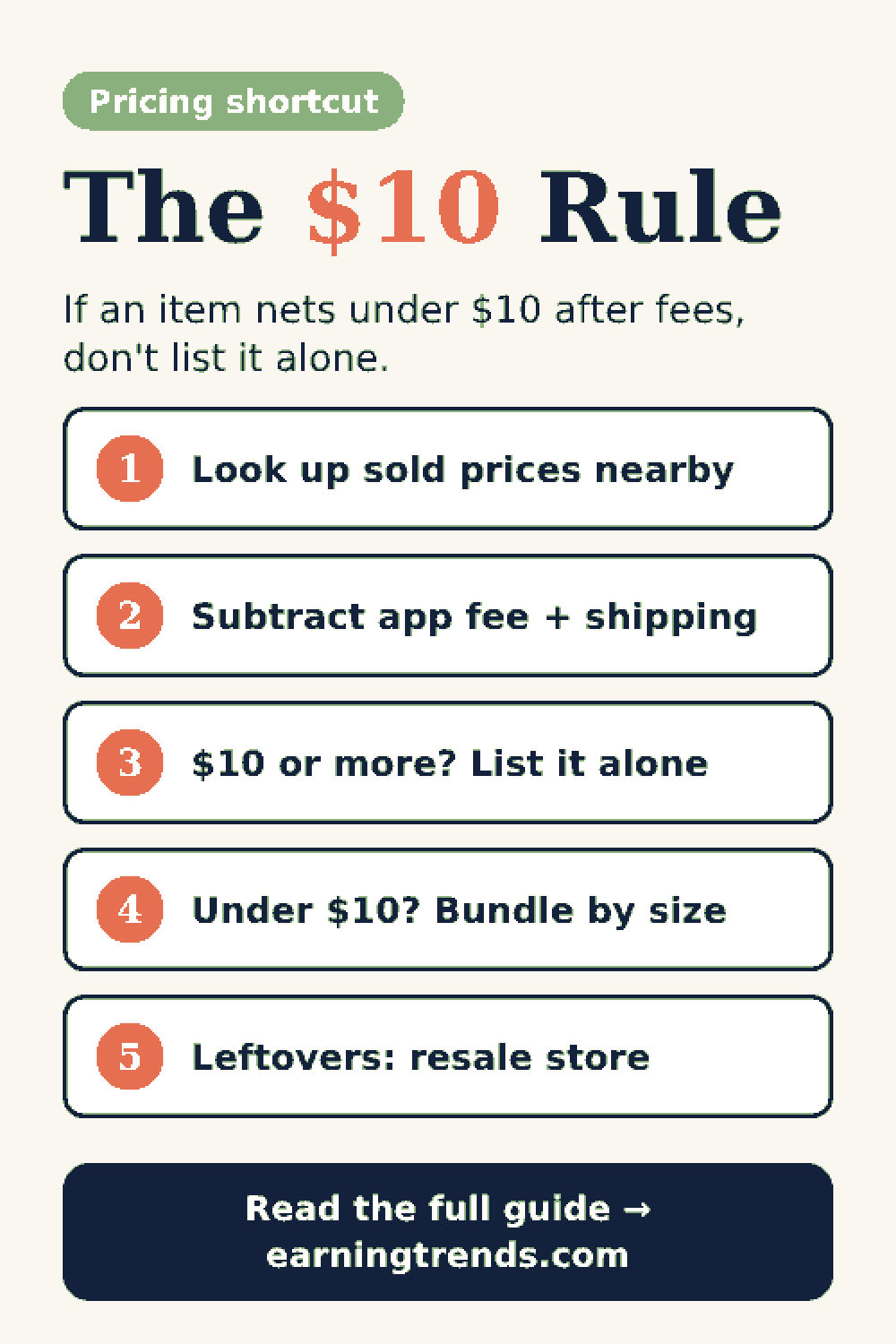
That gap is where the $10 rule comes from: if an item won’t net at least $10 after fees and shipping, don’t list it alone. Bundle it with similar items or send it to a resale store with the leftovers. Your time is part of the price.
A quick note on taxes (US)
Selling your own used items for less than you paid generally isn’t taxable income. Apps and payment platforms only have to send a Form 1099-K when your payments for goods top $20,000 and you have more than 200 transactions in the year. If you ever sell something for more than you paid, that gain is reportable. Keep a simple note of what you sold and roughly what you paid. This isn’t tax advice; check with a tax professional for your situation.
Once the money comes in, give it a job. Moving it straight into your $1,000 emergency fund or a sinking fund for next season’s clothes keeps it from disappearing into groceries. If you enjoy the listing process, it can grow into one of these side hustles you can do during nap time.
FAQ
What is the fastest way to sell kids’ clothes for cash?
A kids’ resale store like Once Upon a Child pays on the spot, usually the same visit. Bring clean, in-season items laid flat in a bin, and expect a lower price than selling yourself.
Is it better to sell kids’ clothes individually or in bundles?
Sell name brands and shoes individually when they will net $10 or more after fees. Bundle everything else by size and season; lots save buyers time and save you hours of listing.
Can I sell used car seats and cribs?
It is illegal to sell any recalled product, and the CPSC says cribs from before its June 2011 standard are very likely noncompliant. Check the model at cpsc.gov first. Many resale stores won’t buy car seats, so if you sell one, do it locally and share the expiration date.
Start today
Pull one bin out tonight and set a 15-minute timer. Make the three piles, then list just the top three “list alone” items before bed. Tomorrow, bag one size lot for Marketplace. Small batches beat a weekend marathon that never happens.
Sources
- Mercari – Changes to our fee structure
- Poshmark fee structure 2026 (Spocket)
- Facebook Marketplace shipped selling fee change (Value Added Resource)
- eBay selling fees 2026 (LitCommerce)
- ThredUp – How do ThredUp’s fees work?
- ThredUp seller terms and payout schedule
- Once Upon a Child – selling FAQ
- Just Between Friends – how to sell
- Vinted UK – Vinted fee
- eBay removes UK seller fees (TechCrunch)
- IRS Taxpayer Advocate – Form 1099-K
- CPSC – Stop online sale of recalled products